Languages
Thursday, October 22, 2026



News and Views from the Global South
Energy

Opinion: The Bursting of Europe’s Biofuels Bubble
Last week, the European Union reached a momentous decision to finally agree a reform to its disastrous biofuels legislation, signalling Europe’s U-turn on the burning of crops for biofuels.
Opinion: South-South Cooperation Vital for Sustainable Development
Sustainable development is central to a range of key discussions at the United Nations and elsewhere at the moment.
Faith-Based Organisations Warn of Impending Nuclear Disaster
As the month-long review conference on the Nuclear Non-Proliferation Treaty (NPT) continued into its second week, a coalition of some 50 faith-based organisations (FBOs), anti-nuclear peace activists and civil society organisations (CSOs) was assigned an unenviable task: a brief three-minute presentation warning the world of the disastrous humanitarian consequences of a nuclear attack.
Unifying Transmission from North to South Means Cheaper Energy in Chile
Chile expects to have a more efficient and stable electricity market, with a more steady - and above all, less expensive – supply, when the country’s two major power grids are interconnected over a distance of more than 3,000 km.
Falling Oil Prices Trigger Initial Economic Gains for Pacific Islanders
The recent dramatic fall in world oil prices, with Brent crude plummeting from a high of 115 dollars per barrel in June last year to around 47 dollars in January 2015, is beginning to benefit Pacific Islanders who are seeing lower prices for fuel and energy.
Costa Rica’s Energy Nearly 100 Percent Clean
Costa Rica has almost reached its goal of an energy mix based solely on renewable sources, harnessing solar, wind and geothermal power, as well as the energy of the country’s rivers.
The Blue Amazon, Brazil’s New Natural Resources Frontier
The Atlantic ocean is Brazil’s last frontier to the east. But the full extent of its biodiversity is still unknown, and scientific research and conservation measures are lagging compared to the pace of exploitation of resources such as oil.
Opinion: Don’t Sell Sweden’s Vattenfall, Keep Coal in the Ground
The Swedish government is in the process of pondering an important decision -- whether to sell the vast lignite reserves of the state-owned Vattenfall energy giant or ensure that they stay in the ground. The decision will define Sweden’s commitment to tackling climate change.
Caribbean Stakes Out “Red Lines” for Paris Climate Talks
When the international climate change talks ended in Peru last December, the 15-member Caribbean Community (CARICOM), a political and economic union comprising small, developing, climate-vulnerable islands and low-lying nations, left with “the bare minimum necessary to continue the process to address climate change”.European Biofuel Bubble Bursts
Ten years of debate in the European Union over the detrimental effects of the demand for biofuels for transport on food prices, hunger, forest destruction, land consumption and climate change have come to an end.
Cash-Strapped Latin American Countries Turn to China for Credit
Angolans are generally grateful for China’s participation in the reconstruction of their central African country, in spite of the fact that some of the roads and buildings built by Chinese firms are of poor quality, and mainly Chinese labourers have been hired rather than local workers.
New Anti-Terrorism Law Batters Cameroonians Seeking Secession
Cameroon’s government under President Paul Biya is bearing down on a separatist movement fighting for the rights of a minority English-language region, using as its weapon a sweeping new anti-terrorism law introduced at the end of last year.
Riches in World’s Oceans Estimated at Staggering 24 Trillion Dollars
The untapped riches in the world’s oceans are estimated at nearly 24 trillion dollars – the size of the world’s leading economies, according to a new report released Thursday by the World Wide Fund for Nature (WWF).
Opinion: The World Has Reached Peak Plutocracy
Parents in despair because they can’t pay the fees at the privatised neighbourhood school…
Shift to Renewables Seems Inevitable, But Is It Fast Enough?
Climate change may be one of the most divisive issues in the U.S. Congress today, but despite the staunch denialism of Republicans, experts say the global transition from fossil fuels to renewables is already well underway.
The U.N. at 70: A View from Outer Space
When the founding fathers of the United Nations met in San Francisco 70 years ago, an American banker named Beardsley Ruml made a remark:
Clean Cookstoves Could Change the Lives of Millions in Nepal
 When 26-year-old Laxmi married into the Archaya household in Chhaimale village, Pharping, south of Nepal’s capital Kathmandu, she didn’t think she would be spending half the day in the kitchen inhaling smoke from the stove.

Fears Grow for Indigenous People in Path of Massive Ethiopian Dam
A United Nations mission is due to take place this month to assess the impact of Ethiopia’s massive Gilgel Gibe III hydroelectric power project on the Omo River which feeds Lake Turkana, the world’s largest desert lake, lying mostly in northwest Kenya with its northern tip extending into Ethiopia.
Investigation Tears Veil Off World Bank’s “Promise” to Eradicate Poverty
An expose published Thursday by the International Consortium of Investigative Journalists (ICIJ) and its media partners has revealed that in the course of a single decade, 3.4 million people were evicted from their homes, torn away from their lands or otherwise displaced by projects funded by the World Bank.
Clean Cookstoves Could Change the Lives of Millions in Nepal
When 26-year-old Laxmi married into the Archaya household in Chhaimale village, Pharping, south of Nepal’s capital Kathmandu, she didn’t think she would be spending half the day in the kitchen inhaling smoke from the stove.
Antigua Draws a Line in the Vanishing Sand
Jabberwock beach, located on the northeastern coast of Antigua, features a mile-long white sand beach and is a favourite with locals and visitors alike.« Previous Page — Next Page »





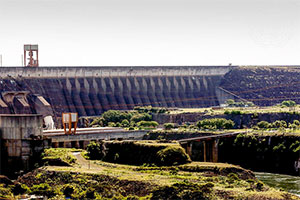 UN Power Plant, Paraguay. Credit: UN Photo/Evan Schneider
Energy has posed a great challenge for economies around the world. As global energy consumption skyrockets throughout the years, so does the need for sustainable solutions. The Sustainable Development Goals are essential in providing people with access to safe, affordable, and sustainable energy sources that minimize harm on the planet. Progress towards these goals opens the door for an advancement in modernization for communities on a global level and allows for a potential mitigation of tensions between nations.
The UN’s Summit of the Future in 2024 offered new initiatives that are being taken to achieve these goals, including a decreased reliance on fossil fuels, a switch to renewable energy sources, and improved climate financing.
IPS is well positioned to provide relevant, insightful, and compelling analysis of recent updates and measures being taken around the world to achieve a cleaner future.

The Week with IPS

NEXT STOP - SDGs
Tracking global progress towards a sustainable world
Tracking global progress towards a sustainable world
