Languages
Sunday, November 8, 2026



News and Views from the Global South
Humanitarian Emergencies
UN’s Development Goals Threatened by a World Economy Facing Recession
The UN’s 17 Sustainable Development Goals (SDGs), described as an integral part of its highly-ambitious development agenda, may be in deep trouble.
Collaboration Can Help Eradicate COVID-19
Since the founding of the United Nations in 1945, space for multilateral policy development and commitment has grown. Its growth in the global health field augurs well as we find ways to mitigate the spread of the novel coronavirus.
Citizen Action is Central to the Global Response to COVID-19
The coronavirus (COVID-19) pandemic has created an unprecedented human and economic crisis. Governments are taking strong actions, enforcing quarantines to reduce contagion, testing populations, building emergency intensive care units. Governments have also launched large fiscal stimulus plans to protect jobs and the economy, as well as temporary social protection programs such as income/food support, subsidies to utilities and care services.
What Does Covid-19 Crisis Mean for Rural Development?
The implications and consequences of the Covid-19 pandemic are playing out before us. Much of the news coverage of the to date in both the Global North and the Global South has understandably focused on the horrifying impact of the disease on urban communities, where it is clearly hitting people, and economies, hardest.
Q&A: Continued Social Distancing and Hundreds of Millions More in Poverty – A New Normal for the World?
With much of the global economy stalled amid an unprecedented lockdown of nations grappling to contain the COVID-19 pandemic, the author of a new United Nations report on the disease’s impact on poverty told IPS that hundreds of millions more could be pushed into poverty and we can expect to see social unrest.
A Global Crisis Like No Other Needs a Global Response Like No Other
I have been saying for a while that this is a ‘crisis like no other.’ It is:-
- • More complex, with interlinked shocks to our health and our economies that have brought our way of life to an-almost complete stop;
-
- • More uncertain, as we are learning only gradually how to treat the novel virus, make containment most effective, and restart our economies; and
- • Truly global. Pandemics don’t respect borders, neither do the economic shocks they cause.

Reimagining a Post COVID World: Key Principles for the Future
In her book, ‘A World Made New: Eleanor Roosevelt and the Universal Declaration of Human Rights,’ Mary Ann Glendon tells the beautiful story of how out of the ashes of the Second World War emerged the world’s pre-eminent rights framework. The Declaration recognises the inherent dignity of every human being and was born out of the shared horror felt by the international community with war crimes and genocide on an unprecedented scale. It acknowledged that fundamental change was needed to make the world fit for future generations.
The Theology of Pandemics
Ingmar Bergman’s 1957 film The Seventh Seal is set in medieval Sweden, as the bubonic plague ravages the countryside. In one famous scene, a procession of zombie-like flagellants enters a village and interrupts a comic stage-show.
Covid-19: Brazil’s Bolsonaro trumps Trump
Brazil’s President Jair Bolsonaro appointed medical entrepreneur Nelson Teich his new health minister on 17 April. The businessman quickly echoed his boss’ desire to resume business as usual regardless of its potentially lethal consequences.
Haunting Forest Spirits – is Mother Nature Striking Back?
Epidemic diseases are not random events that afflict societies capriciously and without warning, on the contrary, every society produces its own specific vulnerabilities. To study them is to understand the importance of a society's structure, its standard of living, and its political priorities. […] Epidemics are a mirror, they show who we really are: Our ethics, beliefs, and socio-economic relationships. Frank Snowden 1
How Some Pacific Women are Responding to Climate Change and Natural Disasters
Sitting atop a banyan tree branch, Fiona Robyn had a cell phone tightly clasped in her fist raised high to get a signal. She was impatiently waiting for the SMS weather alert from the Women's Wetem Weta (Women’s Weather Watch (WWW)) hub in Port Vila as cyclone TC Harold raged towards the Republic of Vanuatu in the South Pacific Ocean on Apr. 5.
Multilateralism Through Public-Private Partnerships Are Key to Flattening the COVID-19 Curve
The UN Secretary-General Antonio Guterres has said that now is “a defining moment for modern society. History will judge the efficacy of the response not by the actions of any single set of government actors taken in isolation, but by the degree to which the response is coordinated globally across all sectors for the benefit of our human family.”
On Watching Contagion: What Do We Learn?
Contagion is a 2011 film by US director Steven Soderbergh (Erin Brockovich, Traffic, Che) that has proved very popular viewing during the first few weeks of the Coronavirus crisis. Set in a fictional global pandemic – modelled on the outbreak of a bat-borne Nipah virus identified in 1999 that killed around 100 people in Malaysia - the film is a tightly-written topical drama with a great castthat includes Matt Damon, Gwyneth Paltrow, Jude Law, Laurence Fishburne, Kate Winslet, Marion Cotillard and Jennifer Ehle.
Concerns for the Nearly 400 Rohingya Refugees Rescued off the Coast of Bangladesh
Nearly 400 Rohingya refugees have been rescued in Bangladesh after being at sea for two months.
COVID-19: Maintaining Food Security in Asia Pacific
COVID-19 has disrupted supply chains that are essential to assure food security in the Asia Pacific region, yet countries overall seem to have managed, so far, to keep supermarkets stocked with food and feed those who can afford it. The Asia Pacific region is home to over 60% of humanity and also contains sub-regions with among the highest frequencies of severe weather events and some of the most challenging environments for agriculture. As a region it is characterized by diverse food systems and a multiplex of supply chains. Under normal circumstances, food security is already threatened by a multitude of factors.
Vietnam Winning New War Against Invisible Enemy
Vietnam, just south of coastal China, is the 15th most populous country in the world with 97 million people.According to its Ministry of Health (MoH), as of 13 April, there were 262 confirmed cases of COVID-19, with 144 recovering or discharged from hospitals, and no deaths.
Unesco to Support Cultural Sector Hit by COVID-19
The United Nations Educational, Scientific and Cultural Organization (UNESCO) has announced it is “launching initiatives” to support cultural industries and cultural heritage, sectors hit hard by the COVID-19 pandemic. “COVID-19 has put many intangible cultural heritage practices, including rituals and ceremonies, on hold, impacting communities everywhere,” the organization stated April 9. “It has also cost many jobs, and across the globe, artists … are now unable to make ends meet.”
UN and Partners Request $267.5 Million to Respond to Humanitarian Needs Arising from COVID-19 Pandemic in Kenya
The Government of Kenya, the United Nations and humanitarian partners have launched today a Flash Appeal requesting $267.5 million to respond to the most immediate and critical needs of10.1 millionpeople.
COVID-19 and Hope for a Compassionate Future
The Coronavirus, COVID-19, makes its deadly round across the world. People fall sick and die, communities and entire nations end up in its deadly grip and try to cope with it. Everything is changing, and changing fast and we all have to deal with it together, even if many of us are being physically apart. Humans are social beings. Our mental and physical capacities are created around that fact and crave for support and compassion.
Kerala Covid-19 Response Model for Emulation
Within weeks, the Covid-19 epidemic was classified by the World Health Organization (WHO) as an epidemic of international significance, triggering a pre-agreed WHO response. By the end of the first week of April, more than 1.3 million people had been confirmed as infected, with over 65,000 deaths across the world.
Helping the homeless of Rome combat COVID-19
Behind the Tiburtina Station, in the East of Rome, with just a small covered area protecting from the inclemency of the weather, sleeping close to each other is the only way to stay warm. A boy of Ivorian origin is alone, far from everyone, in the centre of the sidewalk, exposed to a freezing wind.« Previous Page — Next Page »





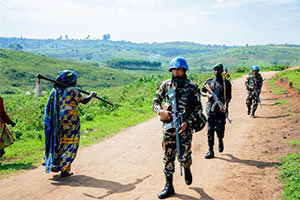 MONUSCO Peacekeepers and FARDC Soldiers Patrol Fataki Area. Credit: UN Photo/Jorkim Jotham Pituwa
Conflict, human rights violations, natural disasters, and famine have been at the forefront of concerns for humanitarian organizations. The escalation of humanitarian crises has led to over 239 million people in need of humanitarian assistance at the start of 2026, as estimated by OCHA’s Global Humanitarian Overview. The 2025 humanitarian appeal received only $12 billion, the lowest funding in over a decade, which has left 24 million fewer people reached in comparison to 2024. Conflict has remained the primary driver of crisis.
Humanitarian emergencies massively impact progress towards the Sustainable Development Goals (SDGs), adversely affecting economic development, inequality, education, planetary well-being, and poverty. Millions of people are faced with reduced access to essential services, including shelter, food, healthcare, and access to clean drinking water. UN Organizations such as UNHCR and the United Nations Children’s Fund (UNICEF) are committed to providing direct relief to affected communities when state governments cannot.
The United Nations 2024 Summit of the Future discussed measures that will be taken to reduce global inequality and promote peacekeeping efforts around the world. The recent UN Climate Change Conference (COP30) in Belém, Brazil, agreed to mobilize $1.3 trillion annually for climate action by 2035, operationalize the loss and damage fund, and triple adaptation finance. However, a fossil fuel transition commitment was not secured, despite climate change and the greenhouse effect being major contributors to humanitarian crises worldwide.
Countries across the world have also rallied to end humanitarian crises, as witnessed in conflicts such as Palestine and Ukraine. IPS is committed to providing relevant and in-depth reports of humanitarian emergencies around the world and their implications.

The Week with IPS

NEXT STOP - SDGs
Tracking global progress towards a sustainable world
Tracking global progress towards a sustainable world