Languages
Friday, November 20, 2026



News and Views from the Global South
Development & Aid

At the International Summit on Balanced & Inclusive Education: A Call to Transform Globally
In an increasingly unequal and divided world, what role can education play to achieve sustainable development globally?
Experts laud International Court of Justice Order on Myanmar to Halt all Genocidal Conduct
In a groundbreaking and much anticipated ruling delivered on Thursday, the International Court of Justice demanded that Myanmar halt all measures that contribute to the genocide of the Rohingya community.
Am I Abused or Am I a Failure to Adjust? – A Migrant’s Story
Every year hundreds of immigrants leave their homes and trail to a land of dream and hope where they aspire to find peace, happiness and sometimes a little bit of safety compared to what they leave behind.
Top UN Court Orders Myanmar to Protect Rohingya from Genocide
Myanmar must take steps to protect its minority Rohingya population, the top UN court unanimously ruled on Thursday.
Blue Innovation in the Commonwealth
With 95 per cent of the ocean still unexplored by humans, we are only just beginning to understand its profound influence on life on earth, including its effect on global climate and ecosystems.
Leprosy Re-emerges as a Global Health Challenge
Fifteen years ago, Sattamma – a daily labourer in the Rangareddy district of southern India’s Telangana state – was abandoned by her husband after she was diagnosed with Hansen’s Disease.
UN Plans to Launch a “Decade of Action” to Deliver Development Goals by 2030
2020 marks the 75th anniversary of the United Nations. I draw tremendous strength from all that we represent and all that we have achieved together.
Global Inequality Continues to Grow: UNDESA Report
More than 70 percent of the global population is currently living in parts of the world where income inequality has grown, according to a World Social Report 2020 launched by United Nations Department of Economic and Social Affairs (DESA).
Mosul, an Epicentre of the ISIS Conflict, is a Devastated Iraqi City
As Iraq this month faces the threat of new conflicts – including a proxy war between the US and Iran – the shadow of the last conflict runs long.
Bridging Africa’s Great Gender-Financing Divide
What stands between Soi Cate Chelang and her dream of turning her small pallet-making business into a major enterprise is capital.
UN Report: Rising Inequality Affects More Than 70% of the Globe
Inequality is growing for more than 70 per cent of the global population, exacerbating the risks of divisions and hampering economic and social development. But the rise is far from inevitable and can be tackled at a national and international level, says a flagship study released by the UN on Tuesday.
Why the Coronavirus Should Worry Us All
The coronavirus outbreak -- which began in Wuhan, China, and causes a pneumonia-like illness -- is raging across Asia, infecting close to 300 people and killing four. It was initially known to be transmitted from animals to human, and was just confirmed to be transmitted from human to human.
“For Generations, We Have Been Nominating Men Just Because They are Men”
Marlène Schiappa, Minister of State for Gender Equality and the Fight against Discrimination in France, attended the 25th year Regional Review Meeting of the Beijing Platform for Action for the UN Economic Commission for Europe (UNECE) Region last month. She highlighted why this meeting is key for advancing the gender equality agenda and the priorities for the Generation Equality Forum in 2020, a global gathering for gender equality, convened by UN Women and co-chaired by France and Mexico.
Ending Bullying and Humiliation over Menstruation as Girls and Boys in Conservative Eswatini are Educated about Reproductive Health
When 14-year-old Nomcebo Mkhaliphi first noticed the blood discharged from her vagina, she was shocked. Confused, she turned to her older sisters for advice. “My sisters told me that they were experiencing the same every month and that they used fabric, toilet paper and newspapers as sanitary wear,” recalls the now 45-year-old Mkhaliphi. She had to follow suit and use these materials because she had no money to buy sanitary pads.
School Lunch Programmes for Progress
If well planned, coordinated and implemented, a government funded school feeding programme for all primary school children can be progressively transformative. Such a programme, involving government departments and agencies working together, can benefit schoolchildren, their families, farmers and public health, now and in the future.
From Digital Diplomacy to Data Diplomacy
The digital revolution arrived late at the heart of ministries of foreign affairs across the Western world. Ministries latched on to social media around the time of Tahrir Square and Iran’s 2009 Green Revolution, beguiled by a vision of the technology engendering a networked evolution toward more liberal societies.
UN Special Rapporteur Offers Assistance to Indian Supreme Court in Case of Rohingya Deportation
University of California professor E. Tendayi Achiume, who is a United Nations Special Rapporteur, has recently offered her assistance to the Indian Supreme Court in a long hearing about India deporting Rohingya refugees to Myanmar.
Pro-Growth Demographic Dogma
Whenever the issue of population comes up, pro-growth demographic dogma invariably dominates. Governments, political parties, businesses, the media and many others typically praise population growth and lament population slowdown, stabilization or decline. The demographic dogma basically advocates maintaining robust population growth and a larger and youthful population.
Empowering Women in Poor Communities & Building Resilience Against Climate Pressure
As global temperatures continue to rise, vulnerable populations around the world are facing increasingly complex climate risks – with ongoing droughts in Zimbabwe and floods devastating Indonesia's capital, Jakarta.
BIOGAS: Cow Dung Holds the Key to Nepal’s Green Economy
Nepal’s future may not be in hydropower, as most assume, but actually in the dung heap. A new industrial-scale biogas plant near Pokhara has proved that livestock and farm waste producing flammable methane gas can replace imported LPG and chemical fertiliser.
Women Activists Escalate Demand for “Bodily Autonomy” as 19 Nations Dissent
The United States and 18 other UN member states have come under fire for denying a woman’s legitimate right to “bodily autonomy”—the right to self-governance over one’s own body without coercion or external pressure.« Previous Page — Next Page »


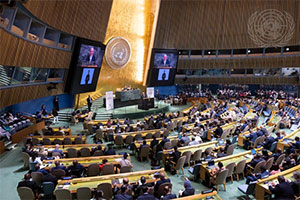 2026 High-level Political Forum on Sustainable Development. Credit: UN Photo/Eskinder Debebe
In 2015, the United Nations and its Member States adopted the Sustainable Development Goals (SDGs) in an effort to make the world a more sustainable and peaceful place for future generations. Progress on the 17 SDGs has been uneven, and inequality persists across the globe. 10 years after adoption, the 2025 UN SDGs Report revealed that only 35% of the SDG targets are on track, with more than half moving too slowly, and 18% moving backwards from the 2015 baseline. Poverty remains one of the world’s most pressing issues, with hunger, violence, and inequality impeding the opportunities for all people to achieve success. In September 2024, the United Nations Summit of the Future introduced a new goal: to eradicate global poverty by 2030, ensure universal rights to basic services, and increase the overall standard of living in terms of industrialization, economic well-being, citizen health, and literacy. Furthermore, recent shifts in United States foreign aid policy – notably, major budget cuts to USAID and the termination of thousands of development programmes– have severely threatened vital lifelines of financial aid to impoverished communities around the world. Additionally, the United States’ withdrawal from the Paris Climate Agreement has undercut international efforts at sustainable development. With the upcoming 2030 deadline, the UN Secretary-General has called for urgent multilateralism across six priority areas: food systems, energy, digital connectivity, education, jobs and social protection, and climate and biodiversity. IPS sheds light on marginalized communities that struggle on a daily basis to survive and have their stories heard and respected.
Updated by Yilan Batista and Shuli Wong August 2026

The Week with IPS

NEXT STOP - SDGs
Tracking global progress towards a sustainable world
Tracking global progress towards a sustainable world
