Languages
Wednesday, September 30, 2026



News and Views from the Global South
Population
A Journey from a Small-Scale Farm to International Stage
As a wife and mother in Nigeria who wanted to support my family and my community, I began my own farm in 2006. When I began, I never could have dreamed that just cultivating the earth would someday lead to my meeting government leaders, and traveling to meet other women from around the world doing their part to make a difference in their own communities.
Mothers in the US Are Dying: What Are We Doing to Save Them?
The maternal mortality rate in the United States is the highest of any developed country – and the rate is rising. The US is currently the most dangerous place to give birth in the developed world.
We Must do More to Speed up Ending Fossil Fuel Subsidies
Fossil fuels—oil, gas, coal and their derivatives—pollute the atmosphere and emit the greenhouse gases that are ramping up global heating to dangerous levels. But did you know that governments around the world are subsidizing this pollution?
We Won’t Achieve Gender Equality Until We Address the Lack of Water, Sanitation & Hygiene
Giving birth is a life changing moment for women. It can be - when women have a safe and caring environment, positive and empowering - a moment to find a previously untapped inner strength.
Modi Cruises with Ease as Prime Minister of India for a Second Term
The boy who sold tea at railway platforms for a living has become the Prime Minister of world’s largest democracy for the second time. Narendra Dhamodaradas Modi, incumbent Prime Minister and leader of the BJP secured a second chance to be the Prime Minister at Indian elections which took place recently. The election was perhaps the largest held in any part of the world with 39 days of polling and involving as many as 900 million voters.
The New Face of Activism: Youth
Rather than waiting for adults to act, more young girls and boys are standing up and speaking out on the world’s pressing issues.
Modernity Triumphs over Feudalism in India
“We worked for the poor and they voted us back to power,” was the explanation that Prime Minister Narendra Modi made to newly-elected legislators on Saturday, May 25, on the spectacular win scored by his nationalist Bharatiya Janata Party (BJP) in India’s just concluded general elections.
Report Reveals Mounting Pressure on Zambia’s Environmental Resources
There is a strong link between provision of basic social services and the use of natural resources in a country. Thus, with increased population comes additional pressure on natural resources. This is a key finding in the latest Zambia Environment Outlook (ZEO) Report 4, published by the Zambia Environmental Management Agency (ZEMA).
Class Analyst: Global Income Inequality
As a child growing up in Communist Yugoslavia, Branko Milanovic witnessed the protests of 1968, when students occupied the campus of the University of Belgrade and hoisted banners reading “Down with the Red bourgeoisie!”
Partnerships to Promote Equality for LGBTI People
As states and civil society organizations are increasingly acting to address stigma, discrimination and human rights violations targeting lesbian, gay, bisexual, transgender and intersex (LGBTI) people, dialogues and alliances jointly tackle these challenges.
Cyclones and Struggling Economy Could Impact Mozambique’s Elections
Mozambique, which was affected by an unprecedented two tropical cyclones over a matter of weeks, is still reeling from the impact a month after the latest disaster. But resultant devastation caused by the cyclones could impact the country’s elections as concerns are raised over whether the southern African nation can properly hold the ballot scheduled for later this year.
Putting Water at the Heart of Sustainable Fashion
The Copenhagen Fashion Summit celebrated its tenth anniversary last week. The summit, which is often referred to as the Davos of fashion, is a key date in the fashion diary for those businesses with a pioneering vision to highlight issues and create solutions for a more sustainable industry.
Women Human Rights Defenders Face Greater Risks Because of their Gender
Does the name Ihsan Al Fagiri ring a bell? How about Heba Omer or Adeela Al Zaebaq? It’s likely that these names, among countless others, are not known to the average news consumer. But their tireless and dangerous work, however, has made news headlines as protests led to historic political change in Sudan.
Citizenship & Growth: Inclusive Citizenship Laws Tend to Foster Economic Development
The notion of citizenship has evolved over time. Historically, allegiance was typically to an ethnic group or a feudal lord. With the birth of the nation-state in the 19th century came the need to distinguish between those who belonged to the state and those who didn’t, and therefore to create a legal distinction between nationals and foreigners.
Unlocking the Power of Women
This June, thousands will flock to Vancouver for a global dialogue on how to accelerate progress for girls and women under the banner of power, progress and change.
Internal Displacement “Deserves Visibility”
More people are displaced inside their own countries than ever before, and only higher figures can be expected without urgent long-term action, a new report found.
As Fathers Die, Kashmir’s Children Become Breadwinners
Mubeen Ahmad was nine years old when his mother sold him into service to a mechanic for the petty sum of few thousand Indian rupees. His mother had found it hard to support the family after his father, a labourer, was killed during one of the anti-India protests in Jammu and Kashmir in 2008.
Campaign to Whitewash Saudi Arabia’s Image Does Little for Women in the Kingdom
Amid a high-profile public relations campaign to convince the world just how much the Kingdom of Saudi Arabia is modernising – highlighted in last year’s lifting of the ban on women driving – Saudi authorities continue their relentless persecution of women human rights defenders.
Leaving No One Behind: Young People’s Participation at UN
Walking down 44th street towards UNICEF House was a poignant moment for me: having sought out resources, gone through strenuous immigration processes and having had my assumptions unraveled with the realities of New York City (NYC). This was it.
Loss of Biodiversity Puts Current and Future Generations at Risk
An alarming report about the massive loss of biodiversity around the world warns that future generations will be at risk if urgent action isn’t taken to protect the more than one million species of plants and animals threatened with extinction.
The Ethiopian City Lost in the Shadow of South Sudan’s War
 Right up against the border with South Sudan, the western Gambella region of Ethiopia has become a watchword for trouble and no-go areas as its neighbour’s troubles have spilled over. But now there may be reason for optimism on either side of the border.
 « Previous Page — Next Page »


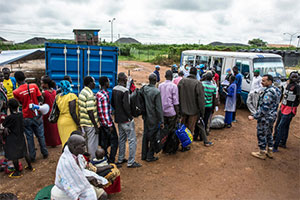 One Thousand Internally Displaced Persons (IDPs) Relocated from Tomping Camp in South Sudan. Credit: UN Photo/Isaac Billy
It took hundreds of thousands of years for the world’s human population to cross one billion in 1804. Approximately 200 years later, the population has multiplied sevenfold. In 2023, the global population crossed 8 billion, and is expected to reach 9 billion before 2050. With the planet more crowded than ever, it is essential to keep track of population trends, urbanization, migration, and reproduction across the world.
Life expectancy has seen significant strides in the past century, largely due to economic development and increased standards of living. On the contrary, trends in global fertility are shifting, with certain regions in Africa and Asia reporting higher rates, while parts of Europe and North America report stagnant or lower rates. This is in part due to differences in sexual and reproductive healthcare, as well as societal and economic conditions around the world. For example, child marriage is prevalent in certain societies, where childbearing is also considered a familial duty. Meanwhile, stagnating economies frequently experience lower marriage and childbearing rates.
The increase in migration and urban development around the world is also linked to global population trends. By 2050, it is expected that approximately 66 percent of all people will live in cities. Furthermore, global crises such as warfare and natural disasters also prompt transnational migration. Transnational migration is linked to a variety of socioeconomic issues in both host and receiving countries: migrants often leave developing countries with less access to educational and economic opportunities and arrive in developed countries where they are frequently the targets of ethnic, racial, and cultural discrimination, and economic exploitation. Recent crises in Europe and the United States demonstrate the importance of advocating for migrants worldwide. As migrants from the Global South are increasingly stripped of their legal and civic rights in unlawful deportations, or targeted in acts of identity-based violence, it is essential to keep track of population trends and protect the human rights of migrant populations. Climate-related disasters are now a major driver of displacement, with nearly half of all new internal displacements in 2025 being disaster-related.
IPS is devoted to covering issues surrounding population trends, migration, and reproduction through its compelling articles, which use both statistics and human stories to provide readers with robust and informative viewpoints.

The Week with IPS

NEXT STOP - SDGs
Tracking global progress towards a sustainable world
Tracking global progress towards a sustainable world
