Languages
Wednesday, October 14, 2026



News and Views from the Global South
Population

Healthy Nutrition Spreads in El Salvador’s Schools
Eating healthy and nutritious food in schools in El Salvador is an effort that went from a pilot plan to a well-entrenched programme that has now taken off.
Wars, Crises and Catastrophes Drive Immigration to Brazil
The war in Angola, the earthquake in Haiti, Venezuela’s political crisis and shortages and the political repression in the Democratic Republic of the Congo are the main driving factors behind the recent waves of immigration to Brazil.
Gender Empowerment: What Will You Do in 2018 to make a Change?
In the last year, a women’s rights tidal wave flooded the world: over 4 million people marched in the first “Women’s March” in January 2017, and over a million marched a year later, from Washington DC to New York, from Sydney to Osaka, and from Rome to Nairobi.
For Millions of Indian Women, Marriage Means Migration
Rekha Rajagopalan, a 26-year-old schoolteacher, migrated to the Indian capital city of New Delhi from southern Chennai in 2015 after her marriage. The reason was simple. Rekha's husband and his family were based in Delhi, so like millions of other married Indian women, she left her maternal home to relocate to a new city with her new family.
Closure of Ethiopia’s Most Notorious Prison: A Sign of Real Reform or Smokescreen?
Ethiopia’s most notorious prison lurks within the capital’s atmospheric Piazza, the city’s old quarter popular for its party scene at the weekend when the neon signs, loud discos and merry abandon at night continue into the early hours of the morning.
The Future of Our Cities: New Agenda, New Faces, New Year
Urban development is one of our greatest challenges. While the world is highly urbanizing, our cities are transforming the nexus for the social, economic, environmental and political realities of our times.
Davos: a Tale of Two Mountains
As the elite in the world of finance gather in the Swiss luxury town of Davos, rallies are taking place around the world as citizens demand for solutions to rising inequality. At the same time as the World Economic Forum’s rich and powerful hold forth about fixing the crisis of inequality they created, a new movement called the Fight Inequality Alliance is telling another story that is growing around the world.
Fate of the Rohingyas – Part Two
With discussions underway between Bangladesh and Myanmar about the repatriation of more than a half a million Rohingya refugees, many critical questions remain, including how many people would be allowed back, who would monitor their safety, and whether the refugees even want to return to violence-scorched Rakhine state.
Fate of the Rohingyas – Part One
The repatriation of Rohingya refugees driven from their villages through violence and terror appears uncertain, with critics saying the agreement legalising the process of their return is both controversial and impractical.
UN Chief Calls for Collective Global Response to Migration
I am very pleased to present this report, “Making Migration Work For All”, which serves as my principal input to the zero draft of the “Global Compact for Safe, Orderly and Regular Migration.”
In the Wake of the Millennium Migration
A century ago, Italian immigrants told a joke: “Before I came to America, I thought the streets were paved with gold. When I got here, I learned three things: one, the streets were not paved with gold; two, the streets were not paved at all; and three, they expected me to pave them.”
Marooned in Bangladesh, Rohingya Face Uncertain Future
Hundreds of thousands of Rohingya refugee women from Myanmar are currently living in the cramped camps along Bangladesh Myanmar border. Victims of sexual and physical violence in the Rakhine state, women have been disproportionately affected by this crisis and these women’s perils are far from over in the host country as they continue to face multifaceted challenges.
Religion: Between ‘Power’ and ‘Force’
In 1994, Dr. David R. Hawkins wrote a book positing the difference between power and force (Power vs. Force: The Hidden Determinants of Human Behavior - the latest revised version came out in 2014).
Nowhere to Hide from Climate Change
The water is nibbling away the beaches of Fiji. Not even the dead are allowed peace of mind. The graveyard of Togoru - a village on the largest island of Fiji - has been submerged. The waves are sloshing softly against the tilted tombstones covered with barnacles. The names have become illegible, erased by the sea.
“Only Our Youth Can Save the Planet” – Kumi Naidoo
"Today’s youth should think of new solutions for old problems like climate change and social injustice." That's the strong message of the South African activist Kumi Naidoo. The former executive director of Greenpeace says young people need to be more innovative and visionary, "because the solutions of my generation have failed."
Rise of Teenage Pregnancy Deters Development Goals
A few years ago, someone shared a video with me that deeply impacted me. It was called "The Girl Effect". In three minutes, the video demonstrates the fate of millions of girls and teenagers around the world.
Helping Nepal by Working Abroad
Only a few millimeters of corrugated metal keeps us apart from the advancing dusk.
Debate on Glyphosate Use Comes to a Head in Argentina
In and around the city of Rosario, where most of Argentina's soybean processing plants are concentrated, a local law banned the use of glyphosate, the most widely-used herbicide in Argentina. But two weeks later, producers managed to exert enough pressure to obtain a promise that the ban would be overturned.
South-South Cooperation Key to a New Multilateralism
“There are new challenges to all states: among them, the real threat to multilateralism... South-South and triangular cooperation can contribute to a new multilateralism and drive the revitalisation of the global partnership for sustainable development.”
Q&A: “What Price Do We Put on Our Oceans?”
“Political resolve is the key for succeeding in our fight against oceans pollution,” Erik Solheim, head of UN Environment, who is leading hands-on the organisation’s global campaign to clean up seas and oceans of plastic litter, agricultural run‑off and chemical dumping, told IPS.
Combating Climate Change? Combat Land Degradation, Says UNCCD Chief
Land restoration is not a “glamorous subject even when you give all the numbers,” admits Monique Barbut, the Executive Secretary of United Nations Convention to Combat Desertification UNCCD). But she also stresses that by 2050, the world population will reach 10 billion. To feed that extra 2.4 billion, current food production would need to be increased by 75 percent.« Previous Page — Next Page »





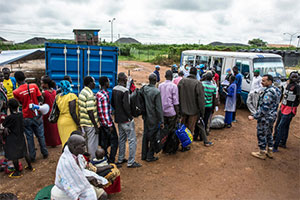 One Thousand Internally Displaced Persons (IDPs) Relocated from Tomping Camp in South Sudan. Credit: UN Photo/Isaac Billy
It took hundreds of thousands of years for the world’s human population to cross one billion in 1804. Approximately 200 years later, the population has multiplied sevenfold. In 2023, the global population crossed 8 billion, and is expected to reach 9 billion before 2050. With the planet more crowded than ever, it is essential to keep track of population trends, urbanization, migration, and reproduction across the world.
Life expectancy has seen significant strides in the past century, largely due to economic development and increased standards of living. On the contrary, trends in global fertility are shifting, with certain regions in Africa and Asia reporting higher rates, while parts of Europe and North America report stagnant or lower rates. This is in part due to differences in sexual and reproductive healthcare, as well as societal and economic conditions around the world. For example, child marriage is prevalent in certain societies, where childbearing is also considered a familial duty. Meanwhile, stagnating economies frequently experience lower marriage and childbearing rates.
The increase in migration and urban development around the world is also linked to global population trends. By 2050, it is expected that approximately 66 percent of all people will live in cities. Furthermore, global crises such as warfare and natural disasters also prompt transnational migration. Transnational migration is linked to a variety of socioeconomic issues in both host and receiving countries: migrants often leave developing countries with less access to educational and economic opportunities and arrive in developed countries where they are frequently the targets of ethnic, racial, and cultural discrimination, and economic exploitation. Recent crises in Europe and the United States demonstrate the importance of advocating for migrants worldwide. As migrants from the Global South are increasingly stripped of their legal and civic rights in unlawful deportations, or targeted in acts of identity-based violence, it is essential to keep track of population trends and protect the human rights of migrant populations. Climate-related disasters are now a major driver of displacement, with nearly half of all new internal displacements in 2025 being disaster-related.
IPS is devoted to covering issues surrounding population trends, migration, and reproduction through its compelling articles, which use both statistics and human stories to provide readers with robust and informative viewpoints.

The Week with IPS

NEXT STOP - SDGs
Tracking global progress towards a sustainable world
Tracking global progress towards a sustainable world
