Languages
Friday, October 16, 2026



News and Views from the Global South
Population

Combating Climate Change? Combat Land Degradation, Says UNCCD Chief
Land restoration is not a “glamorous subject even when you give all the numbers,” admits Monique Barbut, the Executive Secretary of United Nations Convention to Combat Desertification UNCCD). But she also stresses that by 2050, the world population will reach 10 billion. To feed that extra 2.4 billion, current food production would need to be increased by 75 percent.
Who Are Kenya’s Financially Excluded?
The recent 2017 Finscope Tanzania report shows that while mobile money use in Tanzania continues to grow, the percentage of financially excluded adults has risen in parallel — from 27 percent in 2013 to 28 percent in 2017.
The World is Losing the Battle Against Child Labour
The IV Global Conference on the Sustained Eradication of Child Labour, which drew nearly 2000 delegates from 190 countries to the Argentine capital, left many declarations of good intentions but nothing to celebrate.
Global Campaign for Mercury-Free Dentistry Targets Africa
A vibrant global campaign to ban the use of mercury in dentistry is shifting direction: moving from Europe to the developing world.
Nations without Nationality – An ‘Unseen’ Stark Reality
Here’s another ‘unseen’ stark reality—that of millions of people around the world who are deprived of their identity, living without nationality. Their total number is by definition unknown and their only ‘sin” is that they belong to an ethnic, religious or linguistic minority in the country where they have often lived for generations.
Victims of El Salvador’s Civil War Demand Reparations
Among the sea of names of victims of the Salvadoran civil war, engraved on a long black granite wall, Matilde Asencio managed to find the name of her son, Salvador.
Protein Plants Bolster Animal Feed in Cuba
Based on protein plants, pasture and fodder, Orlando Corrales produces cow and goat milk on a farm located next to a major road in the Cuban capital. "We do not use any industrial feed here," he says proudly.
Locals Learn to Live in Harmony with Drought in Brazil’s Semi-arid Region
Irrigated green fields of vineyards and monoculture crops coexist in Brazil’s semiarid Northeast with dry plains dotted with flowering cacti and native crops traditionally planted by the locals. Two models of development in struggle, with very different fruits.
Abu Dhabi population hits 3 million, fertility rate up to 3.7 per citizen-female
Newly-published figures from the Statistics Centre- Abu Dhabi show the emirate's live births increase 317.2 percent from what it was in 1977, with the total population amounting to 2.9 million by the end of 2016, a growth of 4.4 percent as compared to 2015 official census.
Adolescent Health Congress Skirts Issue of Abuse, Trafficking
Twenty-year-old Gogontlejang Phaladi of Mahalapye, Botswana is grateful she was never sent to a so-called “hyena” like scores of girls in neighboring Malawi were.
Developing World Faces Challenge of Large Ageing Population
Experts on population ageing converged in Seoul this week to discuss how to make reaching one's "golden years" a happy and sustainable process across the world.
Open or Closed Borders, or Something in Between?
Recent elections around the world have clearly shown growing public support for candidates and political parties advocating the deportation of migrants and stricter restrictions on immigration, including halting it altogether. At the same time, opposition, challenges and resistance to deportations and immigration restrictions have become more widespread, visible and vocal.
Mexican Immigrants Help Sustain Two Economies – and Are Discarded
They work for years to bolster the economies of two countries. For one, the United States, they provide labour and taxes; for the other, Mexico, they send remittances that support tens of thousands of families and communities. Then they are deported, and neither government takes into account their special needs.
The Road Out of Poverty Depends on Feeding Our Children Nutritious Food First
One drizzly morning in some lush green tea plantations in Rwanda, I was on my way to visit a local community, to assess nutrition indicators among women and children. We stopped in a green blanket of tea fields and spoke to one young tea picker, I’ll call her Mary, who had a baby strapped to her back.
Dams Hurt Indigenous and Fishing Communities in Brazilian Amazon
The dirty water is killing more and more fish and ‘Taricaya’ yellow-spotted river turtles every day. In addition, the river is not following its usual cycle, and the water level rises or declines without warning, regardless of the season, complained three Munduruku indigenous law students in the south of Brazil’s Amazon rainforest.
Trying to Make Immigration an Option Rather than a Need in Latin America
The aim is for migration to become just one option among others for the rural population of Latin America, says Brazilian expert Luiz Carlos Beduschi, referring to an issue that causes concern in the region due to its impact on food security.
Rights of Rural Women Have Seen Uneven Progress in Latin America
In a remote village in the Peruvian Andes, Bonificia Huamán managed to overcome adverse weather conditions with a small greenhouse, where she grows vegetables at 3,533 metres above sea level. This has improved her family’s diet, which she is very proud of.
Strengthening Youth Potential and the Prospects for a Better Future
Investing in youth by developing their potential through education, job creation and instilling the values that advance the cause of humanity is the most daunting, yet promising challenge facing world leaders.
Hydropower Dams Invade Brazil’s Agricultural Economy
“After being displaced for the third time,” Daniel Schlindewein became an activist struggling for the rights of people affected by dams in Brazil, and is so combative that the legal authorities banned him from going near the installations of the Sinop hydroelectric dam, which is in the final stages of construction.
Searching for a Doctor at 3,000 Metres High
Good healthcare can be hard to get – particularly when one lives on top of a mountain. The road to Porcón in the Cajamarca region of Peru, therefore, is as breathtaking as it is sobering. With every step further into its isolated natural beauty, a group of volunteers sent to deliver healthcare essentials are reminded how long the trek would be in an emergency.
Joining Forces to Improve Lives in Honduran Shantytowns
On the north side of the Honduran capital, nine poor neighbourhoods are rewriting their future, amidst the violence and insecurity that plague them as “hot spots” ruled by “maras” or gangs.« Previous Page — Next Page »





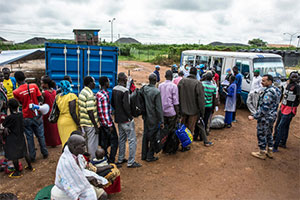 One Thousand Internally Displaced Persons (IDPs) Relocated from Tomping Camp in South Sudan. Credit: UN Photo/Isaac Billy
It took hundreds of thousands of years for the world’s human population to cross one billion in 1804. Approximately 200 years later, the population has multiplied sevenfold. In 2023, the global population crossed 8 billion, and is expected to reach 9 billion before 2050. With the planet more crowded than ever, it is essential to keep track of population trends, urbanization, migration, and reproduction across the world.
Life expectancy has seen significant strides in the past century, largely due to economic development and increased standards of living. On the contrary, trends in global fertility are shifting, with certain regions in Africa and Asia reporting higher rates, while parts of Europe and North America report stagnant or lower rates. This is in part due to differences in sexual and reproductive healthcare, as well as societal and economic conditions around the world. For example, child marriage is prevalent in certain societies, where childbearing is also considered a familial duty. Meanwhile, stagnating economies frequently experience lower marriage and childbearing rates.
The increase in migration and urban development around the world is also linked to global population trends. By 2050, it is expected that approximately 66 percent of all people will live in cities. Furthermore, global crises such as warfare and natural disasters also prompt transnational migration. Transnational migration is linked to a variety of socioeconomic issues in both host and receiving countries: migrants often leave developing countries with less access to educational and economic opportunities and arrive in developed countries where they are frequently the targets of ethnic, racial, and cultural discrimination, and economic exploitation. Recent crises in Europe and the United States demonstrate the importance of advocating for migrants worldwide. As migrants from the Global South are increasingly stripped of their legal and civic rights in unlawful deportations, or targeted in acts of identity-based violence, it is essential to keep track of population trends and protect the human rights of migrant populations. Climate-related disasters are now a major driver of displacement, with nearly half of all new internal displacements in 2025 being disaster-related.
IPS is devoted to covering issues surrounding population trends, migration, and reproduction through its compelling articles, which use both statistics and human stories to provide readers with robust and informative viewpoints.

The Week with IPS

NEXT STOP - SDGs
Tracking global progress towards a sustainable world
Tracking global progress towards a sustainable world
