Languages
Wednesday, November 18, 2026



News and Views from the Global South
Poverty & SDGs

Ecotourism Helps Amazon Jungle Communities Survive
The Tsimane Mosetene people in Bolivia’s Amazon jungle region have found a tool to preserve their habitat and way of life: a community ecotourism project that won a United Nations-sponsored international award.
“Two Children May Have Died for You to Have Your Mobile Phone”
"It’s possible that two children died so that you could have that mobile phone,” says Jean-Bertin, a 34-year-old Congolese activist who wants to end the “absolute silence” around the crimes committed in his country to exploit strategic raw materials like coltan.
Polygamy Throttles Women in Senegal
Fatou (40), Awa (32) and Aissatou Gaye (24) sit in a meditative mood on the tiled floor outside their matrimonial home in Keur Massar, a township in the Senegalese capital Dakar.
‘Misoprostol – Must for Reducing Maternal Mortality’
“I can’t imagine life without misoprostol,” says Dr. Azra Ahsan, a gynaecologist and obstetrician who has, for more than a decade, been using the controversial drug to stop women from bleeding to death after delivery.
OP-ED: Women and Girls at Heart of the Blue Revolution
World Water Week recently concluded in Stockholm with a special emphasis on the linkages between water and food security.
Kenya’s Water Wars Kill Scores
Water scarcity is fuelling deadly inter-ethnic wars that continue to claim lives in Kenya, according to government officials. And if nothing is done to educate communities on how to conserve the valuable resource, the situation will escalate, governance experts and environmentalists warn.
Small Dams – from Heroes to Villains in Brazil
A recent Brazilian court decision to suspend construction of small hydroelectric dams along the Paraguay River has highlighted the doubts raised about a growing alternative source of energy that until recently was considered one of the most environmentally-friendly sources.Agricultural Activity to Slow Clandestine Emigration from Senegal
"It was Ibrahima Sarr, a friend and fellow fisherman, who got me involved with smuggling people across the seas." Senegalese fisherman Doudou Ndoye speaks with the bittersweet conviction of a man redeemed.Microfinance Brings Hope to Myanmar’s Farmers
After decades of grinding poverty under successive military dictatorships, Myanmar’s rice farmers have a chance at a better future through rural reforms ushered in by the country’s quasi-civilian government. Microfinance is at the root of it.
Justice a Long Way Off for Dead Miners
The South African Police Service members who were involved in a bloodbath with striking workers at the Marikana mine in North West Province could face murder charges, sources close to the investigation told IPS.
Informal Sector Work Survives Economic Boom in Argentina
Behind “yerba mate”, a caffeinated herbal brew that is popular in Argentina and neighbouring countries, lies a shameful reality: the dismal labour and living conditions of the workers who harvest the leaves of the bush used to make the infusion.
Hazaras in Pakistan Caught Between Persecution and the High Seas
It will be no less than a miracle if Nadir Ali makes it to Australia, where he planned to seek asylum. But with each passing day, since his boat went missing over two months ago, hopes are dimming.
U.S. Company Accused of Greenwashing Cameroon ‘Land-Grab’
Environment groups are accusing a New York-based agricultural company, Herakles Farms, of going forward with plans for a 73,000-hectare palm-oil plantation and refinery in southwest Cameroon despite a lack of government authorisation, two court injunctions, and in the face of significant community opposition.Water in DRC More Often Cause of Death than Source of Life
Despite the desperate lack of access to water for domestic use in Mwene Ditu, in the central Democratic Republic of Congo, Dieudonné Ilunga spent a good part of July blocking up residents' wells.
Indigenous Consultations in Peru to Debut in Amazon Oil Region
Peru will debut a new mechanism for prior consultation with indigenous peoples by seeking their approval for a new stage of oil drilling operations in the infamous Lot 1AB in the northeastern Amazon region of Loreto.
Forcing South Sudan’s Idle Youth into Farming
Police in South Sudan have begun press-ganging every "idle" youth they can find to provide labour on police farms. The State Police Commissioner in Northern Bahr al Gazal state says young men cannot be left to drink tea and play cards all day while food insecurity threatens the country.
Ruling Against Thermoelectric Plant Sparks Debate
A Chilean Supreme Court decision ordering a halt to the construction of the Castilla thermoelectric power plant has sparked a debate over the country’s energy security.
Declaration of War in Mato Grosso do Sul
The land conflict between the Guaraní-Kaiowá indigenous people and large landowners in the southwestern Brazilian state of Mato Grosso do Sul is a powder keg ready to explode, say observers.Nearer the Church, Farther From MDGs
When Philippines President Benigno Aquino III delivered his annual state of the union address in July, he appealed to the country’s lawmakers to break a deadlock on progressive birth control laws in this predominantly Catholic nation.Gun Violence a Growing Concern in Papua New Guinea
In Papua New Guinea, the largest island nation in Melanesia in the southwest Pacific, where more than 60 percent of major crimes involve guns, a burgeoning illegal arms trade is associated with lack of employment growth and low human security, with vulnerable communities suffering the consequences.
Debate on Asbestos Safety Reaches Brazil’s Supreme Court
Brazil’s Supreme Court is assessing the level of risk posed by asbestos to human health, while industry defends its use under controlled conditions, and associations of people with asbestos-related diseases argue that it should not be used under any circumstances, even with regulations.« Previous Page — Next Page »


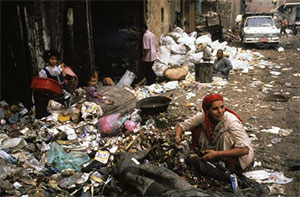 Romani people in Cairo, Egypt, forage through trash. Credit: UN Photo/Armineh Johannes
In 2015, the United Nations adopted the Sustainable Development Goals (SDGs) in an effort to promote “peace and prosperity for people and the planet.” To achieve that goal, it is essential to provide equal opportunities and access to basic services to all people. The 2025 UN SDG Report found that 35% of the 169 SDG targets are on track or making moderate progress, while 18% have reversed compared to the 2025 baseline. One in ten people still live in extreme poverty, one in eleven experience food insecurity, and over 1.1 billion people live in slums without access to clean water and sanitation. It is imperative to acknowledge the societal, technological, economic, and political issues that sustain poverty in countries around the world. Eradicating poverty will require significant frameworks in policy and governance on a national and international scale to ensure that all people will have equal access to basic services and economic opportunities by 2030. Furthermore, a dramatic reduction of United States foreign aid in 2025, including the termination of 83% of USAID programmes, threatens to erode years of fragile development gains.
Throughout the world, violent conflict and natural disasters also contribute to extreme poverty. The complete destruction of infrastructure and blockage of aid has significantly impoverished Palestine since October 7th. The destructive impact of Hurricane Maria in Puerto Rico left $91 billion in damage. An inadequate US government response also revealed significant and enduring questions within the issue of mitigating poverty: how do we rebuild infrastructure after its destruction? How do we restimulate economic development and bring in financial aid after disasters? Similar questions have been raised in the realm of regional cooperation, as devastating floods have wrecked hundreds of thousands of homes across multiple Southeast Asian nations in the past few years. Furthermore, the COVID-19 pandemic has greatly exacerbated the global poverty crisis, particularly in developing countries, setting back the United Nations goal of eradicating poverty by 2030.
IPS is committed to providing comprehensive features that focus on the persisting environmental, sociopolitical, and systemic issues that sustain poverty, and the steps taken worldwide towards poverty eradication.

The Week with IPS

NEXT STOP - SDGs
Tracking global progress towards a sustainable world
Tracking global progress towards a sustainable world

