Languages
Monday, November 2, 2026



News and Views from the Global South
Poverty & SDGs

An Ambitious Year for Climate Action Is a Big Year for Women’s Empowerment
This year, the Paris Agreement’s effectiveness as a global response to the climate crisis is being tested as governments are preparing to submit more ambitious national targets for mitigation and adaptation.
VIDEO: I am Generation Equality: Realizing Women’s Rights
 The narrative surrounding women’s rights in 2020 carries much hope and possibility. This year’s International Women’s Day, bearing the theme “I am Generation Equality: Realizing Women’s Rights,” falls on the celebration’s 110th anniversary.

On 8th March – and All the Other Days: Each for Equal
Development efforts over the past two decades have seen millions of people freed from poverty and hunger, and inequalities reduced worldwide. This is an undoubted achievement, but is no reason for complacency. The fact is that inequality between men and women, between boys and girls, remains not only a social justice concern, but one of the impediments on development in countries across Africa and beyond. Addressing such inequalities is a duty for all of us, and one which is at the heart of the theme of this year’s International Women’s Day on 8th March: Each for Equal.
Realising Women’s Rights Difficult for Africa’s Fragile States
Pokot girls are expected to face the knife stark naked and with courage. To inspire confidence, their fathers sit a few metres away from them with a spear in hand.
Slavery Modernises, Adapts to Stay Alive in Brazil
"Slave labour is not declining; it has taken on new forms and is growing; it expanded to new sectors where it did not previously exist," said Ivanete da Silva Sousa, an activist in the fight against modern-day slavery in northern Brazil.
Many Milestones but Painfully Slow Progress Towards Gender Equality
The narrative surrounding women’s rights in 2020 carries much hope and possibility. A new decade is ushering in important anniversaries and milestones: 25 years since the Beijing Platform for Action, 110 years since the birth of International Women's Day and the 10-year countdown to achieve the UN Sustainable Development Goals.
UN Report: World remains a ‘violent, highly discriminatory place’ for girls
Twenty-five years after the historic Beijing women’s conference in China – a milestone in advancing equal rights – violence against women and girls is not only common, but widely accepted, a new UN report revealed.
Indonesia’s Laws Ineffective against Human Trafficking
When her uncle offered her an opportunity to work in Jakarta almost a decade ago, the then 15-year-old Afra Burga Ambui immediately agreed and soon she was boarding a two-hour flight to the country’s capital and away from her village on Flores Island in East Nusa Tenggara, southern Indonesia.
Senegal Farmer Succeeds with Regenerative Agriculture & Begins Teaching Others
Souylemane Samb sits under a crowded tent on a hot Senegalese day. He wears a canvas vest with Trees for the Future printed across the back.
Climate-Smart Agriculture means More Time for Eswatini Women Farmers
Aside from the seven hours Mantfombi Msibi (63) would spend daily during the Eswatini farming season planting, applying herbicides and weeding her 1.2-hectare maize field, she would also spend E1 750 ($125) on tractor services. It was a huge cost of both time and money. But this season, Msibi will be benefiting from climate-smart farming technology that has opened up a new world of farming to her, saving her time in the process.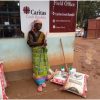
Biofortified Crop Project Reaches Refugees in Zambia
The Mutwales farm a small plot of land in the camp, growing primarily cassava and maize for food. They are also one of the 105 refugee farming families participating in an initiative during the 2019/2020 growing season to help them cultivate nutritious, vitamin A-biofortified orange maize, which was developed by the International Maize and Wheat Improvement Center (CIMMYT) in partnership with HarvestPlus.
No Country On Track to Ensuring a Better Future for its Children
There is no country that is on the right path to ensure the safety, health and proper environment for their children, an explosive report has claimed.
SDGs Corporate Tracker to Monitor Progress of UN’s Development Agenda
This year marks just ten years ahead of the deadline for completing the UN Sustainable Development Goals (SDGs) by 2030. These universally supported targets were always ambitious in their scope – yet what is clearer now than ever before is that quicker progress is crucial in the decade to come.
Nepal’s Baby Export
A major discrepancy between Nepal government and foreign records of the number of Nepali children adopted in North America and Europe has exposed a trafficking ring that involves various child welfare agencies in Kathmandu.
Zimbabwe’s Thin Line between Child Smuggling and Child Trafficking
Elton Ndumiso*, a bus-conductor who works the route from Zimbabwe’s capital, Harare, to neighbouring South Africa, sees it all the time: Zimbabwean women travelling with three or four children, who are clearly not their own kids, and taking them across the border.It’s a crime that most bus drivers or conductors either turn a blind eye to, or become accomplices in by assisting the women.

Mr. Ban Ki-moon begins second term in office as President and Chair of GGGI
On February 20, 2020 – Mr. Ban Ki-moon, 8th Secretary-General of the United Nations, has officially begun his second term in office as the President of the Assembly and Chair of the Council of the Global Green Growth Institute (GGGI). In his letter to Members of GGGI, President and Chair Mr. Ban reaffirmed his commitment to raise awareness of the Institute and its work to tackle climate change and help countries accelerate achievement of the Sustainable Development Goals (SDGs).
Why Trade in Services Matters for Development and Inclusiveness in Africa
The rise of the services economy around the world represents a profound transformation that offers significant opportunities for countries' sustainable development strategies.
Why Paraguay Can Be a “Beacon State” for Forest Management
Imagine a forest that covered half of your entire country. A biodiverse forest which supports thousands of species from giant anteaters to armadillos to jaguars. A forest that is home to one the world’s last uncontacted tribes.1
Inequalities in Human Development in the 21st Century
Inequalities. The evidence is everywhere. And although they may be hard to measure and summarize, there is a sense in many countries that many are approaching a precipice beyond which it will be difficult to recover.
Could Africa’s Marketplace Platforms Help Upskill a Generation for the Digital Age?
By 2030, sub-Saharan Africa will be home to more than a quarter of the world’s population under 25. Between 15 and 20 million young people will enter the African workforce each year, joining the ranks of the millions of currently under- and unemployed people searching for better livelihoods.
Pulses for a Sustainable Future
Reducing poverty and inequalities, eliminating hunger and all forms of malnutrition and achieve food security for all – these are some of the most important objectives of the Sustainable Development Goals. Still, the rate of poverty and inequalities is increasing and over 820 million people are going hungry. In addition, 2 billion people in the world are food insecure with great risk of malnutrition and poor health. This alarming situation is further aggravated by current trends such as the rate of population growth, impacts of climate change, loss of biodiversity, soil degradation and many others. Transition to more sustainable food systems can provide adequate solutions to all these challenges. Pulses could play an important role in this transition, having nutritional and health benefits, low environmental footprint, and positive socio-economic impacts as well. What is required to promote and support the production and consumption of more pulses? This question is particularly relevant now, since 10 February is the World Pulses Day.« Previous Page — Next Page »





 Romani people in Cairo, Egypt, forage through trash. Credit: UN Photo/Armineh Johannes
In 2015, the United Nations adopted the Sustainable Development Goals (SDGs) in an effort to promote “peace and prosperity for people and the planet.” To achieve that goal, it is essential to provide equal opportunities and access to basic services to all people. The 2025 UN SDG Report found that 35% of the 169 SDG targets are on track or making moderate progress, while 18% have reversed compared to the 2025 baseline. One in ten people still live in extreme poverty, one in eleven experience food insecurity, and over 1.1 billion people live in slums without access to clean water and sanitation. It is imperative to acknowledge the societal, technological, economic, and political issues that sustain poverty in countries around the world. Eradicating poverty will require significant frameworks in policy and governance on a national and international scale to ensure that all people will have equal access to basic services and economic opportunities by 2030. Furthermore, a dramatic reduction of United States foreign aid in 2025, including the termination of 83% of USAID programmes, threatens to erode years of fragile development gains.
Throughout the world, violent conflict and natural disasters also contribute to extreme poverty. The complete destruction of infrastructure and blockage of aid has significantly impoverished Palestine since October 7th. The destructive impact of Hurricane Maria in Puerto Rico left $91 billion in damage. An inadequate US government response also revealed significant and enduring questions within the issue of mitigating poverty: how do we rebuild infrastructure after its destruction? How do we restimulate economic development and bring in financial aid after disasters? Similar questions have been raised in the realm of regional cooperation, as devastating floods have wrecked hundreds of thousands of homes across multiple Southeast Asian nations in the past few years. Furthermore, the COVID-19 pandemic has greatly exacerbated the global poverty crisis, particularly in developing countries, setting back the United Nations goal of eradicating poverty by 2030.
IPS is committed to providing comprehensive features that focus on the persisting environmental, sociopolitical, and systemic issues that sustain poverty, and the steps taken worldwide towards poverty eradication.

The Week with IPS

NEXT STOP - SDGs
Tracking global progress towards a sustainable world
Tracking global progress towards a sustainable world

