Languages
Saturday, October 24, 2026



News and Views from the Global South
Financial Crisis
The Rich Complain That we do not Love Them
F. Scott Fitzgerald famously said “The rich are different from you or me”, yet in his days, in the early years of the 20th century, the rich were not subject to public scrutiny, and were generally an object of envy, not resentment.New Economic Crisis Engulfing Developing Countries
Several developing countries are now being engulfed in new economic crises as their currency and stock markets are experiencing sharp falls, and the end is not yet in sight.Emerging Economies – From Easy Money to Hard Landing?
Before the world economy has been able to fully recover from the crisis that began more than five years ago, there is a widespread fear that we may be poised for yet another crisis, this time in emerging economies.
Arab NGOs Warn IMF Against Sharp Cuts to Subsidies
Civil society activists from five Arab countries are urging the International Monetary Fund (IMF) to ease pressure on their governments to reduce food and fuel subsidies until stronger social-protection schemes and other basic reforms are implemented.New Discontent Surfaces in Bosnia
Thousands of people have rallied in streets of major Bosnian cities since last week, demanding social justice, decent living conditions and resignation of top officials who they openly blame for unprecedented poverty and the country's economic decline.
Recession and Repression Fuel Anger
As Ukraine’s capital experiences the worst violence in its post-Soviet history, some protestors are warning that the festering discontent with the regime which led to the current crisis is unlikely to disappear overnight even if a solution to the current impasse is found.
Troika Becomes the Villain in a Greek Tragedy
A humanitarian crisis is unfolding in Greece and other recession-hit European countries as they undergo harsh austerity measures in exchange for a bailout. At the heart of it is the Troika, say trade unions, civil society and rights activists.
Elites Will ‘Consider Inequality’
With no acute crisis on the radar, this year's Annual Meeting of the World Economic Forum (WEF) will move away from the response mode of the past years and “look for solutions for the really fundamental issues,” its founder Klaus Schwab said at the pre-meeting press conference.
Zimbabwe’s Rocky Economic Start to 2014
Evelyn Mhasi, a qualified nurse, has not worked in her profession for the last seven years. Hiring in several Zimbabwean government sectors, including nursing, remains frozen despite colleges churning out skilled professionals each year.
Europe’s Leaders Visit Athens to Celebrate Their Failure
The start of Greece’s six-month presidency of the EU was marked by a ceremony Wednesday in the Greek capital attended by the EU commissioners. But protests were banned and there was no in-depth talk about the raging controversy over the bloc’s handling of the Greek debt crisis and the renewed concerns about the vitality of the Eurozone.
Cuba’s Reforms Don’t Believe in Tears
The landscape is changing in Cuba’s cities and towns, with political slogans giving way to lighted signs advertising the best of local and international cuisine and air-conditioned lodgings – signs of an emerging private sector that was inconceivable until recently.
The Legacy of 2013
At this time of hope for what the new year may bring, it would be useful to look at the legacy we carry with us from the year we leave behind. It was a year full of events - wars, rising social inequality, unchecked finance, the decline of political institutions, and the erosion of global governance.Illicit Capital Leaving Developing Countries Up by 14 Percent
Developing countries are likely losing more than a trillion dollars a year in "illicit financial flows" stemming from crime and corruption, according to new estimates. This fast-rising figure is already 10 times the total amount of foreign aid these countries are receiving.
Cuba, What Are Your Plans for the New Year?
After three decades of supposedly planned socialism (1960-1990), when government plans were often only halfway fulfilled, lost in oblivion due to lack of oversight or of realism, or in the best of cases carried out any which way just to live up to the goals, Cubans got used to waiting (with or without hope) for the political leadership, financed with heavy Soviet subsidies, to come up with the next “plan”.
Golan Druze Feel the Brunt of Syria’s Civil War
The faint explosion is a reminder that though the newly refurbished fence protects their town, the two-and-a-half-year-old civil war which is tearing their motherland apart is never far off.
Gaza Returns to Donkey Days
The garbage trucks of Gaza city are at a standstill due to an ongoing fuel shortage affecting all aspects of daily life, including garbage collection, sewage and waste disposal and other vital services. But the local donkeys are here to help.
Where Is the Global Economy Heading?
In a passage in Charles Darwin’s The Voyage of the Beagle, he condemns an egalitarian native people at the tip of South America to remain primitive.
Egypt Begs Gulf for Rescue
“Subsidies from the Arab world are large and reflect Arabs’ love towards the Egyptian people, but we cannot depend on that to build an economy that can compete with other countries,” said economist Dr Alia el Mahdi.
More Chileans Want the Benefits of Living in Latin America’s ‘Tiger’
Hugo Hurtado, 47, is a chef. Anyone would say that in his country, Chile, the Latin American “tiger”, his profession would be synonymous with success and even fame. But unfortunately that’s not true.
Bank Crash Hits Women Harder
Women in Iceland have been more badly affected by the economic collapse in 2008 than their male counterparts, both in terms of physical and mental health, studies show.
The NSA and the End of the U.S. Empire
The linchpin of an empire is the link between two elites, one in the imperial centre, the others in the peripheries. Symmetric alliances exist, but not when there is a superpower at the centre.« Previous Page — Next Page »





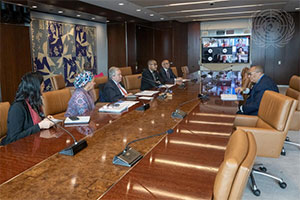 Secretary-General Meets with Members of Debt Expert Group. Credit: UN Photo/Eskinder Debeb
Financial crises are often defined by banking panics, recession, loss of market value, and deflation. Various financial crises at the turn of the 20th century, such as the Asian Crisis of 1997-1998 and the 2007-2008 Global Financial Crisis, have had immense impacts on the world economy. The COVID-19 pandemic also caused a financial crisis when mass lockdowns triggered staggering unemployment rates, a stagnation of economic growth, and led to the 2020 stock market crash. With the Russian invasion of Ukraine, the world has also witnessed a global energy crisis with shortages and increased prices in oil, gas, and electricity markets. According to UNCTAD’s World of Debt 2025, global public debt surpassed $100 trillion in 2024, with developing country debt growing twice as fast as developed economies since 2010. Burdens of debt servicing come with economic slowdowns and demands of austerity from lenders, with some economists arguing that this will lead to a new “lost decade” for the Global South. IPS brings you worldwide coverage of these financial developments and how we should manage these crises.

The Week with IPS

NEXT STOP - SDGs
Tracking global progress towards a sustainable world
Tracking global progress towards a sustainable world
