Languages
Tuesday, September 29, 2026



News and Views from the Global South
Green Economy

Developing Countries Take Lead at Climate Change Agreement Signing
An unprecedented 175 countries signed the Paris Climate Change Agreement here Friday, with 15 developing countries taking the lead by also ratifying the treaty.
No Turning Back in the Global Fight Against Climate Change
As people around the globe observe Earth Day today, world leaders are making history at the United Nations in New York. Over 100 countries will sign the Paris Agreement on climate change, representing their commitment to join it formally. This marks a turning point in the story of our planet and may set a record for the largest number of signers to an international agreement in a single day. Moreover, last month, President Obama announced with President Xi Jinping that our two countries will sign the Paris Agreement today and formally join this year. We are confident other countries will do so too, with the intention of bringing this historic and ambitious agreement into force as quickly as possible.
Climate: Africa’s Human Existence Is at Severe Risk
“Africa’s human existence and development is under threat from the adverse impacts of climate change – its population, ecosystems and unique biodiversity will all be the major victims of global climate change.”
Opinion: Unnoticed, We Are Close to Destruction of Our Planet
On the 17th of April, Italians were called to vote in a national referendum, on the extension of licenses to extract petrol and gas from the seas. The government, the media and those in the economic circles, all took a position against the referendum, claiming that 2000 jobs were at a stake. The proponents of the referendum (among them five regions), lost. Italy is following a consistent trend, after the Summit on Climate Change (Paris December 2015), in which all countries (Italy included) took a solemn engagement to reduce emissions.
Climate Change and the Middle East (II)
No Water in the Kingdom of the Two Seas—Nor Elsewhere
There is an oil producing country situated in the Gulf region, made of a cluster of islands. It is small, surface and population wise. But it holds the dubious privilege of ranking top of the list out of the 33 countries most likely to be water-stressed in the year 2040.

Climate Change (I)
Will the Middle East Become ‘Uninhabitable’?
This is not about any alarming header—it is the dramatic conclusion of several scientific studies about the on-going climate change impact on the Middle East region, particularly in the Gulf area. The examples are stark.

Genetic Resources to Fight Climate Change
With Kenya’s meteorological records over the last 50 years indicating increased irregularity and variability in precipitation, the effects of changing climate are hitting hard. Rising temperatures as well other forms of extreme weather events in form of droughts and floods are a common feature.A Promising Start for a High Seas Treaty
Delegates from 83 countries came together at the United Nations from March 28 to April 8 for the first in a series of landmark meetings on ocean protection. This Preparatory Committee will help forge an agreement to determine how nations move forward to protect the high seas—the 64 percent of the ocean that belongs to everyone but is governed by no one.
Sri Lanka Braces for Extreme Heat
Sri Lanka is facing the heat from a scorching sun for the past one month. In recent times, the country has imposed power cuts after almost a decade. The main reason was the stoppage at a coal power plant, but engineers at the Ceylon Electricity Board (CEB) admit that the island’s hydro-power generation capacity is at such a critical low that without additional coal, diesel and renewable generation, the country’s full demand for power cannot be met.
Papua New Guinea First to Finalize National Climate Plan Under Paris Agreement
On March 29, Papua New Guinea became the first country to formally submit the final version of its national climate action plan (called a “Nationally Determined Contribution,” or NDC) under the Paris Agreement. The small Pacific nation’s plan to transition to 100 percent renewable energy by 2030 is no longer just an “intended” nationally determined contribution (INDC) – it is now the country’s official climate plan.
Benefits of Backpack Biogas
Billions of dollars of aid has been pumped into Africa. Yet effective change too often remains an elusive outcome, leading to a vicious cycle: more needs, more aid but still little change. How to resolve this seemingly intractable dilemma?
Thaw with United States Will Put Cuba’s Agroecology to the Test
The United States has indicated a clear interest in buying organic produce from Cuba as soon as that is made possible by the ongoing normalisation of ties between the two countries. But farmers and others involved in the agroecological sector warn that when the day arrives, they might not be ready.
Agroindustry Provides Jobs, Better Living Standards in Paraguay
“I worked in many companies, in construction, fertilisers, chemicals, but none of them were as good as this one,” said Dario Cardozo, who works in the Angostura Agroindustrial Complex (CAIASA) grain reception facility.
Soy Fuels Industrialisation in Paraguay
A soybean processing plant, Angostura Agroindustrial Complex SA (CAIASA), that does not use fossil fuels and generates practically no waste products from soy reflects Paraguay’s growing industrialization.Damaging Effects
The year 2015 will be remembered for two landmark global agreements. In September, UN member states endorsed the 2030 Development Agenda and the Sustainable Development Goals. Later, 196 parties to the UN Framework Convention on Climate Change adopted the Paris Agreement at the conclusion of UN Climate Change Conference (COP21) in France.
Improving Rural Livelihoods Boost Agrarian Economies
For two decades, Dickson Kamau only grew maize on his 0.5 hectare (ha) of land earning himself the nickname Kamau wa mbembe or Kamau who owns maize in his native Kikuyu language.
Rural Costa Rican Families Flourish in the Shade
Before they got involved in farming, Luis Diego Murillo and Xinia Solano paid their bills and put food on their table with Luis’s salary as a foreman on construction sites, an unstable job that kept him on the move.
Post COP21: Costa Rica’s Innovation Must Become the Global Norm
The Paris agreement means countries and corporations will be compelled to act much more quickly on making agricultural commodity production more sustainable. Companies must look beyond their supply chains. Farmers need support to overcome barriers such as: struggle with ineffective farming practices, lack of investment and fluctuating commodity prices.
Central America Makes Uneven Progress in Clean Energy
Over the last decade, Central America has managed to reduce its dependence on fossil fuels for the production of electric power, while expanding coverage. But the progress made by each country varies widely.
Groundwater Governance in Andhra Pradesh
India is the largest user of ground water in the world. But reliance of this overexploited resource has reached its limits in many parts of the country. Nowhere is this more evident than in the drought-prone districts of Rayalseema, uplands of Prakasam, Krishna, East-West Godavari, parts of Nellore, Vizianagaram and Srikakulam in the state of Andhra Pradesh (AP). Forty per cent of the state’s irrigation needs are met through groundwater. In the drought-prone Rayalseema region – which comprises Chittoor, Anantapur, Kurnool, Prakasam and Kadapa districts -- dependence on groundwater for irrigation is particularly high. The water crisis is also most severe in this region.
Mexico’s Chinampas – Wetlands Turned into Gardens – Fight Extinction
David Jiménez grows two kinds of lettuce and other fresh produce on his “chinampa” or artificial island just under one hectare in size in San Gregorio Atlapulco, on the south side of Mexico City.« Previous Page — Next Page »


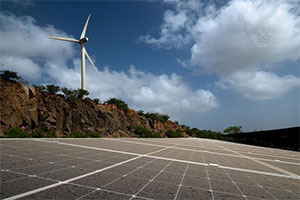 Renewable Energy in Cabo Verde. Credit: UN Photo/Mark Garten
A green economy is an economic model that aims to reduce environmental risks and build a sustainable future. Many of the UN SDGs seek to facilitate a green economy, such as ensuring access to affordable and reliable clean energy, building sustainable cities and communities, and implementing urgent action to combat climate change. Various key negotiations have strived to achieve a green economy, such as the Green New Deal and the Inflation Act of 2022. COP30, held in Belém, Brazil in 2025, agreed to mobilize $1.3 trillion annually for climate action and launched the Belém Mission to 1.5°C. However, the conference was not able to develop a fossil fuel reduction roadmap. Recent years have witnessed a sharp transformation in the geopolitical landscape of international sustainability cooperation. In March 2025, the United States stepped back from formal multilateral support for the SDGs, while China is on the rise as an international leader in renewable energy production. The actions of these global powers may shape shifting alliances on environmental governance. IPS is dedicated to sharing timely news on international developments in building a sustainable future.

The Week with IPS

NEXT STOP - SDGs
Tracking global progress towards a sustainable world
Tracking global progress towards a sustainable world
