Languages
Friday, October 9, 2026



News and Views from the Global South
Labour
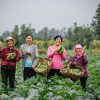
International Women’s Day, 2021
Women’s Leadership in the Global Recovery from COVID-19 Pandemic
Today is International Women’s Day (IWD), and the theme for this year’s celebration is "Women in leadership: Achieving an equal future in a COVID-19 world." We recognize the tremendous contribution and leadership demonstrated by women and girls around the world in shaping our recovery from the COVID-19 pandemic and a more sustainable future.

International Women’s Day, 2021
A Just COVID-19 Recovery – Not Without Women’s Leadership
Almost exactly a year ago today, I packed my computer and a couple of necessities in the office in New York, hugged the colleagues, and headed home to what most people thought would be a couple of week’s Covid-19 lockdown. Little did we know.

International Women’s Day, 2021
International Women’s Day: To Change the World, Women Must Choose to Challenge
Among the greatest gifts with which I have been blessed were parents who instilled in me a deep-rooted sense of identity, and the unequivocal belief that there was no difference between what a boy and a girl could achieve.
This assurance sustained me while growing up, as the tenth child out of twelve wonderful siblings, and through the numerous times when it was suggested by others that I would never succeed, simply because I was black, poor and female.

International Women’s Day, 2021
Women in Leadership: Achieving an Equal Future in a COVID-19 World
International Women’s day 2021 heralds a particularly challenging time for women and girls. The Covid pandemic has battered our world to such an extent that we know that our lives have been irrevocably changed and has rolled back some of the gains we made in the human rights and gender equality field.

International Women’s Day, 2021
#MarchWithUs: 5 Activists on Dismantling “Gender Lies”
Today, despite centuries of activism and mobilisations, women and non-binary people continue to remain disadvantaged in almost every sphere – from “public life” to the “shadow pandemic” of gender-based violence.

International Women’s Day, 2021
Celebrating International Women’s Day on March 8, 2021 AD – What are We Waiting For?
Every year on March 8, the International Women’s Day is commemorated. What do women think about this famous anniversary, first honored 1911 in European countries? As I cannot speak for other women, I share with you my personal reflections on this special day, bringing in a developmental perspective.

International Women’s Day, 2021
Women’s Leadership Must Drive the Global Recovery from COVID-19
International Women’s Day is always an occasion to celebrate strong women and an important day in the global calendar to highlight the gender injustices still lingering in every part of the world.

International Women’s Day, 2021
The World Not Only Needs Women Leaders – It Needs Feminist Leaders
International Women's Day pays tribute to the achievements of women worldwide and reminds us what still needs to be done for full gender equality. In 2021, we are taking stock of the many ways in which COVID-19 has disproportionately affected women and girls around the world.

International Women’s Day, 2021
Removing Barriers to Women’s Leading Role in African Agriculture
Africa’s population will double by 2050 if growth rates continue their trajectory, but the creation of jobs is not keeping pace, with up to five times more young people seeking employment each year as there are new posts to fill. And, on top of this, the COVID pandemic is plunging Africa into its first recession in 25 years.

International Women’s Day, 2021
Women in Leadership Positions: An Economist’s View of International Women’s Day
The COVID-19 pandemic (henceforth pandemic) has women particularly hard. In almost all countries, women constitute the bulk of the labour force in the service sector, which was hardest hit by the pandemic. Furthermore, they also represent a disproportionate share of the work force in particularly vulnerable sectors such as health care. Women also have disproportionate if not sole responsibility for home work including taking care of children.

International Women’s Day, 2021
To Aspire and Achieve- Women’s Leadership in the 21st Century
As a member of the second wave of the feminist movement who were also the first generation of women to receive positions of leadership, I recall the prejudices and biases that framed our experience. Women rarely were put in charge of “hard” core issues, only what were termed “soft” ones in keeping with their role as nurturer and carer. When they were present in the Board room, they were often silent. When they spoke, they were inevitably spoken over. It was the exceptional woman who could navigate the corridors of corporate culture, male expectations, and a workplace that was unsympathetic to her dual burden.

End Inequality and Achieve Sustainable Development for All
Back in the 1990s, the discovery of antiretrovirals offered a ray of hope to save people’s lives from the HIV epidemic. Over this decade, people living with HIV benefited from the scientific advances and began to have longer, healthier and more productive lives. However, almost all the beneficiaries were from rich countries in the global north. As a result, about nine million people died by the year 2000 due to the inequality in accessing these life-saving medicines.
A Technology-based Parasol of Protection for Victims of Domestic Abuse
During the COVID19 lockdown, there has been an approximate 25% increase in domestic abuse, dubbed by the United Nations as the ‘pandemic within a pandemic’. While the home is perceived as a secure place, for domestic abuse victims battling the pandemic is equally and increasingly unsafe. A parasol of protection is needed to rehabilitate victims of abuse starting from detection, reaching out, providing help and support.
Sustainable Energy Key to COVID-19 Recovery in Asia and the Pacific
The past year is one that few of us will forget. While the impacts of the COVID-19 pandemic have played out unevenly across Asia and the Pacific, the region has been spared many of the worst effects seen in other parts of the world. The pandemic has reminded us that a reliable and uninterrupted energy supply is critical to managing this crisis.
Money vs. Happiness
The question whether the rich are more satisfied with their lives is often taken for granted, even though surveys, like the Gallup World Poll, show that the relationship between subjective well-being and income is often weak, except in low-income countries in Africa and South Asia. Researcher Daniel Kahneman and his collaborators, for example, report that the correlation between household income and reported life satisfaction or happiness with life typically ranges from 0.15 to 0.30. There are a few plausible reasons. First, growth in income mostly has a transitory effect on individuals’ reported life satisfaction, as they adapt to material goods. Second, relative income, rather than the level of income, affects well-being — earning more or less than others looms larger than how much one earns. Third, though average life satisfaction in countries tends to rise with GDP per capita at low levels of income, there is little increase in life satisfaction once GDP per capita exceeds $10,000 (in purchasing power parity). This article studies the relationships between subjective well-being, which is narrowly defined to focus on economic well-being in India, and variants of income, based on the only panel survey in India Human Development Survey (IHDS).
Peace in Yemen, But not Without Women’s Role in Peacebuilding
The armed conflict in Yemen which has lasted six years, has killed and injured over thousands of civilians, displaced more than one million people and given rise to cholera outbreaks, medicine shortages and threats of famine. By the end of 2019, it is estimated that over 233,000 Yemenies have been killed as a result of fighting and the humanitarian crisis. With nearly two-thirds of its population requiring food assistance, Yemen is also experiencing the world's worst food security crisis. The United Nations has called the humanitarian crisis in Yemen “the worst in the world”.
History of Female (Im)Mobility in Nepal
A proposal by Nepal’s Immigration Department requiring consent from a guardian and local government for women under the age of 40 travelling to the Gulf or Africa has sparked public fury, and is taken as yet another proof of a misogynist, bungling bureaucracy.
Valérie Allain – Women in Science (2021)
 "Working in Science, like any other career, is fit for women too… Just go for it, nobody can stop you", Valérie Allain, Senior Fisheries Scientist at the Pacific Community (SPC).
Labour Rights Have Worsened in India Post-Lockdown
As the Indian economy officially heads into a recession and news of layoffs and unemployment reaches us with increasing frequency, we at Gram Vaani turned to workers to hear their side of the story. Industrial sector workers, largely engaged in the automotive and garments factories in the Gurgaon-Manesar belt, spoke to us about the turn that their lives have taken due to the COVID-19 crisis.
Water Graves: Nightmare for Mexican Fishermen
All of Erizo's nightmares are the same. Since his return from the ocean - almost unrecognizable - every bad dream is identical. A wave punches his little boat and throws him into the deep sea where everything is so dark that he can't even see his own hands.
A Grey Cloud Over Lebanon: Mental Health Burdens
Humankind is no stranger to the destabilizing events of 2020. The state of the global economy and the outbreak of the COVID-19 pandemic hit the headlines. In this ever escalating global crisis, Lebanon, has been facing what can only be described as unimaginable hardships. For the past year the country has seen challenges which have resulted in an utter state of hopelessness and rapid deterioration in mental health of many of its citizens.« Previous Page — Next Page »





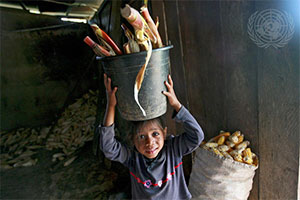 Timorese Girl with Fresh-Picked Corn. Credit: UN Photo/Martine Perret
A global common denominator is the need for a decent job. The economic realities of each country determine just how difficult it is to find one. Despite the labour movement's achievements, serious challenges persist: gender discrimination, child labour, worker migration, the digital divide and AI automation, evaporating pensions, unsafe workplaces, corporate pressure against union organising, negative impacts of trade agreements, and the precariousness of informal employment. The 2025 UN SDG Report identifies jobs and social protections as one of the six priority areas requiring urgent action, with progress either stalled or reversing in many developing nations.
In recent years, the fight to protect labour equality has taken on new dimensions with the rise of Environmental, Social and Governance standards. With the Social aspect aiming to promote equality and human rights, ESG principles have strengthened labour advocacy within corporate and governmental regulatory landscapes. In particular, ESG has become much more institutionalized in emerging economies such as Brazil and China. IPS follows the world’s workers as they confront these challenges - their setbacks and their successes.

The Week with IPS

NEXT STOP - SDGs
Tracking global progress towards a sustainable world
Tracking global progress towards a sustainable world
