Languages
Thursday, October 8, 2026



News and Views from the Global South
Labour

Pandemic Relief Policies Need More Resources, Better Design
Pandemic relief measures in developing countries have been limited by modest resources, fear of financial market discipline and policy mimicry. COVID-19 has triggered not only an international public health emergency, but also a global economic crisis, setting back decades of uneven progress, especially in developing countries.
– Jamaica Failing to Cope with Plastic Waste –
On the occasion of World Environment Day, 5 June 2021, drawing from IPS’s bank of features and opinion editorials published this year, we are re-publishing one article a day, for the next two weeks. The original article was published on January 20 2021

Pakistanis in Italy: Against All Odds
We met 22-year old Ali B. in a park in Rome’s city center on a rather cold and windy April evening. We could not share a meal, or even a coffee, as all restaurants were shut due to continuing COVID-19 restrictions. He had travelled down from Cerveteri (a small town about 50km north of Rome) where he works for an old couple. They provide boarding and lodging as well as a decent salary and social security benefits. In return, he has to cook for them and look after the kitchen.
The Garment Industry Needs More Women Leaders
If you enter a garment factory in India, or any part of the world for that matter, you will see that the workforce is starkly female. The Indian textile and garment industry employs 45 million people, out of which more than 60 percent are women. This makes it the biggest formal employer of women in a country where 80 percent of them are not engaged in paid work. While that might paint a rosy picture of women’s empowerment at the first glance, a closer look reveals something different.
Challenges with Skill Development Programmes During the Pandemic
India’s evolving Technical and Vocational Education and Training ecosystem (TVET) faced many challenges during the COVID-19 pandemic. Because of the national lockdown, organisations had to remain shut for 7-8 months, until September 2020.
People’s Leader: A Dalit Woman Becomes The Voice of Farmers In India
On 12 January this year, somewhere in the outskirts of the capital, New Delhi, 24 year old Dalit activist Nodeep Kaur was arrested by the Haryana police for protesting outside a factory. During the lockdown in 2020, Nodeep joined a local workers’ rights organization called Mazdoor Adhikar Sangathan (MAS) in the Kundli Industrial Area in Haryana. In January Nodeep was accused of allegedly manhandling management and staff of an industrial area during a protest and also assaulting the police team.
Clash of Cultures – Is it Real or a Smokescreen?
The notion of “Clash of Cultures” is most frequently used as a justification for anti-immigrant prejudice and, particularly in Europe and in the USA, for islamophobia. The reasoning goes as follows: immigrants, especially Muslims, have a deeply different culture from the hosting communities and these differences create unsurmountable tensions and conflicts.
Helping Youth Agribusiness Keep Pace with Fast Growing Africa
From small towns to big cities, sub-Saharan Africa has the fastest urban growth rate in the world. The continent’s population is expected to double by 2050 with the youth representing 60% of the overall population. The UN Department of Global Communication, for example, projects that for the next 15 years urban growth is set to double for several African cities: Dar es Salaam will reach over 13 million inhabitants and Kampala will exceed seven million.
Pandemic Accentuates Need for Caribbean Countries to Improve Food and Nutrition Security
Last year, Jaxine Scott was off work as a caregiver at a primary school as a result of the pandemic. One day, she noticed a green shoot emerging from some garlic in her fridge. She decided to plant it, and to her surprise, it thrived. “I thought ‘It looks like I have a green thumb, let me plant something else,’” Scott says. She now has a backyard garden, including cucumber, pumpkin, melon, callaloo, cantaloupe, pak choy and tomatoes. “It makes me feel good,” she says. “I can help my family members and neighbours. It has saved me money. I’m not going to stop, I’m going to continue,” she says.
World Autism Awareness Day – 2 April 2021
 Autism Spectrum Disorder is a complex condition that remains misunderstood.
The effects of ASD and the severity of symptoms vary so much between individuals.
Autism Spectrum Disorder is a complex condition that remains misunderstood.
The effects of ASD and the severity of symptoms vary so much between individuals.

Maquila Female Workers in Their Own Words: Fighting COVID and Labor Abuse
A compilation of testimonies collected by Blanca Velázquez Díaz and published by the Ebert Foundation (available at: http://library.fes.de/pdf-files/bueros/mexiko/17328.pdf) offers an account of the harsh reality by which some workers of the maquila industry in the Mexican state of Morelos have gone through over these last twelve months. Their words reflect, undoubtedly, similar experiences of millions of workers in different parts of the country.
Brexit Shows Why Traders Need Reliable Information But Many Are Ahead of the Game
It’s now almost three months since the United Kingdom entered into a new trade agreement with the European Union. During that time, we’ve seen traders struggle to get to grips with the new arrangements. From lorry drivers having their sandwiches confiscated by Dutch customs officers to estimates of additional paperwork costs of $7 billion a year, and pig breeders watching their meat rot on the quayside for want of the correct forms.
Five Steps to Combat Gender-Based Violence Globally
The 410 Legal Aid Centers that I manage in Bangladesh for BRAC’s Human Rights and Legal Aid Services received approximately 35,900 requests for assistance in 2020. Almost all of them involve gender-based violence against women and girls.
Inequality, COVID-19 and the Plight of the Young
Inequality characterizes the world we live in, predisposing how we act and think. We perceive our existence as composed of dichotomies – men and women, young and old, black or white, as well as a difference between those who have and those who do not have access to wealth, health, education and influence. Dichotomies are also born out of comparisons, about how things are now and how they could have been, how they were before and how they are now.
Sustainable Development Goals Can Guide Asia-Pacific to Build Back Better
The COVID-19 crisis poses an unprecedented threat to development in the Asia-Pacific region that could reverse much of the hard-earned progress made in recent years. The good news is we know how to tackle this challenge. Recovery from the pandemic and our global efforts to deliver the United Nations Sustainable Development Goals (SDGs) by 2030 must go hand-in-hand. The Goals provide a compass to navigate this crisis, faster and greener, everywhere and for everyone.
Malawian Youth Wipe Away Unemployment Tears with Agribusiness
After getting tired of searching for employment for seven years, Feston Zale from Chileka area in Malawi’s Southern Region decided to venture into agribusiness.
Down in Hell
I am about 200 feet down a rickety old mine shaft, in the Ashanti gold mining region of Ghana. It is stiflingly hot and darker than a moonless night. I can only feel the touch of sweaty bodies passing in the darkness and hear the reverberating sound of miners coughing and breaking rocks. The lack of oxygen and dust make it hard to breathe. I have no idea how deep this shaft goes – hundreds of feet? More? If there is a Hell this must be what it feels like.
International Women’s Day, 2021
Why Green Growth and Climate Action Fall Short Without Addressing Gender Inequality
As the global effort to address climate change has strengthened over the last few years, so has the realization that rising temperatures and climactic disruptions disproportionately impact women, particularly in developing countries, as they tend to be more dependent upon natural resources and are thus overrepresented in resource-intensive economic sectors. Furthermore, inherent in gender inequality are disadvantages for and discrimination against women in all facets of society, including in the economy and politics. Thus, it is unfortunate, yet perhaps unsurprising, that these structural disparities are mirrored in the negative effects of climate change. Therefore, if gender differences are not incorporated into climate change plans, women will be unable to access the co-benefits that arise from concerted climate action.
The Mexican Economy: A Short or Long Recession Cycle?
The trend of the Mexican economy during the last two years has not been positive. INEGI, the official bureau of statistics, has just reported that GDP registered a fall of 8.5 percent compared to 2019 with seasonally adjusted figures. But in 2019 GDP also receded, although in far less measure, less than one percentage point. However, it must be considered that the Mexican economy has been falling for 6 quarters (compared to the previous year). Considering the population growth rate (1.2 percent per year), the fall in the GDP per capita is close to 11 percent. This figure matters because it gives a more accurate idea of the size of the downturn. It is also necessary to take into account the two years, since our interest should be now to try to figure out how long the recession will be the endure, that is, when will Mexico reach the pre-pandemic level of GDP.
International Women’s Day, 2021
Every Girl Has a Right to An Education
Access to an inclusive quality education is a universal human right. When the inherent right to a good education is ignored or denied, the consequences are severe. For a girl in country of conflict or forced displacement, the impact is brutally multiplied.

International Women’s Day, 2021
Women Must Continue To Claim Power & Challenge The Unseen Barriers
Power is an intriguing concept and it means different things to different people. In simple words, power is the ability to influence the behavior of others to get what you want. Power distribution is usually visible in most societies when there is a clear and obvious division between the roles of the men and expectations from women. One can’t talk about power without talking about patriarchy - in which men always hold the power and women are largely excluded from it. Women are almost always taught power and ambition are two dirty words, and should not be linked to their personalities.
« Previous Page — Next Page »





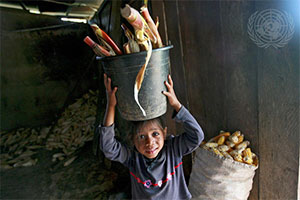 Timorese Girl with Fresh-Picked Corn. Credit: UN Photo/Martine Perret
A global common denominator is the need for a decent job. The economic realities of each country determine just how difficult it is to find one. Despite the labour movement's achievements, serious challenges persist: gender discrimination, child labour, worker migration, the digital divide and AI automation, evaporating pensions, unsafe workplaces, corporate pressure against union organising, negative impacts of trade agreements, and the precariousness of informal employment. The 2025 UN SDG Report identifies jobs and social protections as one of the six priority areas requiring urgent action, with progress either stalled or reversing in many developing nations.
In recent years, the fight to protect labour equality has taken on new dimensions with the rise of Environmental, Social and Governance standards. With the Social aspect aiming to promote equality and human rights, ESG principles have strengthened labour advocacy within corporate and governmental regulatory landscapes. In particular, ESG has become much more institutionalized in emerging economies such as Brazil and China. IPS follows the world’s workers as they confront these challenges - their setbacks and their successes.

The Week with IPS

NEXT STOP - SDGs
Tracking global progress towards a sustainable world
Tracking global progress towards a sustainable world
