Languages
Monday, October 19, 2026



News and Views from the Global South
Labour

New Label Defends Family Farming in Argentina
It’s pouring rain in the capital of Argentina, but customers haven’t stayed away from the Bonpland Solidarity Economy Market, where family farmers sell their produce. The government has now decided to give them a label to identify and strengthen this important segment of the economy: small farmers.
Opinion: Time for the World to Protect and Value its Young Human Rights Defenders
There’s a deep irony that as people around the world mark International Youth Day on Aug. 12, hardly any attention will be paid to the shrinking space for young human rights defenders who increasingly find themselves on the receiving end of government repression.
Unique Alliance Between Gauchos and Environmentalists Protects Argentina’s Pampas
The traditions of Argentina’s gauchos or cowboys have joined together with modern agricultural technology in a unique alliance between stockbreeders and environmentalists aimed at preserving biodiversity in the pampas, boosting productivity, and enhancing the flavour of this South America’s country’s famous beef.
Workplace Diversity Still a Pipe Dream in Most U.S. Newsrooms
Although the United States as a whole is becoming more ethnically diverse, newsrooms remain largely dominated by white, male reporters, according to a recent investigation by The Atlantic magazine.
Latin America Tackles Informal Labour among the Young
The 56 million young people who form part of Latin America’s labour force suffer from high unemployment, and many of those who work do so in the informal sector. Governments in the region have begun to adopt more innovative policies to address a problem that undermines the future of the new generations.
Papua New Guinea’s Unemployed Youth Say the Future They Want Begins With Them
Zibie Wari, a former teacher and founder of the Tropical Gems grassroots youth group in the town of Madang on the north coast of Papua New Guinea, has seen the hopes of many young people for a decent future quashed by the impacts of corruption and unfulfilled promises of development.
Opinion: Strengthen Tax Cooperation to End Hunger and Poverty Quickly
By the end of this year, the 15-year time frame for the Millennium Development Goals will end, with good progress on several indicators, but limited achievements on others.
Opinion: Unrestrained ‘Privatisation of Poverty-Reduction’ Puts Human Rights at Risk
Corporate lobbyists are unusual guests at development meetings, but when the United Nations held its Financing for Development conference in Addis Ababa this week to decide who pays for its new “Sustainable Development Goals”, some governments laid out the red carpet for the private sector.
In Search of Jobs, Cameroonian Women May End Up as Slaves in Middle East
Her lips are quavering her hands trembling. Susan (not her real name) struggles to suppress stubborn tears, but the outburst comes, spontaneously, and the tears stream down her cheeks as she sobs profusely.
New Census Paints Grim Picture of Inequality in India
Despite being Asia’s third-largest economy, positioning itself as a major geopolitical player under a new nationalist government, India's first ever Socio Economic and Caste Census (SECC) paints a grim picture of poverty and deprivation despite billions of dollars being funneled into state-sponsored welfare schemes.
Opinion: Women in Sport – Scoring for Equality
The Women’s World Cup has shown people everywhere what women athletes are all about: skill, strength, unity and determination. I extend my heartfelt congratulations to the winners – the team from the United States – and to all others who participated. You are inspiring millions of women and girls around the world to pursue their goals and dreams.
Earthquakes Don’t Kill, Buildings Do – Or Is It Inequity?
70-year-old Chiute Tamang was working in his field when the earth shook on Apr 25. He grabbed a tree. His wife and daughter were inside the house at the time, but managed to run out. In the blink of an eye, the building turned into a heap of stones. They were the lucky ones.
Fishing Families Left High and Dry by Amazon Dams
Small-scale fisherpersons were among the first forgotten victims of mega construction projects like the Belo Monte hydroelectric dam on the Xingú River in the Brazilian Amazon.
Q&A: “If We Don’t Close the Poverty Gap, the 21st Century Will End in Extreme Violence”
Implementation of the ambitious post-2015 development agenda which will be adopted in September 2015 at the United Nations depends to a large extent on funding.Social Safety Net Not Wide Enough to Protect World’s Poor
Fifty-five percent of the world’s poor still have limited protection from hunger and economic, social or political crises despite expansion of social safety programmes in developing countries in recent years.
Opinion: Unlocking the Potential of Mali’s Young Women and Men
The recent peace agreements in Mali offer grounds for optimism. It’s now time to capitalise on the accord to accelerate recovery, reconciliation and development. An important part of that process will entail placing the country’s youth at the center of the country’s agenda for peace and prosperity.
Despite Scepticism, U.N. Hails Its Anti-Poverty Programme
The United Nations, which launched one of its most ambitious anti-poverty development programmes back in 2000, has hailed it as a riveting success story – despite shortcomings.
Child Labour: A Hidden Atrocity of the Syrian Crisis
In a conflict that has claimed over 220,000 lives and injured a further 840,000 people as of January 2015, it is sometimes hard to see beyond the death toll.
Sustainable Use of Biodiversity Could Fill Gap When Belo Monte Dam Is Finished
Some argue that the sustainable use of biodiversity is the best alternative for local development in the area surrounding the enormous Belo Monte hydroelectric dam, now that the construction project is entering its final phase on the Xingú River in Brazil’s Amazon jungle.
Bangladeshi Migrants Risk High Seas and Smugglers to Escape Poverty
Though he is only 16 years old, Mohammad Yasin has been through hell and back. He recently survived a hazardous journey by sea, crammed into the cargo-hold of a rudimentary boat along with 115 others.
U.N. Chief Seeks Equity in Paris Climate Change Pact
When the 193-member General Assembly hosted a high level meeting on climate change Monday, Secretary-General Ban Ki-moon warned that any proposed agreement at an upcoming international conference in Paris in December must uphold the principle of equity.« Previous Page — Next Page »





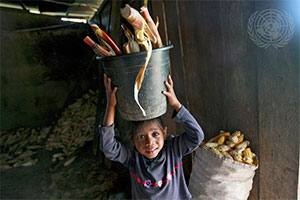 Timorese Girl with Fresh-Picked Corn. Credit: UN Photo/Martine Perret
A global common denominator is the need for a decent job. The economic realities of each country determine just how difficult it is to find one. Despite the labour movement's achievements, serious challenges persist: gender discrimination, child labour, worker migration, the digital divide and AI automation, evaporating pensions, unsafe workplaces, corporate pressure against union organising, negative impacts of trade agreements, and the precariousness of informal employment. The 2025 UN SDG Report identifies jobs and social protections as one of the six priority areas requiring urgent action, with progress either stalled or reversing in many developing nations.
In recent years, the fight to protect labour equality has taken on new dimensions with the rise of Environmental, Social and Governance standards. With the Social aspect aiming to promote equality and human rights, ESG principles have strengthened labour advocacy within corporate and governmental regulatory landscapes. In particular, ESG has become much more institutionalized in emerging economies such as Brazil and China. IPS follows the world’s workers as they confront these challenges - their setbacks and their successes.

The Week with IPS

NEXT STOP - SDGs
Tracking global progress towards a sustainable world
Tracking global progress towards a sustainable world
