Languages
Friday, October 16, 2026



News and Views from the Global South
Labour

Decent Work Crucial To Eliminating Poverty and Hunger
Over the eight years since the onset of the global financial crisis in 2008, the ranks of the unemployed have swollen to over 200 million worldwide. That number captures only a fraction of those who remain vulnerable and insecure, since more than four-fifths of the global workforce is outside the formal sector, with poor access to unemployment or other traditional social security benefits.
Opinion: The Broken Promises of the Peruvian Development Model
Lima was the host, in October 2015, of the International Monetary Fund (IMF) and the World Bank annual meetings. The two Bretton Woods institutions, criticized for their record of lowering social and environmental conditions, seek to showcase Peru as a success of their neoliberal policies and reforms to the rest of the world.
Brazil’s Megaprojects, a Short-lived Dream
Working as a musician in a military band is the dream of 21-year-old Jackson Coutinho, since hopes that a petrochemical complex would drive the industrialisation of this Brazilian city near Rio de Janeiro have gone up in smoke.
Itaborai, a City of White Elephants and Empty Offices
Itaboraí still recalls its origins as a sprawling city that sprang up along a highway, not far from Rio de Janeiro. But a few years ago big modern buildings began to sprout all over this city in southeast Brazil, whose offices and shops are almost all empty today.
Opinion: Demography and Destiny
The demographic revolutions the world is experiencing are profound and far-reaching, affecting virtually every aspect of human society. Whether in politics, business, international relations, environmental affairs or even personal matters, understanding the fundamental demographic changes underway and anticipating their juggernaut consequences can contribute considerably to the setting of meaningful goals, designing effective strategies and achieving genuine progress.
Angus Deaton: An Appreciation
After Adam Smith and Amartya Sen, Angus Deaton, this year’s Nobel laureate in economics, has contributed most to broaden and enrich our understanding of human well-being. His brilliant and path-breaking contributions to the theory and measurement of consumption, poverty, inequality, nutrition – and, more recently, aging, morbidity and suicides – have inspired a generation of economists to carry out reformulations, refinements and extensions.
Native Women Green the Outskirts of the City, Feed Their Families
The hands of women who have migrated from rural areas carefully tend to their ecological vegetable gardens in the yards of their humble homes on the outskirts of Sucre, the official capital of Bolivia, in an effort to improve their families’ diets and incomes.
Opinion: Will the SDGs Serve to Bridge the Gender Gap?
Increasingly gender equality, rooted in human rights, is recognized both as a key development goal on its own and as a vital means to helping accelerate sustainable development. And while the field of gender has expanded exponentially over the years, with programmes focused exclusively on women and girls and greater mainstreaming of gender into many development activities, a range of challenges remain.
Opinion: Having to Choose, A Nation’s Agonizing Immigration Duty
It’s auniversally acknowledged truth that no nation can sustain open borders. Even the wealthiest, most popular “nations of immigrants” like the US cannot possibly accept everyone who wants to immigrate here or even qualifies to do so.
Social Programmes Here to Stay in Argentina
Above and beyond the uncertainty about the direction that Argentina’s economy will take after the Oct. 25 presidential elections, the government’s main social programmes, which have helped bring down poverty levels in the last decade, are definitely here to stay, no matter who is elected.
Chile’s Altiplano Region Seeks Sustainable Tourism
Chile’s altiplano or high plateau region, pounded by the sun of the Atacama desert, the driest place in the world, is home to dozens of indigenous communities struggling for subsistence by means of sustainable tourism initiatives that are not always that far removed from out-of-control capitalism.
Opinion: Global Justice Necessary For Lasting Peace
Last year saw considerable reflection on the First World War, which began a century ago. In reality, it was very much a European war, but with nonetheless profound implications for the last century.
Cuban Agroecological Project Foments Local Innovation
Armando Marcelino Pi divides his day between the university, where he teaches philosophy, work on his family farm, and coordinating a group of 33 agroecological farmers, in this mountainous rural municipality in western Cuba.
Opinion: From Inequality to Inclusion
Recent years have seen a remarkable resurgence of interest in economic inequality, thanks primarily to growing recognition of some of its economic, social, cultural and political consequences in the wake of Western economic stagnation.
Women Revolutionise Waste Management on Nicaraguan Island
A group of poor women from Ometepe, a beautiful tropical island in the centre of Lake Nicaragua, decided to dedicate themselves to recycling garbage as part of an initiative that did not bring the hoped-for economic results but inspired the entire community to keep this biosphere reserve clean.
Shifting Sands: How Rural Women in India Took Mining into their Own Hands
Thirty-seven-year-old Kode Sujatha stands in front of a hut with a palm-thatched roof, surrounded by a group of men shouting angrily and jostling one another for a spot at the front of the crowd.
Opinion: Mexico’s Gruesome War Against Migrants
“Pray for me.” Those are the last words Eva Nohemi Hernández Murillo told her mother, Elida Yolanda, through a patchy phone line on the evening of Aug. 22, 2010.
The Future Tastes Like Chocolate for Rural Salvadoran Women
Idalia Ramón and 10 other rural Salvadoran women take portions of the freshly ground chocolate paste, weigh it, and make chocolates in the shapes of stars, rectangles or bells before packaging them for sale.
Time to Work Out a Plan C for Greece
Just over a month ago, Greek citizens were asked to go to the polls for a referendum that posed the country with an unprecedented existential dilemma and challenged the EU with the possibility of its collapse.
The U.N. at 70: Leading the Global Agenda on Women’s Rights and Gender Equality – Part Two
The efforts of the United Nations and the global women’s movement to promote the women’s rights agenda and make it a top international priority saw its culmination in the creation of U.N. Women, by the General Assembly in 2010.
New Label Defends Family Farming in Argentina
It’s pouring rain in the capital of Argentina, but customers haven’t stayed away from the Bonpland Solidarity Economy Market, where family farmers sell their produce. The government has now decided to give them a label to identify and strengthen this important segment of the economy: small farmers.« Previous Page — Next Page »





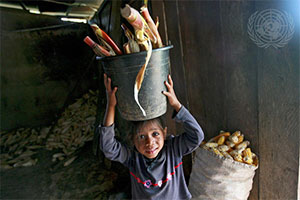 Timorese Girl with Fresh-Picked Corn. Credit: UN Photo/Martine Perret
A global common denominator is the need for a decent job. The economic realities of each country determine just how difficult it is to find one. Despite the labour movement's achievements, serious challenges persist: gender discrimination, child labour, worker migration, the digital divide and AI automation, evaporating pensions, unsafe workplaces, corporate pressure against union organising, negative impacts of trade agreements, and the precariousness of informal employment. The 2025 UN SDG Report identifies jobs and social protections as one of the six priority areas requiring urgent action, with progress either stalled or reversing in many developing nations.
In recent years, the fight to protect labour equality has taken on new dimensions with the rise of Environmental, Social and Governance standards. With the Social aspect aiming to promote equality and human rights, ESG principles have strengthened labour advocacy within corporate and governmental regulatory landscapes. In particular, ESG has become much more institutionalized in emerging economies such as Brazil and China. IPS follows the world’s workers as they confront these challenges - their setbacks and their successes.

The Week with IPS

NEXT STOP - SDGs
Tracking global progress towards a sustainable world
Tracking global progress towards a sustainable world
