Languages
Thursday, October 29, 2026



News and Views from the Global South
Labour
OPINION: A New Era of Hemispheric Cooperation Is Possible
Two decades after the first Summit of the Americas, a lot has changed in the continent and it has been for the good. Today, a renewed hemispheric dialogue without exclusions is possible.
Escape Route Towards Social Inclusion for War-Disabled Gazan Youth
The Israeli attacks that the Gaza Strip has suffered in recent years have left in their wake a large number of young people who have come up against a further barrier to their creative energies – physical disability caused by military aggression.
Battle Heats Up Over Legalisation of Sex Work in India
Thirty-six-year-old Chameli Devi, a sex worker operating out of New Delhi's G.B. Road - Asia's largest red-light district, housing an estimated 12,000 of India’s three million sex workers – is an unhappy woman these days.
Children Starving to Death in Pakistan’s Drought-Struck Tharparkar District
 The main entrance to the Civil Hospital in Mithi, headquarters of the Tharparkar district in Pakistan’s southern Sindh Province, is blocked by a couple of men clad in traditional dress and turbans. They are trying to console a woman who is sobbing so heavily she has to gasp for breath.

Humanity’s Future: Below Replacement Fertility?
Is below replacement level fertility the future for humanity? The answer to this seemingly simple question regarding human reproduction is not only of considerable demographic concern, but also has enormous social, economic and environmental consequences for the planet.
Papal Visit Rekindles Hopes in Former War Zone
Jessi Jogeswaran, a 20-year-old woman from Sri Lanka’s northern Jaffna district, waited over six hours with 18 friends in the sweltering heat just to get a glimpse of Pope Francis on Jan. 14.
Island States Throw Off the Heavy Yoke of Fossil Fuels
The Caribbean nation of St. Kitts and Nevis, on a quest to become the world’s first sustainable island state, has taken a giant leap in its programme to cut energy costs.
Haitians Worry World Bank-Assisted Mining Law Could Result in “Looting”
With Haiti’s Parliament having dissolved on Tuesday, civil society groups are worried that the Haitian president may move to unilaterally put in place a contentious revision to the country’s decades-old mining law.
Oil, An Invasive Water Species in the Carnival Capital
"We ran down to the beach and found a black tide, whose waves didn’t make the sound of water, but the slurp of a thick paste,” said Alexandre Anderson, describing the oil spill in Guanabara bay in the Brazilian state of Rio de Janeiro which turned him into an activist and leader among the local small-scale fishing community.
Women ‘Sewing’ a Bright Future in Northern Pakistan
At 46, Naseema Nashad is starting her life over, not out of choice but out of necessity. The Afghan woman was just 25 years old when Taliban militants stormed Kabul and her family was forced to flee to neighbouring Pakistan to escape what they knew would be a brutal regime.
Integrated Farming: The Only Way to Survive a Rising Sea
When the gentle clucking grows louder, 50-year-old Sukomal Mandal calls out to his wife, who is busy grinding ingredients for a fish curry. She gets up to thrust leafy green stalks through the netting of a coop and two-dozen shiny hens rush forward for lunch.
Organic Farming in India Points the Way to Sustainable Agriculture
Standing amidst his lush green paddy fields in Nagapatnam, a coastal district in the southern Indian state of Tamil Nadu, a farmer named Ramajayam remembers how a single wave changed his entire life.
The Rise and Fall of the World’s Poorest Nations
The world's 48 Least Developed Countries (LDCs) - a special category of developing nations created by the General Assembly in 1971 but refused recognition by the World Bank - have long been described as "poorest of the poor" in need of special international assistance for their economic survival.
From the American Dream to the Nightmare of Deportation
Julio César Cordero’s American dream didn’t last long. He was trying to reach Houston, Texas as an undocumented immigrant but was detained in Acayucán in southeastern Mexico. And like thousands of other deported Salvadorans, he doesn’t know what the future will hold.
Spectre of Violence Hangs Over Sri Lanka Polls
As 14.5 million Sri Lankans prepare to select their next leader, there is growing fear that violence could mar the Jan. 8 elections, billed as the closest electoral contest in the island’s history.
India’s ‘Manual Scavengers’ Rise Up Against Caste Discrimination
Watching Bittal Devi deftly weave threads of different colours into a vibrant patchwork quilt, it’s hard to imagine that this 46-year-old’s hands have spent the better part of their life cleaning toilets.
Pakistan’s Tribal Areas Demand Repatriation of Afghan Refugees
They number between two and three million; some have lived in makeshift shelters for just a few months, while others have roots that stretch much further back into history. Most fled to escape war, others simply ran away from joblessness.
Small Grants for Big Solutions in Northeast Argentina
Summers in northeast Argentina are hot and humid. At siesta time, the people of this rural municipality like to drink “tereré” (cold yerba mate), which until now they had problems preparing because of lack of clean water or electricity. But sometimes small donations can make a big dent in inequality.
Ruble’s Rout Breeds Uncertainty for Central Asian Migrants
Sardor Abdullayev, a construction worker from eastern Uzbekistan, had planned to go to Russia next spring to join relatives working construction sites in the Volga River city of Samara. But now, he says, “I am better off staying at home and driving a taxi.”
Q&A: “The Economy Needs to Serve Us and Not the Other Way Around”
Since his college days, John Schmitt says, he’s been “very interested in questions of economic justice, economic inequality.”
GDP and the Unaccounted for 82 Percent of National Wealth
Virtually all countries use Gross Domestic Product (GDP) as their primary measurement of economic progress and overall societal progress. At the same time, countries express allegiance to the doctrine of sustainable development. This exposes an obvious disconnect.« Previous Page — Next Page »





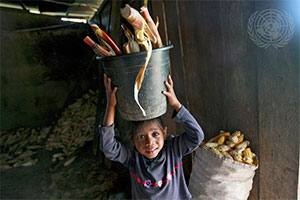 Timorese Girl with Fresh-Picked Corn. Credit: UN Photo/Martine Perret
A global common denominator is the need for a decent job. The economic realities of each country determine just how difficult it is to find one. Despite the labour movement's achievements, serious challenges persist: gender discrimination, child labour, worker migration, the digital divide and AI automation, evaporating pensions, unsafe workplaces, corporate pressure against union organising, negative impacts of trade agreements, and the precariousness of informal employment. The 2025 UN SDG Report identifies jobs and social protections as one of the six priority areas requiring urgent action, with progress either stalled or reversing in many developing nations.
In recent years, the fight to protect labour equality has taken on new dimensions with the rise of Environmental, Social and Governance standards. With the Social aspect aiming to promote equality and human rights, ESG principles have strengthened labour advocacy within corporate and governmental regulatory landscapes. In particular, ESG has become much more institutionalized in emerging economies such as Brazil and China. IPS follows the world’s workers as they confront these challenges - their setbacks and their successes.

The Week with IPS

NEXT STOP - SDGs
Tracking global progress towards a sustainable world
Tracking global progress towards a sustainable world
