Languages
Wednesday, August 26, 2026



News and Views from the Global South
Natural Resources

The Data Revolution Should Not Leave Women and Girls Behind
If there is one political principle that has been constant throughout the history of human civilization it is the fact that land is power. This is something that is particularly true, and often painfully so, for women who farm in Africa.
Production Diversity, Diet Diversity and Nutrition in Sub -Saharan Africa
Lack of diet diversity is viewed as the major cause of micronutrient malnutrition in Sub-Saharan Africa. Imbalanced diets resulting from consumption of mainly high carbohydrate based-diets also contribute to productivity losses and reduced educational attainment and income. Consequently, micronutrient malnutrition is currently the most critical for food and nutritional security problem as most diets are often deficient in essential vitamins and minerals. In Tanzania, for example, most rural and urban households consume mainly staples as their main food, which are high in carbohydrates, but low in micronutrients and vitamins. Staple food items increase energy availability but do not improve nutritional outcomes if not consumed together with micro-nutrient rich foods.
Venezuela’s Oil Industry Is Falling Apart
Corruption in the Venezuelan state oil industry, denounced by the government itself, and with former ministers and senior managers behind bars, is the latest evidence that, in the country with the largest oil reserves on the planet, the industry on which the economy depends is falling apart.
Long Maligned for Deforestation, Charcoal Emerges from the Shadows
“We have various financial obligations that push us to charcoal making. Top on the list is farming inputs and school fees,” explains Arclay Moonga, a charcoal producer and chairperson of the recently formed Choma District Charcoal Association in Southern Zambia.
Global Initiative to Relieve Pressure on Mountains
International Mountain Day and the Mountain Partnership’s 15th anniversary coincided on December 11, kicking off a three-day Mountain Partnership Global Meeting at the headquarters of the Food and Agriculture Organization of the United Nations (FAO) in Rome.
Food Sovereignty as a Pillar of Self-Determination
A recent meeting in Rome between our Pacific leaders and UN Food & Agriculture Organisation (FAO) highlighted the urgency of food security in our region given the reality of climate change affecting our agriculture and aquaculture.
Q&A: “What Price Do We Put on Our Oceans?”
“Political resolve is the key for succeeding in our fight against oceans pollution,” Erik Solheim, head of UN Environment, who is leading hands-on the organisation’s global campaign to clean up seas and oceans of plastic litter, agricultural run‑off and chemical dumping, told IPS.
One Third of Food Lost, Wasted – Enough to Feed All Hungry People
Believe it or not, the way to eradicate hunger from the face of the Earth is as feasible as it is handy. In fact, the current loss and waste of one-third of all food produced for human consumption would be just enough to feed the nearly one billion people who go to bed hungry every single night.
Combating Climate Change? Combat Land Degradation, Says UNCCD Chief
Land restoration is not a “glamorous subject even when you give all the numbers,” admits Monique Barbut, the Executive Secretary of United Nations Convention to Combat Desertification UNCCD). But she also stresses that by 2050, the world population will reach 10 billion. To feed that extra 2.4 billion, current food production would need to be increased by 75 percent.
Desperate Need to Halt ‘World’s Largest Killer’ — Pollution
Now that the lights of the UN climate change summit’s meeting rooms have been turned off in Bonn, after a week of intense negotiations and some partial results, another major environmental event is now scheduled in Nairobi, this time to search for ways to halt the world’s major killer – pollution.
Good to Know (Perhaps) That Food Is Being ‘Nuclearised’
It might sound strange, very strange, but the news is that scientists and experts have been assuring, over and again, that using nuclear applications in agriculture --and thus in food production—are giving a major boost to food security. So how does this work?
Coal Pollution Continues to Spread in Latin America
Despite growing global pressure to reduce the use of coal to generate electricity, several countries in Latin America and the Caribbean still have projects underway for expanding this polluting energy source.
The Mekong, Dammed to Die
In Laos, the lush forests are alive with the whines of drills that pierce the air. On the Mekong, a giant concrete wall rises slowly above the trees. The Don Sahong dam is a strong symbol, not only for a power-hungry Asia but also for what critics fear is a disaster in the making.
Conservation Agriculture: Zambia’s Double-edged Sword against Climate Change and Hunger
As governments gather in Bonn, Germany for the next two weeks to hammer out a blueprint for implementation of the global climate change treaty signed in Paris in 2015, a major focus will be on emissions reductions to keep the global average temperature increase to well below 2°C by 2020.
Protein Plants Bolster Animal Feed in Cuba
Based on protein plants, pasture and fodder, Orlando Corrales produces cow and goat milk on a farm located next to a major road in the Cuban capital. "We do not use any industrial feed here," he says proudly.
Argentina Aims to Be a Leader in Mining, But Obstacles Abound
Argentina does not have the mining tradition of other South American countries, but this could begin to change. The government wants to draw 30 billion dollars in foreign investment to tap the great mining potential along the eastern slope of the Andes mountain range, stretching from north to south.
Impending Drought? There’s an App for That – Or Should Be
Fostering and harnessing innovative technologies could significantly reduce the negative impacts from climate change, including drought, water scarcity and food insecurity in African countries.
Pollution or How the ‘Take-Make-Dispose’ Economic Model Does Kill
The prevailing “Take-Make-Dispose” linear economic model consisting of voracious depletion of natural resources in both production and consumption patterns has proved to be one of the world’s main killers due to the huge pollution it causes for air, land and soil, marine and freshwater.
Innovation for Climate-Smart Agriculture Key to Ending Hunger in Kenya
Some parts of Kenya are reeling from the effects of probably the worst drought in the last 20 years. With nearly 3.4 million people food insecure, Kenya’s food security prognosis looks gloomy, with climate change and natural resource depletion set to pose even greater risks in the long term.
Cycles of Wealth in Brazil’s Amazon: Gold, Lumber, Cattle and Now, Energy
The burning down of the local forest, on Jun. 29, 1979, was the first step towards the creation of the city of Paranaita, in a municipality that is now trying to shed its reputation as a major deforester of Brazil’s Amazon rainforest and has named itself “the energy capital.”
World Campaign to Clean Torrents of Plastic Dumped in the Oceans
With 30 countries from Kenya to Indonesia and from Canada to Brazil now involved in the world campaign to beat pollution by countering the torrents of plastic trash that are degrading oceans and endangering the life they sustain, the UN has strengthened its massive efforts to clean up the seas, which are the Earth’s main buffer against climate change.« Previous Page — Next Page »


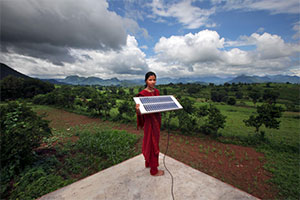 Bringing clean energy to rural India. Credit: Abbie Trayler-Smith / Panos Pictures / Department for International Development
Large reserves of oil, gas and minerals in developing countries generate opulent revenues. They could be used to stimulate economic growth and reduce poverty, but often result in environmental destruction and conflict, benefiting large companies and corrupt governments. Furthermore, competition over natural resources often manifests through geopolitical conflict. For example, before the US-Iraq war, Iraq’s domestic oil industry was nationalized. With US aggression came weakened Iraqi institutions and foreign intervention, thus eventually leading to the privatization of Iraqi oil, leaving the industry now largely dominated by Western companies. As another example, China’s rising investments within the lithium sector in South America are increasing the US-China rivalry across the Western Hemisphere. Notably, Bolivia has the largest reserves of lithium in the world, and the nation’s state-owned lithium extraction firm recently signed a contract with China’s CBC Consortium, while rejecting the entry of Western firms into the nation. In Bolivia’s case, rising Chinese investment in the nation’s lithium sector also raises concerns about environmental sustainability and the sociopolitical rights of Indigenous communities. More broadly, Sub-Saharan Africa holds nearly 30% of global reserves of critical minerals required for low-carbon technologies. Despite this, the region attracts less than 10% of global exploration investment, depicting a critical barrier to both the clean energy transitions and Sub-Saharan Africa’s economic development. Furthermore, resource wealth continues to fuel conflict like Sudan’s civil war, which has led to 9.1 million internally displaced people and is intensely connected to competition over gold, water, and agricultural land. IPS covers news about major oil, gas, and mining projects, their effects on the environment and local communities, and the ideas and actions of the interest groups involved.

The Week with IPS

NEXT STOP - SDGs
Tracking global progress towards a sustainable world
Tracking global progress towards a sustainable world
