Languages
Wednesday, August 26, 2026



News and Views from the Global South
Natural Resources
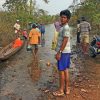
Drowning for Progress in Cambodia
Suddenly the road ends. The cart track disappears under the water. A vast lake stretches out in front of me. I have to transfer from a motorbike to a canoe. "Tuk laang," my guide says coolly. "The water is rising."
Washington’s Ambiguity Equals De Facto Sanctions On Teheran
Over the last few months, the United States’ rhetoric on the Iran nuclear agreement has been ambiguous, creating an uncertain environment for investors. With John Bolton, President Donald Trump has now appointed a national security adviser who is actively seeking to leave the Iran deal.
A Whole New Decade for Water
As old and new challenges continue to threaten its access, the UN has dedicated the next decade in order to protect a crucial but fragile natural resource: water.
Governance is key to boosting intra-Africa trade of timber products, says report by African Natural Resources Centre, African Development Bank
A new report by the African Natural Resources Centre of the African Development Bank has stressed the importance of forestry governance to boosting intra-African trade of wood products.
High and Dry: Can We Fix the World’s Water Crisis?
April 12 is expected to be the infamous “Day Zero” in South Africa’s second largest city of Cape Town, a tourist hub which attracts millions of visitors every year.
A Breath of Fresh Air in India
With India’s citizens clamouring for breathable air and efficient energy options, the country’s planners are more receptive than ever to explore sustainable development options, says Frank Rijsberman, Director-General of the Global Green Growth Institute (GGGI).
Latin American Indigenous People Fight New Plunder of Their Resources
Indigenous communities in Latin America, who have suffered the plunder of their natural resources since colonial times, are reliving that phenomenon again as mega infrastructure are jeopardising their habitat and their very survival.
Water Scarcity: India’s Silent Crisis
As Cape Town inches towards ‘Zero Hour’ set for July 15, 2018, the real threat of water scarcity is finally hitting millions of people worldwide. For on that day, the South African city's 3.78 million citizens -- rich and poor, young and old, men and women -- will be forced to queue up with their jerry cans at public outlets for their quota of 25 litres of water per day.
Water Stress Poses Greatest Threat to MENA Region
This year, World Water Day, celebrated annually on 22 March, is themed “Nature for Water”, examining nature-based solutions (NBS) to the world’s water problems.
How Can the Large-Scale Poaching in the South Atlantic Be Stopped?
The capture of a Spanish vessel illegally fishing in the so-called Argentine Sea made headlines, once again, although it is not news that hundreds of boats regularly pillage the South Atlantic, taking advantage of the lack of regulations and controls.
Women Miners Stake a Claim in Zimbabwe
Tapiwa Moyo, 40, religiously leaves her home each day when the first cock crows and joins a throng of women who have taken up artisanal mining in her community.
Three Things Cape Town Teaches Us About Managing Water
Cape Town has always been water insecure. The city has done some things well to prepare for a situation like this, but if the drought has shown us something, it is that you need to get everything right and have some luck on top to get out unscathed when the unexpected actually happens.
Keeping Jewelry Companies Accountable: Where Do Our Gold and Diamonds Come From?
How many people know where their gold and diamond jewelry comes from? How many people consider the human cost of its production?
Inclusive Green Growth Must Shape Thailand’s Future, Says GGGI Chief
Energy efficiency in industries presents a unique opportunity for Thailand’s environmental and economic policies as regional trends push towards more inclusive and sustainable green cities for the country and its neighbors, says the Director-General of the Global Green Growth Institute (GGGI) Dr. Frank Rijsberman.
Dung-Eating Earthworms Restore Soil Nutrients in Bangladesh
In Kaliganj village, 20 kilometres south of Rangpur city in Bangladesh, small farmers are turning to vermicomposting after crop yields started dropping. The problem was that soil fertility eroded due to organic nutrient depletion.
UN Refugee Agency Calls for Aid and Peace in South Sudan
As South Sudan quickly becomes Africa’s largest refugee and humanitarian crisis, the world must come to its aid, said the UN refugee agency. The UN Refugee Agency (UNHCR) has launched a global appeal to support displaced persons amid South Sudan’s rapidly deteriorating humanitarian situation.
Women on the Front Lines of Halting Deforestation
In Zimbabwe, the bulk of rural communities and urban poor still get their energy supplies from the forests, leading to deforestation and land degradation.
Can Drought Be Prevented? Slovakia Aims to Try
A landmark programme to combat drought set to be implemented in the small Central European country of Slovakia could be an inspiration for other states as extreme weather events become more frequent, the environmental action group behind the plan has said.
40% of India’s Thermal Power Plants in Water-Scarce Areas, Threatening Shutdowns
New WRI research finds that 40 percent of the country’s thermal power plants are located in areas facing high water stress, a problem since these plants use water for cooling. Scarce water is already hampering electricity generation in these regions—14 of India’s 20 largest thermal utilities experienced at least one shutdown due to water shortages between 2013-2016, costing the companies $1.4 billion.
Argentina Pursues the Lithium Dream
The government of Mauricio Macri dreams of Argentina becoming the world leader in lithium production. But it does not seem so clear that this aspiration, underpinned by the interest of multinational corporations, would also drive the development of local communities.
The Data Revolution Should Not Leave Women and Girls Behind
If there is one political principle that has been constant throughout the history of human civilization it is the fact that land is power. This is something that is particularly true, and often painfully so, for women who farm in Africa.« Previous Page — Next Page »


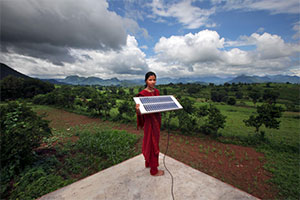 Bringing clean energy to rural India. Credit: Abbie Trayler-Smith / Panos Pictures / Department for International Development
Large reserves of oil, gas and minerals in developing countries generate opulent revenues. They could be used to stimulate economic growth and reduce poverty, but often result in environmental destruction and conflict, benefiting large companies and corrupt governments. Furthermore, competition over natural resources often manifests through geopolitical conflict. For example, before the US-Iraq war, Iraq’s domestic oil industry was nationalized. With US aggression came weakened Iraqi institutions and foreign intervention, thus eventually leading to the privatization of Iraqi oil, leaving the industry now largely dominated by Western companies. As another example, China’s rising investments within the lithium sector in South America are increasing the US-China rivalry across the Western Hemisphere. Notably, Bolivia has the largest reserves of lithium in the world, and the nation’s state-owned lithium extraction firm recently signed a contract with China’s CBC Consortium, while rejecting the entry of Western firms into the nation. In Bolivia’s case, rising Chinese investment in the nation’s lithium sector also raises concerns about environmental sustainability and the sociopolitical rights of Indigenous communities. More broadly, Sub-Saharan Africa holds nearly 30% of global reserves of critical minerals required for low-carbon technologies. Despite this, the region attracts less than 10% of global exploration investment, depicting a critical barrier to both the clean energy transitions and Sub-Saharan Africa’s economic development. Furthermore, resource wealth continues to fuel conflict like Sudan’s civil war, which has led to 9.1 million internally displaced people and is intensely connected to competition over gold, water, and agricultural land. IPS covers news about major oil, gas, and mining projects, their effects on the environment and local communities, and the ideas and actions of the interest groups involved.

The Week with IPS

NEXT STOP - SDGs
Tracking global progress towards a sustainable world
Tracking global progress towards a sustainable world
