Languages
Thursday, August 27, 2026



News and Views from the Global South
Natural Resources

How to Eradicate Rural Poverty, End Urban Malnutrition – A New Approach
Population growth, increasing urbanisation, modern technologies, and climate change are transforming the world at a fast pace. But what direction are these transformations headed in? Are they benefitting the poor and the food insecure? And will the food systems of the future be able to feed and employ the millions of young people poised to enter labour markets in the decades to come?
Mercury Mining Awaits International Control in Mexico
For environmentalist Patricia Ruiz the only word that comes to mind is “devastating,” when describing the situation of mercury mining in her home state of Querétaro in central Mexico.
World Hunger on the Rise Again
Exacerbated by climate-related shocks, increasing conflicts have been a key driver of severe food crisis and recently re-emerged famines, a major United Nations joint report has just revealed.
Alert: Nature, on the Verge of Bankruptcy
Pressures on global land resources are now greater than ever, as a rapidly increasing population coupled with rising levels of consumption is placing ever-larger demands on the world’s land-based natural capital, warns a new United Nations report.
Europe, New Border of Africa’s ‘Great Desert’ – The Sahara
 With the highest temperatures on record and unprecedented heat waves hitting Europe this year, Africa’s ‘Great Desert’, the Sahara, is set continue its relentless march on the Southern European countries until it occupies more than 30 per cent of Spain just three decades from now.

Towards a Resource Efficient and Pollution Free Asia-Pacific
Senior government officials from across Asia and the Pacific will meet in Bangkok this week for the first-ever Asia-Pacific Ministerial Summit on the Environment. The high-level meeting is co-convened by the United Nations Economic and Social Commission for Asia and the Pacific (UN ESCAP) and UN Environment and is a unique opportunity for the region’s environment leaders to discuss how they can work together towards a resource efficient and pollution-free Asia-Pacific.
Climate-Smart Agriculture Urgently Needed in Africa
Africa contributes only 4 per cent of global greenhouse gas emissions, while six of the 10 most affected countries by climate change are in Africa, warns a major agricultural research for development partnership, while stressing the urgent need to scale up climate-smart agriculture, improve forestry and transform the productivity of water use.
Protecting Africa’s Drylands Key to the Continent’s Future
Africa’s population continues to grow, putting intense pressure on available land for agricultural purposes and life-supporting ecosystem services even as the scenario is compounded by the adverse impacts of climate change.
Geothermal – a Key Source of Clean Energy in Central America
Energy from the depths of the earth - geothermal - is destined to fuel renewable power generation in Central America, a region with great potential in this field.
Jordan Makes Strides Toward Inclusive Green Economy
Jordan may be one of the smallest economies in the Middle East, but it has high ambitions for inclusive green growth and sustainable development despite the fact that it lies in the heart of a region that has been long plagued with wars and other troubles, says the Director-General of the Global Green Growth Institute (GGGI) Dr. Frank Rijsberman.
Can the Gender Gap Be Measured in Dollars Only?
Until a decade or so ago, experts and world organisations measured the impact of natural and man-made disasters in terms of human losses. For instance, they would inform about the number –and suffering—of human beings falling victims of extraordinary floods, droughts, heat or cold waves, and armed conflicts. This is not the case anymore.
Collectively Managing South Asia’s Stressed Water Resources
Experts and policymakers here say regional cooperation is a must to resolve long-standing water problems in South Asian countries like Bangladesh, Bhutan, China, India and Nepal, and to harness the full value of water.
Water Is Precious, Fragile and Dangerous – It Can Sustain or Destroy
Water is precious, fragile, and dangerous. It can sustain or destroy.
Value of Water Is on the Rise
In the wake of recent water-related disasters in Bangladesh, including water-logging and floods that displaced thousands of families, a high-level consultation in the capital Dhaka on valuing water will look at ways to optimize water use and solutions to water-related problems facing South Asia.
2 Billion People Don’t Have Access To Clean Water, Opens up Fissures of Inequality
More than two billion people lack access to clean and safe drinking water, according to a new report released by the World Health Organisation (WHO).
Any Way to Help Slow Down Climate Change… Individually?
It is no secret that the biggest responsible for climate change is greed. The greed of the world’s largest private corporations, which blindly seek unlimited high financial benefits. And the greed of those politicians who are also blindly keen about holding their temporary power at any cost, thus not daring to challenge big business. Ordinary people can meanwhile help slow down such a hellish race.

The World Is Burning
Record high temperatures are gripping much of the globe and more hot weather are to come. This implies more drought, more food insecurity, more famine and more massive human displacements.
Children Now More Than Half of the 65 Million Displaced
Around 20 people are newly displaced every minute of the day, according to a new report. In its annual Global Trends report, the UN’s refugee agency UNHCR has recorded unprecedented and concerning levels of displacement around the world.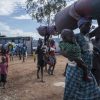
New Inhumane Record: One Person Displaced Every Three Second
Nearly 66 million people were forcibly displaced from their homes last year, the United Nation refugee agency has reported.
Africa: Drought and Jobless, Hopeless Youth, Fertile Grounds for Extremism
Ignoring the plight of jobless young people in sub-Saharan Africa is a recipe for political instability and global insecurity, warned a high-level symposium of Africa’s interior, environment and foreign affairs ministers in Ouagadougou, Burkina Faso.
Safeguarding Precious Crop Genes in Trust for Humanity
A genetic resource centre run by the Nigeria-based International Institute for Tropical Agriculture (IITA) has banked thousands of crop varieties for disaster relief and research, holds the world’s largest and most diverse collection of cowpeas, and contains some of Africa’s rarest insect species.« Previous Page — Next Page »


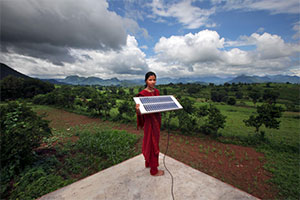 Bringing clean energy to rural India. Credit: Abbie Trayler-Smith / Panos Pictures / Department for International Development
Large reserves of oil, gas and minerals in developing countries generate opulent revenues. They could be used to stimulate economic growth and reduce poverty, but often result in environmental destruction and conflict, benefiting large companies and corrupt governments. Furthermore, competition over natural resources often manifests through geopolitical conflict. For example, before the US-Iraq war, Iraq’s domestic oil industry was nationalized. With US aggression came weakened Iraqi institutions and foreign intervention, thus eventually leading to the privatization of Iraqi oil, leaving the industry now largely dominated by Western companies. As another example, China’s rising investments within the lithium sector in South America are increasing the US-China rivalry across the Western Hemisphere. Notably, Bolivia has the largest reserves of lithium in the world, and the nation’s state-owned lithium extraction firm recently signed a contract with China’s CBC Consortium, while rejecting the entry of Western firms into the nation. In Bolivia’s case, rising Chinese investment in the nation’s lithium sector also raises concerns about environmental sustainability and the sociopolitical rights of Indigenous communities. More broadly, Sub-Saharan Africa holds nearly 30% of global reserves of critical minerals required for low-carbon technologies. Despite this, the region attracts less than 10% of global exploration investment, depicting a critical barrier to both the clean energy transitions and Sub-Saharan Africa’s economic development. Furthermore, resource wealth continues to fuel conflict like Sudan’s civil war, which has led to 9.1 million internally displaced people and is intensely connected to competition over gold, water, and agricultural land. IPS covers news about major oil, gas, and mining projects, their effects on the environment and local communities, and the ideas and actions of the interest groups involved.

The Week with IPS

NEXT STOP - SDGs
Tracking global progress towards a sustainable world
Tracking global progress towards a sustainable world
