Languages
Sunday, August 30, 2026



News and Views from the Global South
Natural Resources
Asia’s Rising Prosperity, Climate Change Taking Toll on Food Security
Asia’s economic growth over the last decade has been relentless, bringing with it a rising population and an influx of people from the countryside to the cities in search of prosperity. These trends are not expected to abate.
Grim News from Cape Grim puts Australians on Alert
There's some grim news in the media now, if you read newspapers or surf the internet, and it's coming from a scientific CO2 monitoring station in Tasmania situated on Cape Grim there. But more on this later, a few paragraphs down. First the good news, if it can be called that.
Fences and Walls: A Short-sighted Response to Migration Fears?
European nations from which millions once left to escape hardship and hunger – Greece, Ireland, Italy - are today destinations for others doing the same.
Building Africa’s Energy Grid Can Be Green, Smart and Affordable
It’s just after two p.m. on a sunny Saturday and 51-year-old Moses Kasoka is seated outside the grass-thatched hut which serves both as his kitchen and bedroom.
Drought Dries Up Money from Honey
“It is everything” is how smallholder farmer Nyovane Ndlovu describes beekeeping, which has long been an alternative sweet source of income for drought-beaten farmers in Zimbabwe.
Climate-Proofing Agriculture Must Take Centre Stage in African Policy
After over a year of extreme weather changes across the world, causing destruction to homes and lives, 2015-16 El Niño has now come to an end.
Seeds for Supper as Drought Intensifies in South Madagascar
Havasoa Philomene did not have any maize when the harvesting season kicked off at the end of May since like many in the Greater South of Madagascar, she had already boiled and eaten all her seeds due to the ongoing drought.
Bougainville Women Turn Around Lives of ‘Lost Generation’
Finding a sense of identity and purpose, as well as employment are some of the challenges facing youths in post-conflict Bougainville, an autonomous region in eastern Papua New Guinea in the southwest Pacific Islands.
Water Scarcity Could Impact West Asian Credit Ratings
Water scarcity, conflict and refugee exodus is the strongest megatrend in West Asia, indicating the status of current trends and how these factors may shape the future, according to UN Environment Programme’s sixth Global Environment Outlook - GEO-6 Regional Assessment for West Asia released May 2016.
Uruguay Seeks Future as Oil Producer in Ultra-Deep Waters
Uruguay is just weeks away from finding out if it will have a chance to stop being totally reliant on oil imports at some point in the future, when the first offshore exploration well in national waters – which set a new world record in terms of water depth - is completed.
‘What Can We Do for You?’ Aid Projects Pour Into Myanmar
International aid agencies, big and small, are beating a path to Myanmar, relishing the prospect of launching projects in a nation of 51 million people tentatively emerging from more than five decades of military rule.
New Protocol Aims to Cut Trillion-Dollar Food Waste Bill
Four years ago, 27-year-old Tsering Dorji of western Bhutan’s Satsam village took to organic vegetable farming. Since then, thanks to composted manure and organic pesticide, the soil health of his farm has improved, and the yield has increased manifold.
Polynesian Voyagers Bring Messages of Hope to UN on World Oceans Day
Polynesian voyagers who have sailed the world by canoe using ancient navigation skills will bring pledges they collected along the way to the UN on Wednesday as part of World Oceans Day celebrations.
Coral Reef Tourism in Danger as Reefs Struggle to Adapt to Warming
A recent UN Educational, Scientific and Cultural Organization (UNESCO) report on world heritage sites in danger from climate change received widespread media attention after the Australian government requested the removal of a chapter on the Great Barrier Reef.
Q&A: Crisis and Climate Change Driving Unprecedented Migration
Climate change is now adding new layers of complexity to the nexus between migration and the environment.
Golden Rice: The Malnutrition Fighting Crop
Over the past two decades, Bangladesh has remarkably managed to feed an increasing population better - the UN's Food and Agricultural Organization estimates that in 1993, the average Bangladeshi had access to just 2,000 calories per day, whereas today that number has increased to 2,450 calories per day. To a large extent, this success comes on the back of ever-higher rice production - rice makes up 70 percent of the average daily calorie intake.Climbing the Knowledge Ladder
After the Paris Agreement on climate change endorsed by every participating country last December at the 21st Conference of Parties (COP21) of the United Nations Convention in Climate Change (UNFCCC), all the participants , including both developing as well as developed countries, have to put in place a clear strategy to not only reduce emissions of greenhouse gases through mitigation actions, but also to adapt to the adverse impacts of human-induced climate change.
World Oceans Day – A Death Sea Called Mediterranean
While the United Nations identifies 17 major regional seas in its planning, the Mediterranean is perhaps the most dramatic case as it has gone from being the so-called cradle of civilization to be a cemetery for thousands of asylum-seekers and migrants. And it is most probably also the most polluted water basin the whole world. See this report.
Mega Dams Remain Controversial Source of Energy
Although mega dams can have devastating impacts on ecosystems and indigenous communities, many of the world’s poorest countries still see them as a way to fill gaping holes in their energy supplies.Wildlife Trafficking Needs to Be a Policy Priority in Asia Pacific Before It Is Too Late
This year’s World Environment Day on June 5 puts the spotlight on the illegal trade in wildlife. The problem has particular significance in Asia, which is the destination for most of the ivory taken from 20,000 to 25,000 elephants and the horns of more than 1,200 rhinos killed in Africa every year. Demand in the region is driven by fast growing middle and upper classes with an appetite for exotic pets, décor, food and fashion.
Battered by Storms, Sri Lanka Rethinks Food Security
The picture could be straight out of a tourist postcard – a sleepy green mountain with misty clouds floating above the canopy – if not for one fatal flaw: the ugly gash running right through the middle.« Previous Page — Next Page »


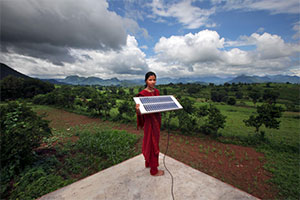 Bringing clean energy to rural India. Credit: Abbie Trayler-Smith / Panos Pictures / Department for International Development
Large reserves of oil, gas and minerals in developing countries generate opulent revenues. They could be used to stimulate economic growth and reduce poverty, but often result in environmental destruction and conflict, benefiting large companies and corrupt governments. Furthermore, competition over natural resources often manifests through geopolitical conflict. For example, before the US-Iraq war, Iraq’s domestic oil industry was nationalized. With US aggression came weakened Iraqi institutions and foreign intervention, thus eventually leading to the privatization of Iraqi oil, leaving the industry now largely dominated by Western companies. As another example, China’s rising investments within the lithium sector in South America are increasing the US-China rivalry across the Western Hemisphere. Notably, Bolivia has the largest reserves of lithium in the world, and the nation’s state-owned lithium extraction firm recently signed a contract with China’s CBC Consortium, while rejecting the entry of Western firms into the nation. In Bolivia’s case, rising Chinese investment in the nation’s lithium sector also raises concerns about environmental sustainability and the sociopolitical rights of Indigenous communities. More broadly, Sub-Saharan Africa holds nearly 30% of global reserves of critical minerals required for low-carbon technologies. Despite this, the region attracts less than 10% of global exploration investment, depicting a critical barrier to both the clean energy transitions and Sub-Saharan Africa’s economic development. Furthermore, resource wealth continues to fuel conflict like Sudan’s civil war, which has led to 9.1 million internally displaced people and is intensely connected to competition over gold, water, and agricultural land. IPS covers news about major oil, gas, and mining projects, their effects on the environment and local communities, and the ideas and actions of the interest groups involved.

The Week with IPS

NEXT STOP - SDGs
Tracking global progress towards a sustainable world
Tracking global progress towards a sustainable world
