Languages
Saturday, August 29, 2026



News and Views from the Global South
Natural Resources

Newly Empowered Black Farmers Ruined by South Africa’s Drought
Almost half a decade of drought across most of South Africa has led to small towns in crisis and food imports for the first time in over 20 years, as well as severely hampering the government’s planned land redistribution programme.
Chronic Hunger Lingers in the Midst of Plenty
In a fraught global economic environment, exacerbated by climate change and shrinking resources, ensuring food and nutrition security is a daunting challenge for many nations. India, Asia's third largest economy and the world's second most populous nation after China with 1.3 billion people, is no exception.List of Acts President Must Do for Disaster Risk Reduction and Management
President Rody Dutuerte’s SONA could not possibly give details about every important program of his administration. But a SONA does mark for the people which activities a president thinks should be given top priority.
Climate Migrants Lead Mass Migration to India’s Cities
Deepa Kumari, a 36-year-old farmer from Pithoragarh district in the Himalayan state of Uttarakhand, lives in a one-room tenement in south Delhi's Mongolpuri slum with her three children. Fleeing devastating floods which killed her husband last year, the widow landed up in the national capital city last week after selling off her farm and two cows at cut-rate prices.
Fertilizer Access Grows Farmers, Food and Finance
Brightly coloured cans, bags of fertilizer and packets containing all types of seeds catch the eye upon entering Nancy Khorommbi’s agro dealer shop tucked at the corner of a roadside service station.
Economic Recovery Needed To Enhance Food Security
After a half century of decline, agricultural commodity prices rose with oil prices in the 1970s, and again for a decade until 2014. Food prices rose sharply from the middle of the last decade, but have been declining since 2012, and especially since last year, triggering concerns of declining investments by farmers.
Fast-track Development Threatens to Leave Indigenous Peoples Behind
Fast-tracked development often means that indigenous people and their territories get run over and their rights are not taken into consideration, Roberto Borrero, from the International Indian Treaty Council and Indigenous Peoples Major Group, said here Friday.
Rewriting Africa’s Agricultural Narrative
Albert Kanga Azaguie no longer considers himself a smallholder farmer. By learning and monitoring the supply and demand value chains of one of the country’s staple crops, plantain (similar to bananas), Kanga ventured into off-season production to sell his produce at relatively higher prices.
What can Development Banks do to Protect Human Rights?
In a petition signed by 150 NGOs, the Coalition for Human Rights in Development have called for development banks to make sure that human rights are respected by their beneficiaries.
What Does it Really Mean to “Leave No One Behind”?
Although “leave no one behind” has become a central rallying cry around the UN's Sustainable Development Goals, more needs to be done for it to be put into practice, civil society said during a review conference of progress made on the Post-2030 agenda here this week.
Large-Scale Rainwater Harvesting Eases Scarcity in Kenya
Rainwater harvesting in Kenya and other places is hardly new. But in this water-stressed country, where two-thirds of the land is arid or semiarid, the quest for a lasting solution to water scarcity has driven useful innovations in this age-old practice.
Record High Seafood Consumption Not Sustainable, Warns UN
The UN's Food and Agricultural Organisation (FAO) warned Thursday that global fish stocks cannot keep up with record consumption, with the average person now consuming 20 kilograms of fish a year.
Biogas Brings Heat and Light to Pakistan’s Rural Poor
Nabela Zainab no longer chokes and coughs when she cooks a meal, thanks to the new biogas-fueled two-burner stove in her kitchen.
Making Sustainability Part of the Corporate DNA
Companies, governments and non-profit actors agree that economic growth and sustainable development have to go hand in hand to shape our increasingly globalised world in a fair way.
Can Better Technology Lure Asia’s Youth Back to Farming?
Farming and agriculture may not seem cool to young people, but if they can learn the thrill of nurturing plants to produce food, and are provided with their favorite apps and communications software on agriculture, food insecurity will not be an issue, food and agriculture experts said during the Asian Development Bank (ADB)’s Food Security Forum from June 22 to 24 at the ADB headquarters here.
Least Developed Countries’ Vulnerabilities Make Graduation Difficult
Last month, over two thousand high-level participants from across the world met in Antalya, Turkey for the Midterm Review of the Istanbul Programme of Action, an action plan used to guide sustainable economic development efforts for Least Developed Countries for the 2011 to 2020 period. The main goal was to understand the lessons learnt by the world’s Least Developed Countries (LDCs) over the past five years and apply the knowledge moving forward.
Cotton Crisis
Pakistan’s economy is in grave trouble. According to the Pakistan Economic Survey 2015-16, it failed to meet the growth target of 5.5pc in FY2016. GDP grew by 4.7 pc. This was mainly due to the ‘major setback’ (to use the finance minister’s words) in agriculture.
African Fisheries Plundered by Foreign Fleets
In 2011, Dyhia Belhabib was a volunteer in the Fisheries Centre at the University of British Columbia in Vancouver when she was asked to participate in the Sea Around Us’s project to determine how much fish had been taken out of the world’s oceans since 1950 in order to better avoid depleting the remaining populations of fish.
Latin America and the Caribbean: What does it take to prevent people from falling back into poverty
Latin America and the Caribbean countries have experienced historic economic and social transformation in recent years. This has led to a considerable reduction in poverty and inequality and to advances in closing gender, labor and education gaps. These achievements are the result of a favorable economic environment as well as proactive social inclusion policies.
Aquaculture Meets Agriculture on Bangladesh’s Low-Lying Coast
A continuous influx of sea water is threatening agriculture and food security in vast coastal areas of Bangladesh, but farmers are finding ways to adapt, like cultivating fish and crops at the same time.
The Environment: Latin America’s Battleground for Human Rights
2015 was the deadliest year on record for the killings of environmental activists around the world, according to a new Global Witness report.« Previous Page — Next Page »


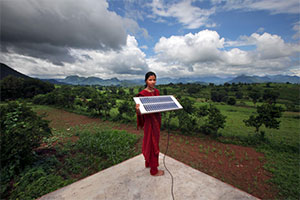 Bringing clean energy to rural India. Credit: Abbie Trayler-Smith / Panos Pictures / Department for International Development
Large reserves of oil, gas and minerals in developing countries generate opulent revenues. They could be used to stimulate economic growth and reduce poverty, but often result in environmental destruction and conflict, benefiting large companies and corrupt governments. Furthermore, competition over natural resources often manifests through geopolitical conflict. For example, before the US-Iraq war, Iraq’s domestic oil industry was nationalized. With US aggression came weakened Iraqi institutions and foreign intervention, thus eventually leading to the privatization of Iraqi oil, leaving the industry now largely dominated by Western companies. As another example, China’s rising investments within the lithium sector in South America are increasing the US-China rivalry across the Western Hemisphere. Notably, Bolivia has the largest reserves of lithium in the world, and the nation’s state-owned lithium extraction firm recently signed a contract with China’s CBC Consortium, while rejecting the entry of Western firms into the nation. In Bolivia’s case, rising Chinese investment in the nation’s lithium sector also raises concerns about environmental sustainability and the sociopolitical rights of Indigenous communities. More broadly, Sub-Saharan Africa holds nearly 30% of global reserves of critical minerals required for low-carbon technologies. Despite this, the region attracts less than 10% of global exploration investment, depicting a critical barrier to both the clean energy transitions and Sub-Saharan Africa’s economic development. Furthermore, resource wealth continues to fuel conflict like Sudan’s civil war, which has led to 9.1 million internally displaced people and is intensely connected to competition over gold, water, and agricultural land. IPS covers news about major oil, gas, and mining projects, their effects on the environment and local communities, and the ideas and actions of the interest groups involved.

The Week with IPS

NEXT STOP - SDGs
Tracking global progress towards a sustainable world
Tracking global progress towards a sustainable world
