Languages
Monday, September 7, 2026



News and Views from the Global South
Natural Resources

Agroecology in Africa: Mitigation the Old New Way
Millions of African farmers don’t need to adapt to climate change. They have done that already.
Water, Water Everywhere but Too Much or Too Little
“Water is at the core of the Lima-Paris Action Agenda (LPAA), but it is true that for a long time water and oceans issues have been marginalized in climate conferences, considering that 90 per cent of natural catastrophes are linked to water and 40 per cent of global population will face water scarcity from now to 2050,” stated Marie-Ségolène Royal, French Minister of Ecology, Sustainable Development and Energy, during the press conference at the launch of the #ClimateIsWater initiative at COP21. “It is through water that it is possible to measure climate change impacts,” she said.
‘Good, But Not Perfect’, Pacific Islands Women on Climate Deal
Women leaders in the Pacific Islands have acclaimed the agreement on reducing global warming achieved at the United Nations (COP21) Climate Change conference in Paris as an unprecedented moment of world solidarity on an issue which has been marked to date by division between the developing and industrialized world. But for Pacific small island developing states, which name climate change as the single greatest threat to their survival, it will only be a success if inspirational words are followed by real action.
Credit Innovation has a Key Role in Bangladesh’s Climate Change Adaptation
Expected climate change makes improving agricultural practices even more important than many already suggest, according to a new study of Bangladesh, considered one of the most at-risk nations from rising temperatures.
Kitchen Gardens are Victory Gardens in Boosting Nutrition and Incomes in Western Kenya
Busia County in western Kenya is home to an array of indigenous vegetables. But for decades there has been a shift in popular taste leading to leading to little interest in what is indigenously grown. This relegated the vegetables to the periphery with most farmers cultivating kale and cabbages among other more exotic varieties.American Mining Giant Escaped Indonesian Law with ISDS
If you want to make your developing country more attractive for foreign investors, try signing bilateral investment treaties (BITs) with rich countries. With these treaties countries promise to look after each others' investors.
Initiatives Revive Palestinian Heritage Boosting Economy and ‘Homeland’
Deep into the subtly monochrome landscape of the southern West Bank, Abu Ismaeel’s tent stands out amongst bare rolling hills that stretch into the horizon. A lonely gate, with no fence around it, signals the official entrance to two large tents in the Rashayda Desert.French firm attacks Ugandan tax using ISDS
The heavily criticized legal mechanism, known as ISDS, is an important tool for European companies to pressurize developing countries. This year Uganda joins the rank of developing nations asking themselves: "Why have we ever signed this?"
Mexican Government Ignores Social Impact of Energy Projects
Mexico’s hydrocarbons law stipulates that oil contracts must include a social impact assessment. But this has not been done in the case of the oilfields granted to the country’s former oil monopoly, Pemex, or to private companies since the industry was opened up to private investment.
Indigenous Villagers Fight “Evil Spirit” of Hydropower Dam in Brazil
At dusk on the Tapajós River, one of the main tributaries of the Amazon River in northern Brazil, the Mundurukú indigenous people gather to bathe and wash clothes in these waters rich in fish, the staple of their diet. But the “evil spirit”, as they refer in their language to the Sao Luiz Tapajós dam, threatens to leave most of their territory – and their way of life – under water.Farmers, CSOs Rally Behind Environmentalist Jailed for Exposing Land Grabbing in Cameroon
Farmers and activists in Cameroon say a jail sentence handed down on an environmentalist who exposed land-grabbing by a multinational agro-industrial company, sends a dangerous signal to communities trying to protect their land and resources.
Pacific Islands’ Marine Reserve: Safe Haven for Depleted Tuna and New Holiday Spot
President Tommy Remengesau Jr. of the Pacific island nation of Palau has cemented a legacy as the world’s most effective protector of marine life by creating a giant marine reserve that will directly benefit his people through increasing tourism and securing its food supply, scientists say.
Paris Delivers Historic Climate Treaty, but Leaves Gender Untouched
After 2 weeks of intense negotiations, on Saturday evening, the 21st UN climate conference (COP21) in Paris finally delivered a historic agreement that, for the first time, promises to keep the global warming under 2 degrees Celsius. The treaty, consisting 31 pages and signed by by 196 countries, include the big five steps of climate action:
Paris Delivers the Promised Climate Deal to Resounding Cheer and Applause
The impossible was made possible. Governments from 195 countries around the world emerged here with the first universal agreement to cut greenhouse gases emissions and reduce the negative impacts of climate change.
Sargassum and Climate Change in the Caribbean
When the habitants of Puerto Morelos saw their white beaches turn brown, they felt they needed to take urgent action for their community. Given the limited effectiveness of the response, they organized themselves to clean public beaches, but the situation got worse.Tackling Climate Change in Africa: Europe’s Solution to the Migrant Crisis?
As thousands of Africans arrive in Europe every month, often risking their lives aboard shaky boats to get to a better life, lack of access to energy could be one of the reasons for their exodus.
Farmers to COP 21: Don’t Bite the Hand That Feeds You!
When Dr. Evelyn Nguleka says that the world’s people shouldn’t bite the hand that feeds them, she explains that she’s not only referring to protecting farmers, but also to safeguarding the environment.
Cities Emerge as Urgent Climate Solution at COP21
As the climate conference advances into its final stages amid the colossal challenge of having 195 countries agree on a single and unified global policy on climate change, urban areas appear a a different issue but complementary solution for all.
Climate Negotiators Discussing Warming and Migration Links
Stirred by the exodus of hundreds of thousands of refugees from Syria, where global warming exacerbated a drought that fueled warfare, links between climate change and human displacement have finally been thrust into news reports and political debates.
Peruvian Women Install Solar Panels and Light Up their Communities
Five women from Candarave Province, located in Tacna (Peru), travelled to India to be trained and to learn how to install solar panels. The training has enabled 272 families to have electricity and improve their quality of life.
Permeable Dams Prevent Land Loss and Save Mangroves in Suriname
Suriname’s coastline is eroding so quickly scientists predict the country’s maze of mangroves could disappear in just 30 years unless there is urgent action on climate change.« Previous Page — Next Page »


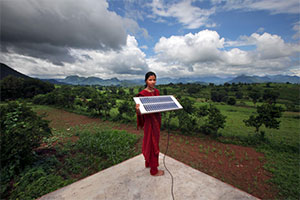 Bringing clean energy to rural India. Credit: Abbie Trayler-Smith / Panos Pictures / Department for International Development
Large reserves of oil, gas and minerals in developing countries generate opulent revenues. They could be used to stimulate economic growth and reduce poverty, but often result in environmental destruction and conflict, benefiting large companies and corrupt governments. Furthermore, competition over natural resources often manifests through geopolitical conflict. For example, before the US-Iraq war, Iraq’s domestic oil industry was nationalized. With US aggression came weakened Iraqi institutions and foreign intervention, thus eventually leading to the privatization of Iraqi oil, leaving the industry now largely dominated by Western companies. As another example, China’s rising investments within the lithium sector in South America are increasing the US-China rivalry across the Western Hemisphere. Notably, Bolivia has the largest reserves of lithium in the world, and the nation’s state-owned lithium extraction firm recently signed a contract with China’s CBC Consortium, while rejecting the entry of Western firms into the nation. In Bolivia’s case, rising Chinese investment in the nation’s lithium sector also raises concerns about environmental sustainability and the sociopolitical rights of Indigenous communities. More broadly, Sub-Saharan Africa holds nearly 30% of global reserves of critical minerals required for low-carbon technologies. Despite this, the region attracts less than 10% of global exploration investment, depicting a critical barrier to both the clean energy transitions and Sub-Saharan Africa’s economic development. Furthermore, resource wealth continues to fuel conflict like Sudan’s civil war, which has led to 9.1 million internally displaced people and is intensely connected to competition over gold, water, and agricultural land. IPS covers news about major oil, gas, and mining projects, their effects on the environment and local communities, and the ideas and actions of the interest groups involved.

The Week with IPS

NEXT STOP - SDGs
Tracking global progress towards a sustainable world
Tracking global progress towards a sustainable world
