Languages
Thursday, September 10, 2026



News and Views from the Global South
Natural Resources

Women Leaders agree COP21 Must Have “Gender-Responsive” Deal.
53-year old Aleta Baun of Indonesia’s West Timor province is a proud climate warrior. From 1995 to 2005 she successfully led a citizens’ movement to shut down 4 large marble mining companies that polluted and damaged the ecosystem of a mountain her community considered sacred. After their closure in 2006, she became a conservationist and restored 15 hectares of degraded mountain land, reviving dozens of dried springs and resettling 6,000 people who were displaced by the mining.
Solar Power Fuels Hope on Neglected Lagos island
For the first time in his 30 years on Sagbo Kodji Island, near Lagos, Friday Onos has electricity at home, thanks to a solar power project that could transform the lives of the island’s 80,000 inhabitants.
Draft in Hand, Ministers in Paris Enter Last Week of Climate Talks
Whatever effort there was made during the past four years to create a global legal architecture to combat climate change, its legacy will be defined in the forthcoming days.
Pakistan Moves to Stop Biodiversity Loss
Pakistan has framed a biodiversity conservation and protection plan aimed at stemming biodiversity loss, restoring ecosystems and promoting sustainable use of natural resources for the wellbeing of the present and the future generations.Africa Hangs its Agricultural Transformation Agenda on COP 21’s Outcome
A famous saying goes: To whom much is given, much is expected. This is the message that the African Development Bank (AfDB) is carrying and delivering for, and on behalf of Africa at the global conference on climate change, COP21, which opened Monday, 30th November.
Solar Kiosks Help Light up Rural Kenya
This market centre in the arid Lake Magadi region, Kajiado of Southern Kenya is with no grid electricity. The area is inhabited by the pastoralist Maasai community. With climate change affecting their pastoral way of life, the community is increasingly adopting a more sedentary life but without amenities.
Antigua: Surrounded by Sea but Catchments are Empty
Antiguan Veronica Yearwood no longer panics when she hears that the rainfall forecast for the tiny Caribbean island is again lower than average rainfall.
Vertical Farming – Agriculture of the Future
Infrared thermometer in hand, Nelson Pérez checks the water temperature in the trays where dozens of small lettuce plants are growing in a nutrient-rich liquid in this vertical farm in Panama.
Saving the Arctic Requires Action on Climate Change and Air Pollution
Arctic temperatures have increased twice as much as the global average in the past 100 years. Recent photos show that thousands of walruses normally resting on sea ice between dives to find food have been forced to crowd ashore because of extreme sea ice melt in Alaska. Such photos have once again reminded us that it is high time we take serious action on climate change if we want to save the Arctic.
Uganda, Tanzania Need Gender Sensitive Climate Change Policies
Climate Change needs to be at the top of the country’s agenda, according to a project examining Uganda’s policies. It says the country hasn’t paid enough attention to climate change in national development and agriculture plans and this needs to be turned around before it’s too late.
Climate Refugees and a Collapsing City
With multiplying impacts of climate change - increasing floods, cyclones, and drought - thousands of climate refugees are migrating to Dhaka. And the city, well beyond its carrying capacity, is bursting at the seams.
From Darkness to Light: Dramatic Rescue of Tanzanian Miners Trapped 41 Days in Rubble
The five artisanal miners who narrowly escaped death last week after a 41-day ordeal in a collapsed gold mine in northern Tanzania called their experience a living hell. They went through a myriad of emotions soon after having been freed.Africa’s Climate Change Funding May Hit 100 Billion by Mid-Century
When the Climate Summit opens in Paris next week, one of the biggest issues facing world leaders is funding: how best to raise the billions of dollars needed to prevent the devastating consequences of global warming worldwide.
Sinking into Paradise: Climate Change Worsening Coastal Erosion in Trinidad
As unusually heavy rainfall battered Trinidad's east coast a year ago, a lagoon here was overwhelmed, flooding a major access road to the island’s south-eastern communities. As the flood waters poured over Manzanilla beach, they washed sand away, caved in sections of road and collapsed a seawall at a tourist beach facility. Further damages were also incurred with the flooding of homes and agricultural plots.
Against the Odds, Caribbean Doubles Down for 1.5 Degree Deal in Paris
Negotiators from the 15-member Caribbean Community (CARICOM) are intent on striking a deal to keep the global temperature rise at 1.5 degrees of pre-industrial levels, but many fear that a 10-year-old agreement to buy cheap petroleum from Venezuela puts their discussions in jeopardy.
Aflatoxins: Poisoning Health and Trade in Sub-Saharan Africa
Aflatoxin contamination is a growing threat to trade, food and health security in sub-Saharan Africa, where smallholder farmers are challenged by food production and now climate change, researchers said.
Solar Power Keeps the Midnight Oil Burning at the University of Dodoma
Power cuts wreak havoc on most lives, but when you have an exam the next day and you have to do well, without light to study by you are stuck. But those dark days in the dorm may soon be over.
Opinion: Risks? What Risks?
We humans are acutely aware of risks. From our earliest times, the risks we faced were from hunger, predatory animals, extreme environmental conditions and, as our numbers grew, from other human tribes.
“Bringing Private Funds into Land Restoration is Risky”
The world loses 23 hectares to land degradation each and every minute, adding up to the disappearance of 12 million hectares worldwide – an area half the size of the UK.
Drinking Water Shortages Plague Pakistan Region
“We have to purchase water from the municipalities for our daily use. The water column has gone too deep and it is hard to pump out the commodity,” said Muhammad Shakir, a resident of Hayatabad, an upscale town in Peshawar, the capital of Khyber Pakhtunkhwa (KP).
African Experts Say the Continent Must Address Livestock Methane Emissions
Increasing calls for Africa to reduce methane emissions from livestock continue to be met with controversy, and livestock scientists say methane is a forgotten short-term climate pollutant with significant global warming potential that Africa cannot continue to overlook.« Previous Page — Next Page »


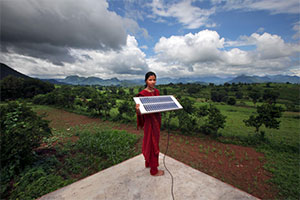 Bringing clean energy to rural India. Credit: Abbie Trayler-Smith / Panos Pictures / Department for International Development
Large reserves of oil, gas and minerals in developing countries generate opulent revenues. They could be used to stimulate economic growth and reduce poverty, but often result in environmental destruction and conflict, benefiting large companies and corrupt governments. Furthermore, competition over natural resources often manifests through geopolitical conflict. For example, before the US-Iraq war, Iraq’s domestic oil industry was nationalized. With US aggression came weakened Iraqi institutions and foreign intervention, thus eventually leading to the privatization of Iraqi oil, leaving the industry now largely dominated by Western companies. As another example, China’s rising investments within the lithium sector in South America are increasing the US-China rivalry across the Western Hemisphere. Notably, Bolivia has the largest reserves of lithium in the world, and the nation’s state-owned lithium extraction firm recently signed a contract with China’s CBC Consortium, while rejecting the entry of Western firms into the nation. In Bolivia’s case, rising Chinese investment in the nation’s lithium sector also raises concerns about environmental sustainability and the sociopolitical rights of Indigenous communities. More broadly, Sub-Saharan Africa holds nearly 30% of global reserves of critical minerals required for low-carbon technologies. Despite this, the region attracts less than 10% of global exploration investment, depicting a critical barrier to both the clean energy transitions and Sub-Saharan Africa’s economic development. Furthermore, resource wealth continues to fuel conflict like Sudan’s civil war, which has led to 9.1 million internally displaced people and is intensely connected to competition over gold, water, and agricultural land. IPS covers news about major oil, gas, and mining projects, their effects on the environment and local communities, and the ideas and actions of the interest groups involved.

The Week with IPS

NEXT STOP - SDGs
Tracking global progress towards a sustainable world
Tracking global progress towards a sustainable world
