Languages
Friday, September 18, 2026



News and Views from the Global South
Natural Resources

“Bringing Private Funds into Land Restoration is Risky”
The world loses 23 hectares to land degradation each and every minute, adding up to the disappearance of 12 million hectares worldwide – an area half the size of the UK.
Drinking Water Shortages Plague Pakistan Region
“We have to purchase water from the municipalities for our daily use. The water column has gone too deep and it is hard to pump out the commodity,” said Muhammad Shakir, a resident of Hayatabad, an upscale town in Peshawar, the capital of Khyber Pakhtunkhwa (KP).
African Experts Say the Continent Must Address Livestock Methane Emissions
Increasing calls for Africa to reduce methane emissions from livestock continue to be met with controversy, and livestock scientists say methane is a forgotten short-term climate pollutant with significant global warming potential that Africa cannot continue to overlook.
One-Third of Papua New Guineans Suffering Drought Crisis
An estimated one-third of the population of Papua New Guinea, the most populous Pacific Island state, is now suffering in from the country’s worst drought this century and experts predict El Nino’s influence will carry on through March 2016.
Improved Post-Harvest Fish Handling Brings Hope to Western Zambia
Hadon Sichali has been in the fish trade for over 22 years. But he says only now does he feel a true businessman—but why?
Africa Demands for More Input to Save the Climate
African civil society organisations championing for climate justice have criticised the Intended Nationally Determined Commitments (INDC’s) presented to the United Nations Framework Convention on Climate Change, calling them “weak, inadequate and not ambitious enough.”
Urgently Needed: Studies Linking Land Degradation, Migration, Conflict and Political Instability
Some 135 million people could be displaced by 2045 as a result of land desertification, according to a recent UK ministry of defence report. This figure could rise to 200 million who are displaced by other climate change impacts like natural disasters by 2050, said British environment refugee specialist Norman Myers.
Open Data – Still Closed to Latin American Communities
Open data policies in Latin America have not yet enabled communities to exercise their right to access to information, consultation and participation with regard to mining or infrastructure projects that affect their surroundings and way of life.
Zimbabwe’s Mega Dam Project Could Flounder in the Face of Climate Change
Zimbabwe's planned Batoka Gorge power project on the Zambezi River is expected to generate 2,400 megawatts (MW) of electricity, upward from an initial 1,600 MW, but the worsening power cuts that are being blamed on low water levels have renewed concerns about the effects of climate change on mega dams.
Opinion: The Broken Promises of the Peruvian Development Model
Lima was the host, in October 2015, of the International Monetary Fund (IMF) and the World Bank annual meetings. The two Bretton Woods institutions, criticized for their record of lowering social and environmental conditions, seek to showcase Peru as a success of their neoliberal policies and reforms to the rest of the world.
Cuba’s Extra-Heavy Crude Awaits Technology and Investment
Cuba's oil industry only exploits five percent of the petroleum found in onshore and offshore deposits due to a lack of foreign capital and technology to develop oilfields like Varadero 1000, the country's biggest oil operation until now.
Bangladesh Facing Tough Climate Choices
Twice a week, 20-year-old Kulsum Begam, a young mother of two, spends over three hours gossiping with the neighbours.
Opinion: It’s Time to Put Local Communities in Charge of Liberia’s Forests
Liberian President Ellen Johnson Sirleaf recently affirmed her commitment to the land rights of Liberia’s local communities, who rely on the forests for their livelihoods and have cared for them for generations.
Pakistan: Looking to Hydropower to Assure More Reliable Electricity
“We are lucky a local dam will give us cheap and uninterrupted power supply. Currently, we remain without electricity for 14-16 hours every day,” Muhammad Shafique, a schoolteacher in Upper Dir, told IPS.
Before Renewable Power Plant is Completed, Geothermal Overtakes Hydro in Kenya
In its quest to generate more reliable, climate-friendly electric energy, Kenya has become the first country in the world to make use of temporary geothermal wellheads, which are currently injecting an extra 56 megawatts into the national grid.
OPINION: Time to Reform the Global Casino
The year 2015 highlights the global shift from traditional money-based, gross domestic product (GDP)-measured economic growth to the new models of sustainable, inclusive human development embodied in the United Nations Sustainable Development Goals (SDGs) ratified by its 193 member nations.
In Hawaii, Concern Rises about Use of Farm Pesticides
Tammy Brehio stood on the back balcony of her home in Kihei on the island of Maui and pointed to a brown field a few hundred yards away.Opinion: Africa’s Agricultural Potential Begins on the Ground
My friend Kofi Boa is a Ghanaian agronomist who is probably the biggest advocate for conservation farming in Africa. For decades, Kofi has taught farmers how to increase their yields using no-till, cover crops and other techniques.
Opinion: Will African Leaders Fight for our Farmers?
Climate change is changing the world we know and love. Our land, homes and food are at risk. With nearly a billion people already living in poverty, it is also the single biggest threat to the fight against hunger.
ASEAN Agreement on Haze? As Clear as Smoke
A regional agreement on managing transboundary haze caused by fires raging in Indonesia’s forests and peatlands appears all but buried in the embers of frustration of its neighbouring countries.Opinion: It’s gettin’ hot in here…so take back all your carbon
Africa is getting hot fast. Already battling against the impacts of climate change, temperatures in Africa will rise faster than any other continent. In fact, they are expected to exceed 2 C and may reach as high as 6 C greater than 20th century levels. These rapidly rising temperatures foreshadow increased drought, famine and disease. The most vulnerable populations – of which millions are smallholder farmers – need solutions, and they need them now.« Previous Page — Next Page »


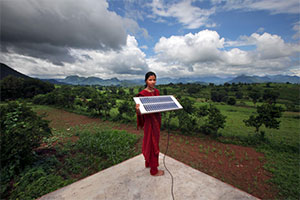 Bringing clean energy to rural India. Credit: Abbie Trayler-Smith / Panos Pictures / Department for International Development
Large reserves of oil, gas and minerals in developing countries generate opulent revenues. They could be used to stimulate economic growth and reduce poverty, but often result in environmental destruction and conflict, benefiting large companies and corrupt governments. Furthermore, competition over natural resources often manifests through geopolitical conflict. For example, before the US-Iraq war, Iraq’s domestic oil industry was nationalized. With US aggression came weakened Iraqi institutions and foreign intervention, thus eventually leading to the privatization of Iraqi oil, leaving the industry now largely dominated by Western companies. As another example, China’s rising investments within the lithium sector in South America are increasing the US-China rivalry across the Western Hemisphere. Notably, Bolivia has the largest reserves of lithium in the world, and the nation’s state-owned lithium extraction firm recently signed a contract with China’s CBC Consortium, while rejecting the entry of Western firms into the nation. In Bolivia’s case, rising Chinese investment in the nation’s lithium sector also raises concerns about environmental sustainability and the sociopolitical rights of Indigenous communities. More broadly, Sub-Saharan Africa holds nearly 30% of global reserves of critical minerals required for low-carbon technologies. Despite this, the region attracts less than 10% of global exploration investment, depicting a critical barrier to both the clean energy transitions and Sub-Saharan Africa’s economic development. Furthermore, resource wealth continues to fuel conflict like Sudan’s civil war, which has led to 9.1 million internally displaced people and is intensely connected to competition over gold, water, and agricultural land. IPS covers news about major oil, gas, and mining projects, their effects on the environment and local communities, and the ideas and actions of the interest groups involved.

The Week with IPS

NEXT STOP - SDGs
Tracking global progress towards a sustainable world
Tracking global progress towards a sustainable world
