Languages
Sunday, September 20, 2026



News and Views from the Global South
Natural Resources

Opinion: “Sanitation, Water & Hygiene For All” Cannot Wait for 2030
The new Sustainable Development Goals, agreed upon recently by the member states of the United Nations, are all interconnected, as has been reiterated time and again. However, it is in the new Goal 6 – “Ensure access to water and sanitation for all”—for which this interconnectedness is most apparent.
Healthy Oceans Key to Fighting Hunger
Seafood offers a large amount of animal protein in diets around the world, and the livelihoods of 12 percent of the global population depend directly or indirectly on fisheries and aquaculture.
Shale Drives Uncertain New Geoeconomics of Oil
The emergence of fracking has modified the global market for fossil fuels. But the plunge in oil prices has diluted the effect, in a struggle that experts in the United States believe conventional producers could win in the next decade.
Solar Power Slowly Making Inroads into Mideast and Africa
To the ordinary eye, it looks like an empty desert but from this spit of endless sand is rising the largest photovoltaic solar project in the Middle East.
Activists Say Fracking Fails to ‘Keep Pennsylvania Beautiful’
U.S. activist Vera Scroggins has been sued five times by the oil industry, and since October 2013 she has faced a restraining order banning her from any properties owned or leased by one of the biggest players in Pennsylvania’s natural gas rush, Cabot Oil & Gas Corporation.
Antofagasta Mining Region Reflects Chile’s Inequality
The inhabitants of the northern Chilean mining region of Antofagasta have the highest per capita income in the country. But some 4,000 local families continue to live in slums - a reflection of one of the most marked situations of inequality in this country.
Africa Sees U.N. Climate Conference as “Court Case” for the Continent
As the clock ticks towards the United Nations climate change conference (COP21) in Paris in December, African experts, policy-makers and civil society groups plan to come to the negotiation table prepared for a legal approach to avoid mistakes made during formulation of the Kyoto Protocol.
G20 Finance Ministers Committed to Sustainable Development
Finance ministers and central bank governors of the world’s 20 major economies, accounting for 66 percent of world population, have pledged to “promote an enabling global economic environment for developing countries as they pursue their sustainable development agendas”.
Opinion: From Inequality to Inclusion
Recent years have seen a remarkable resurgence of interest in economic inequality, thanks primarily to growing recognition of some of its economic, social, cultural and political consequences in the wake of Western economic stagnation.
World Running Out of Time to Save Oceans
The United Nations is posting a new environmental warning: the world is running out of time to prevent the gradual degradation of the world’s oceans and the widespread destruction of marine life.
Opinion: Short-Term Goals are the Key to an Effective Climate Treaty
Less than 100 days before the U.N. climate change conference (COP21) in Paris in December, there are now only few who believe that the conference will not produce a treaty. But for most countries involved, this is rarely the question.
Q&A: “We Must Put Everything Aside and Just Focus on Water”
Globally, more than 748 million people do not have access to safe drinking water. That is more than double the population of the entire United States.
Opinion: Iran and the Non-Proliferation Treaty
Iran’s nuclear programme has been the target of a great deal of misinformation, downright lies and above all myths. As a result, it is often difficult to unpick truth from falsehood.
CORRECTION/Who Will Pay the Price for Australia’s Climate Change Policies?
Rowan Foley has spent many years as a ranger and park manager, caring for Uluru–Kata Tjuta National Park Aboriginal lands in the spiritual heart of Australia’s Red Centre in the Northern Territory. He has been observing the effects of soaring temperatures and extreme weather events on his people, residing in some of the hottest regions of the country.
Urban Farming Mushrooms in Africa Amid Food Deficits
There is a scramble for unoccupied land in Africa, but this time it is not British, Portuguese, French or other colonialists racing to occupy the continent’s vacant land – it is the continent’s urban dwellers fast turning to urban farming amid the rampant food shortages that have not spared them.
Strong Words, But Little Action at Arctic Summit
After a one-day summit in the U.S. Arctic’s biggest city, leaders from the world’s northern countries acknowledged that climate change is seriously disrupting the Arctic ecosystem, yet left without committing themselves to serious action to fight the negative impacts of global warming.
Activists Criticise Offshore Drilling as Obama Prepares for Arctic Summit
A one-day summit taking place here on Aug. 31 hopes to bring Arctic nations together in support of climate action against a backdrop of criticism of offshore oil drilling in the region.
Opinion: How Will Wall Street Greet the Pope?
Millions in the New York City area are excited about Pope Francis’ visit on Sep. 25 to address the U.N. General Assembly as worldwide consensus grows on the need to shift global investments from fossil fuels to clean, efficient, renewable energy in the UN’s Sustainable Development Goals (SDGs) scheduled to replace the expiring Millennium Development Goals (MDGs).
Plant in Chile Opens South America’s Doors to Geothermal Energy
Chile, a land of volcanoes and geysers, has started building South America’s first geothermal plant, which would open a door to this kind of renewable energy in this country that depends largely on fossil fuels.
Shifting Sands: How Rural Women in India Took Mining into their Own Hands
Thirty-seven-year-old Kode Sujatha stands in front of a hut with a palm-thatched roof, surrounded by a group of men shouting angrily and jostling one another for a spot at the front of the crowd.
Climate Change Shrinking Uganda’s Lakes and Fish
Climate change is reducing the size of several species of fish on lakes in Uganda and its neighbouring East African countries, with a negative impact on the livelihoods of millions people who depend on fishing for food and income.« Previous Page — Next Page »


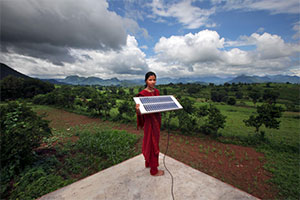 Bringing clean energy to rural India. Credit: Abbie Trayler-Smith / Panos Pictures / Department for International Development
Large reserves of oil, gas and minerals in developing countries generate opulent revenues. They could be used to stimulate economic growth and reduce poverty, but often result in environmental destruction and conflict, benefiting large companies and corrupt governments. Furthermore, competition over natural resources often manifests through geopolitical conflict. For example, before the US-Iraq war, Iraq’s domestic oil industry was nationalized. With US aggression came weakened Iraqi institutions and foreign intervention, thus eventually leading to the privatization of Iraqi oil, leaving the industry now largely dominated by Western companies. As another example, China’s rising investments within the lithium sector in South America are increasing the US-China rivalry across the Western Hemisphere. Notably, Bolivia has the largest reserves of lithium in the world, and the nation’s state-owned lithium extraction firm recently signed a contract with China’s CBC Consortium, while rejecting the entry of Western firms into the nation. In Bolivia’s case, rising Chinese investment in the nation’s lithium sector also raises concerns about environmental sustainability and the sociopolitical rights of Indigenous communities. More broadly, Sub-Saharan Africa holds nearly 30% of global reserves of critical minerals required for low-carbon technologies. Despite this, the region attracts less than 10% of global exploration investment, depicting a critical barrier to both the clean energy transitions and Sub-Saharan Africa’s economic development. Furthermore, resource wealth continues to fuel conflict like Sudan’s civil war, which has led to 9.1 million internally displaced people and is intensely connected to competition over gold, water, and agricultural land. IPS covers news about major oil, gas, and mining projects, their effects on the environment and local communities, and the ideas and actions of the interest groups involved.

The Week with IPS

NEXT STOP - SDGs
Tracking global progress towards a sustainable world
Tracking global progress towards a sustainable world
