Languages
Sunday, September 20, 2026



News and Views from the Global South
Natural Resources

China’s Economy Has Sounded the Alert; Will Latin America Listen?
For years, Latin America has exported its raw materials to China’s voracious factories, fuelling economic growth. But now that the Asian giant is putting a priority on domestic consumption over industrial production, how will this region react?
UAE Wins Hearts and Minds at World Exhibition in Milan
She only turned nine last June. But Mahra Mustafa has become a celebrity at the Expo Milan. She stars as Sara in ‘The Family Tree’, a short film on the UAE’s heritage being screened at the United Arab Emirates pavilion. Sara is in fact the face of young, dynamic and innovative Emirates.
Latin America Should Lead in Protecting the Planet’s Oceans
Latin America should assume a position of global leadership by adopting effective measures to protect the oceans, which are threatened by illegal fishing, the impacts of climate change, and pollution caused by acidification and plastic waste.
Zimbabwe’s Forest Carbon Programme Not All It Seems
The efficacy of attempts to sustainably manage forests and conserve and enhance forest carbon stocks in Zimbabwe is increasingly coming under scrutiny as new research warns that the politics of access and control over forests and their carbon is challenging conventional understanding.
Caribbean Artists Raise Their Voices for Climate Justice
Award-winning St. Lucian poet and playwright Kendel Hippolyte thinks that Caribbean nationals should view the Earth as their mother.
Opinion: The Road to Paris and the Path to Renewable Energy
Renewable energy is now being seen by many people around the world as a cost-effective development solution both for developed and developing nations. Countries have slowly been realising that the use of coal and the huge amount of carbon emissions it generates harms the environment and impacts our daily activities.
U.N. Post-2015 Development Agenda Adopted Amidst Closed-Door Deals
At about a quarter to seven on the evening of Sunday, Aug. 2, the member states of the United Nations adopted the post-2015 development agenda outcome document, titled "Transforming Our World: The 2030 Agenda."
Trans Fat Substitute May Lead to More Deforestation
Following growing concerns in the United States about the risks of trans fat since 1999, demand for palm oil, a cheap substitute for trans fat, more than doubled over the last decade and is expected to increase, eliciting concerns about deforestation in several Southeast Asian countries that provide 85 percent of the world’s palm oil.
Humanitarian Crisis Looming Over Venezuela, Says ICG
A Brussels-based think-tank has warned Venezuela of an impending humanitarian calamity in tandem with growing political instability.
Fish Farming Now a Big Hit in Africa
Hillary Thompson, aged 62, throws some grains of left-over rice from his last meal, mixed with some beer dregs from his sorghum brew, into a swimming pool that he has converted into a fish pond.
Zimbabwe’s Climate Change Ambitions May be Too Tall
With the U.N. Climate Change conference later this year in Paris fast approaching, Zimbabwe's climate change commitments face the slow progress on an issue that continues to stalk other developing countries – climate finance.
Nigeria to Balance GHG Emission Cuts with Development Peculiarities
Nigeria seems in no haste to unveil its climate pledge with just four months to go before the U.N. Climate Conference scheduled for December in Paris.
‘Permaculture the African Way’ in Cameroon’s Only Eco-Village
Marking a shift away from the growing trend of abandoning sustainable life styles and drifting from traditional customs and routines, Joshua Konkankoh is a Cameroonian farmer with a vision – that the answer to food insecurity lies in sustainable and organic methods of farming.
Kenyan Pastoralists Fighting Climate Change Through Food Forests
Sipian Lesan bends to attend to the Vangueria infausta or African medlar plant that he planted almost two years ago. He takes great care not to damage the soft, velvety, acorn-shaped buds of this hardy and drought-resistant plant. ”All over here it is dry,” says the 51-year-old Samburu semi-nomadic pastoralist.
UAE Described as Pioneer in the Field of Renewable Energy
When the government of Kenya hosted a U.N. Conference on New and Renewable Sources of Energy in Nairobi back in 1981, one of the conclusions at that meeting was a proposal for the creation of an international agency dedicated to renewable energy.
One Tune, Different Hymns – Tackling Climate Change in South Africa
Anti-nuclear energy activists are up in arms, and have taken to vigils outside South Africa’s parliament in Cape Town to protest against President Jacob Zuma’s push for nuclear development.
Kenya’s Climate Change Bill Aims to Promote Low Carbon Growth
Alexander Muyekhi, a construction worker from Ebubayi village in the heart of Vihiga County in Western Kenya, and his school-going children can now enjoy a tiny solar kit supplied by the British-based Azuri Technologies to light their house and play their small FM radio.
Faith Leaders Issue Global “Call to Conscience” on Climate
“We received a garden as our home, and we must not turn it into a wilderness for our children.”
Opinion: Addis Outcome Will Impact Heavily on Post-2015 Agenda – Part 2
The United Nations is the only universal forum that connects systemic issues to the global partnership for development. The latter recognises North-South cooperation based on historical responsibility and varying levels of development and capacity among member states of the U.N.
Africa Advised to Take DIY Approach to Climate Resilience
African countries would do well to take their own lead in finding ways to better adapt to and mitigate the changes that climate may impose on future generations instead of relying only on foreign aid.
Tribal Priestesses Become Guardians of Seeds in Eastern India
As the rhythmic thumping of dancing feet reaches a crescendo, the women offer a song to their forest god for a bountiful harvest.« Previous Page — Next Page »


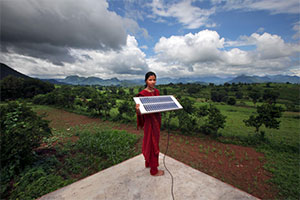 Bringing clean energy to rural India. Credit: Abbie Trayler-Smith / Panos Pictures / Department for International Development
Large reserves of oil, gas and minerals in developing countries generate opulent revenues. They could be used to stimulate economic growth and reduce poverty, but often result in environmental destruction and conflict, benefiting large companies and corrupt governments. Furthermore, competition over natural resources often manifests through geopolitical conflict. For example, before the US-Iraq war, Iraq’s domestic oil industry was nationalized. With US aggression came weakened Iraqi institutions and foreign intervention, thus eventually leading to the privatization of Iraqi oil, leaving the industry now largely dominated by Western companies. As another example, China’s rising investments within the lithium sector in South America are increasing the US-China rivalry across the Western Hemisphere. Notably, Bolivia has the largest reserves of lithium in the world, and the nation’s state-owned lithium extraction firm recently signed a contract with China’s CBC Consortium, while rejecting the entry of Western firms into the nation. In Bolivia’s case, rising Chinese investment in the nation’s lithium sector also raises concerns about environmental sustainability and the sociopolitical rights of Indigenous communities. More broadly, Sub-Saharan Africa holds nearly 30% of global reserves of critical minerals required for low-carbon technologies. Despite this, the region attracts less than 10% of global exploration investment, depicting a critical barrier to both the clean energy transitions and Sub-Saharan Africa’s economic development. Furthermore, resource wealth continues to fuel conflict like Sudan’s civil war, which has led to 9.1 million internally displaced people and is intensely connected to competition over gold, water, and agricultural land. IPS covers news about major oil, gas, and mining projects, their effects on the environment and local communities, and the ideas and actions of the interest groups involved.

The Week with IPS

NEXT STOP - SDGs
Tracking global progress towards a sustainable world
Tracking global progress towards a sustainable world
