Languages
Monday, September 21, 2026



News and Views from the Global South
Natural Resources

Caribbean Seeks Funding for Renewable Energy Mix
A leading geothermal expert warns that the small island states in the Caribbean face “a ticking time bomb” due to the effects of global warming and suggests a shift away from fossil fuels to renewable energy is the only way to defuse it.
Papua New Guinea’s Unemployed Youth Say the Future They Want Begins With Them
Zibie Wari, a former teacher and founder of the Tropical Gems grassroots youth group in the town of Madang on the north coast of Papua New Guinea, has seen the hopes of many young people for a decent future quashed by the impacts of corruption and unfulfilled promises of development.
Opinion: Strengthen Tax Cooperation to End Hunger and Poverty Quickly
By the end of this year, the 15-year time frame for the Millennium Development Goals will end, with good progress on several indicators, but limited achievements on others.
Opinion: Iran Deal Has Far-Reaching Potential to Remake International Relations
The Vienna agreement between Iran and the five permanent members of the United Nations Security Council acting in concert with Germany has the potential to remake international relations beyond the immediate goal of stopping Iran from acquiring nuclear weapons.
Opinion: Unrestrained ‘Privatisation of Poverty-Reduction’ Puts Human Rights at Risk
Corporate lobbyists are unusual guests at development meetings, but when the United Nations held its Financing for Development conference in Addis Ababa this week to decide who pays for its new “Sustainable Development Goals”, some governments laid out the red carpet for the private sector.
Opinion: What Will It Take to Bring a Second Green Revolution to India?
Long-term agricultural growth in India is slowing down. The lands that saw remarkable increases in productivity in the 1970s and 80s, thanks to the technology rolled out as part of the first “Green Revolution”, are not yielding the same results today.
Jamaica’s Coral Gardens Give New Hope for Dying Reefs
With time running out for Jamaica's coral reefs, local marine scientists are taking things into their own hands, rebuilding the island’s reefs and coastal defences one tiny fragment at a time - a step authorities say is critical to the country’s climate change and disaster mitigation plans.
Water and Sanitation Urged as Focal Points at Addis Ababa
Ahead of the all-important International Financing for Development Conference in Addis Ababa, a top water charity has called upon world leaders to prioritise programmes for water, sanitation and good hygiene, so that no one is left behind.
Opinion: ASEAN Must Unite Against Climate Change
The Association of Southeast Asian Nations (ASEAN) started as a cooperation bloc in 1968. Founded by five countries - Thailand, Singapore, Malaysia, Indonesia and the Philippines - ASEAN has since evolved into a regional force which is slowly changing the landscape in global politics.
Views from the Caribbean ahead of COP21, the December 2015 Climate Change Summit in Paris – Building Resilience to Disaster: Biodiversity
 Thanks to its varied geography and climate, the Caribbean region is one of the world's greatest centers of unique biodiversity. With most people living near the coast, marine ecosystems, including mangroves, beaches, lagoons and cays, are essential not only for biodiversity, but as protection from storms. Many are now threatened, along with the coral reefs the region is famous for.
Q&A: “Climate Change is About Much More Than Temperature”
The cost of inaction is high when it comes to climate change and, so far, countries’ commitments to reduce greenhouse gas (GHG) emissions are not enough, says Michel Jarraud, Secretary-General of the World Meteorological Organisation (WMO).
Putting the “Integrity of the Earth’s Ecosystems” at the Centre of the Sustainable Development Agenda
By 2050, we will be a world of nine billion people. Not only does this mean there’ll be two million more mouths to feed than there are at present, it also means these mouths will be consuming more – in the next 20 years, for instance, an estimated three billion people will enter the middle class, in addition to the 1.8 billion estimated to be within that income bracket today.
Financial Inclusion Key to Climate Risk Reduction for Zambia’s Smallholders
In the advent of unpredictable weather, smallholder rain-dependent agriculture is increasingly becoming a risky business and the situation could worsen if, as seems likely, the world experiences levels of global warming that could lead to an increase in droughts, floods and diseases, both in frequency and intensity.
Caribbean Fights to Protect High-Value, Declining Species
Threats from climate change, declining reefs, overfishing and possible loss of several commercial species are driving the rollout of new policy measures to keep Caribbean fisheries sustainable.
Drastic CO2 Cuts Needed to Save Oceans
If global carbon dioxide emissions are not dramatically curbed, the world's oceans – and the many services they provide humanity – will suffer "massive and mostly irreversible impacts," researchers warned in Science magazine Friday.
Sustainable Use of Biodiversity Could Fill Gap When Belo Monte Dam Is Finished
Some argue that the sustainable use of biodiversity is the best alternative for local development in the area surrounding the enormous Belo Monte hydroelectric dam, now that the construction project is entering its final phase on the Xingú River in Brazil’s Amazon jungle.
Opinion: If You’re Against Coal Mining, Walk In and Stop It
“If you’re against coal mining, why don’t you just walk into a coal mine and stop the excavators?”
Union Islanders Wonder if Their Home Will Be the Next Atlantis
Fifteen years ago, Stephanie Browne, a former Member of Parliament in St. Vincent and the Grenadines, needed only to look at the beach outside her house to know why her community in Union Island was called “Big Sand”.
U.N. Chief Seeks Equity in Paris Climate Change Pact
When the 193-member General Assembly hosted a high level meeting on climate change Monday, Secretary-General Ban Ki-moon warned that any proposed agreement at an upcoming international conference in Paris in December must uphold the principle of equity.
Rome March Celebrates Pope’s Call for Urgent Climate Action
People of faith, civil society groups, and communities affected by climate change marched together in Rome Sunday Jun. 28 to express gratitude to Pope Francis for the release of his Laudato Si encyclical on the environment, and call for bolder climate action by world leaders.
Fracking Expands Under the Radar on Mexican Lands
“People don’t know what ‘fracking’ is and there is little concern about the issue because it’s not visible yet,” said Gabino Vicente, a delegate of one of the municipalities in southern Mexico where exploration for unconventional gas is forging ahead.« Previous Page — Next Page »


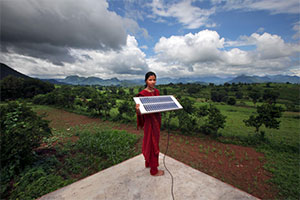 Bringing clean energy to rural India. Credit: Abbie Trayler-Smith / Panos Pictures / Department for International Development
Large reserves of oil, gas and minerals in developing countries generate opulent revenues. They could be used to stimulate economic growth and reduce poverty, but often result in environmental destruction and conflict, benefiting large companies and corrupt governments. Furthermore, competition over natural resources often manifests through geopolitical conflict. For example, before the US-Iraq war, Iraq’s domestic oil industry was nationalized. With US aggression came weakened Iraqi institutions and foreign intervention, thus eventually leading to the privatization of Iraqi oil, leaving the industry now largely dominated by Western companies. As another example, China’s rising investments within the lithium sector in South America are increasing the US-China rivalry across the Western Hemisphere. Notably, Bolivia has the largest reserves of lithium in the world, and the nation’s state-owned lithium extraction firm recently signed a contract with China’s CBC Consortium, while rejecting the entry of Western firms into the nation. In Bolivia’s case, rising Chinese investment in the nation’s lithium sector also raises concerns about environmental sustainability and the sociopolitical rights of Indigenous communities. More broadly, Sub-Saharan Africa holds nearly 30% of global reserves of critical minerals required for low-carbon technologies. Despite this, the region attracts less than 10% of global exploration investment, depicting a critical barrier to both the clean energy transitions and Sub-Saharan Africa’s economic development. Furthermore, resource wealth continues to fuel conflict like Sudan’s civil war, which has led to 9.1 million internally displaced people and is intensely connected to competition over gold, water, and agricultural land. IPS covers news about major oil, gas, and mining projects, their effects on the environment and local communities, and the ideas and actions of the interest groups involved.

The Week with IPS

NEXT STOP - SDGs
Tracking global progress towards a sustainable world
Tracking global progress towards a sustainable world
