Languages
Thursday, September 24, 2026



News and Views from the Global South
Natural Resources

Heat Wave Picking Off Pakistan’s Urban Poor
Over 950 people have perished in just five days. The morgues, already filled to capacity, are piling up with bodies, and in over-crowded hospitals the threat of further deaths hangs in the air.
Grenada Rebuilds Barrier Reefs
The Eastern Caribbean nation of Grenada is following the example of its bigger neighbours Belize and Jamaica in taking action to restore coral reefs, which serve as frontline barriers against storm waves.
Views from the Caribbean ahead of COP21, the December 2015 Climate Change Summit in Paris – Building Resilience to Disaster: Mitigation
 Despite being a relatively small source of greenhouse gas emissions, the Caribbean region has been taking steps to introduce renewable energy sources like wind, solar and geothermal, which also reduce its dependence on expensive oil imports.

On Kenya’s Coast, a Struggle for the Sacred
Travel into the heart of Kenya’s southern Coast Province, nearly 500 km from the capital city of Nairobi, and you will come across one of the planet’s most curious World Heritage Sites: the remains of several fortified villages, revered by the indigenous Mijikenda people as the sacred abodes of their ancestors.
Young People Lend a Hand to Trinidad’s Ailing Watersheds
Starting in 1999, the Water and Sewerage Authority (WASA) of Trinidad and Tobago began a 10-year effort to map the country’s water quality. They started to notice a worrying trend.
Opinion: Sub-Saharan Africa, Addis and Paris
After the turn of the century, growth in sub-Saharan Africa (SSA) picked up again after a quarter century of near stagnation for most, mainly due to increased world demand for minerals and other natural resources.
Opinion: The Oceans Need the Spotlight Now
The international community must focus its energies immediately on addressing the grave challenges confronting the oceans. With implications for global order and peace, the oceans are also becoming another arena for national rivalry.
Amazon Dam also Brings Health Infrastructure for Local Population
Extensive public health infrastructure and the eradication of malaria will be the most important legacy of the construction of the Belo Monte hydropower dam in Brazil’s Amazon jungle for the population affected by the megaproject.
U.N. Takes First Step Towards Treaty to Curb Lawlessness in High Seas
The 193-member General Assembly adopted a resolution Friday aimed at drafting a legally binding international treaty for the conservation of marine biodiversity and to govern the mostly lawless high seas beyond national jurisdiction.
Farmers Find their Voice Through Radio in the Badlands of India
Eighty-year-old Chenabai Kushwaha sits on a charpoy under a neem tree in the village of Chitawar, located in the Tikamgarh district in the central Indian state of Madhya Pradesh, staring intently at a dictaphone.
Opinion: No Place to Hide in Addis
My colleagues just got back from Munich, where we held a summit bringing together over 250 young volunteers from across Europe. These youngsters campaigned in the run-up to and at the doorstep of the G7 Summit in Schloss Elmau, as one of the key moments in a year brimming with opportunities to tackle extreme poverty.
Views from the Caribbean ahead of COP21, the December 2015 Climate Change Summit in Paris – Building Resilience to Disaster: Adaptation
From constructing barriers against rising sea levels to rehabilitating mangroves and providing agrometeorology services, the Caribbean isn’t waiting for a new international agreement on climate change to start implementing adaptation measures. But funding to roll out such projects on the necessary scale remains a key issue, and many communities remain desperately vulnerable to storms and flooding. 
South Sudan Again Tops Fragile States Index
For the second year in a row, South Sudan has been designated as the most fragile nation in the world, plagued by intensifying internal conflict that has displaced more than two million of its people.
Industrial Fisheries Crowd out Artisanal Fisherpersons in South America
Millions of families on South America’s Pacific coast have long depended on artisanal fishing for a living. But they have been increasingly being pushed aside by the industrial fisheries that have made this region a major player in the global seafood industry.
From Residents to Rangers: Local Communities Take Lead on Mangrove Conservation in Sri Lanka
Weekends and public holidays are deadly for one of Sri Lanka’s most delicate ecosystems – that is when the island’s 8,815 hectares of mangroves come under threat.
Cities Will Be Decisive in Fight for Sustainable Development
With cities increasingly in the spotlight on the international stage, urban planning and development has become a critical issue in the Sustainable Development Goals (SDGs).
Opinion: We Have a Moral Imperative to Act on Climate Change
My country, the Philippines, is one of the most vulnerable to the impacts of climate change. Even though we are among those countries that hardly contributed emissions and benefited least from burning fossil fuels, we find ourselves at the frontline of the climate crisis.
Opinion: What the Philippines Can Learn from Morocco, Peru and Ethiopia
(Last week, Australian Climate Activist offered an apology to the Philippines for his country’s lack of action. Today, he partners up with climate tracker from the Philippines Jed Alegado to talk about what the Philippines can do to show its leadership in tackling climate change.)
Climate Justice: Trial by Public Opinion for World’s Polluters
The United Nations, which is tasked with the protection of the global environment, has asserted that climate change affects people everywhere - with no exceptions.
From Residents to Rangers: Local Communities Take Lead on Mangrove Conservation in Sri Lanka
Weekends and public holidays are deadly for one of Sri Lanka’s most delicate ecosystems – that is when the island’s 8,815 hectares of mangroves come under threat.

Adaptation Funding a Key Issue for Caribbean at Climate Talks
With less than six months to go before the next full United Nations Conference of the Parties also known as COP 21 – widely regarded as a make-or-break moment for an agreement on global action on climate change – Caribbean nations are still hammering out the best approach to the talks.« Previous Page — Next Page »


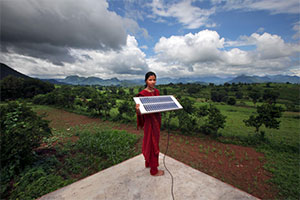 Bringing clean energy to rural India. Credit: Abbie Trayler-Smith / Panos Pictures / Department for International Development
Large reserves of oil, gas and minerals in developing countries generate opulent revenues. They could be used to stimulate economic growth and reduce poverty, but often result in environmental destruction and conflict, benefiting large companies and corrupt governments. Furthermore, competition over natural resources often manifests through geopolitical conflict. For example, before the US-Iraq war, Iraq’s domestic oil industry was nationalized. With US aggression came weakened Iraqi institutions and foreign intervention, thus eventually leading to the privatization of Iraqi oil, leaving the industry now largely dominated by Western companies. As another example, China’s rising investments within the lithium sector in South America are increasing the US-China rivalry across the Western Hemisphere. Notably, Bolivia has the largest reserves of lithium in the world, and the nation’s state-owned lithium extraction firm recently signed a contract with China’s CBC Consortium, while rejecting the entry of Western firms into the nation. In Bolivia’s case, rising Chinese investment in the nation’s lithium sector also raises concerns about environmental sustainability and the sociopolitical rights of Indigenous communities. More broadly, Sub-Saharan Africa holds nearly 30% of global reserves of critical minerals required for low-carbon technologies. Despite this, the region attracts less than 10% of global exploration investment, depicting a critical barrier to both the clean energy transitions and Sub-Saharan Africa’s economic development. Furthermore, resource wealth continues to fuel conflict like Sudan’s civil war, which has led to 9.1 million internally displaced people and is intensely connected to competition over gold, water, and agricultural land. IPS covers news about major oil, gas, and mining projects, their effects on the environment and local communities, and the ideas and actions of the interest groups involved.

The Week with IPS

NEXT STOP - SDGs
Tracking global progress towards a sustainable world
Tracking global progress towards a sustainable world
