Languages
Friday, September 25, 2026



News and Views from the Global South
Natural Resources

Opinion: GM Cotton a False Promise for Africa
Genetically modified (GM) cotton has been produced globally for almost two decades, yet to date only three African countries have grown GM cotton on a commercial basis – South Africa, Burkina Faso and Sudan.
U.N. Urged to Put Global Citizenship at Centre of Post-2015 Development Agenda
When Denmark hosted the World Summit on Social Development (WSSD) in March 1995, one of the conclusions of that international gathering in Copenhagen was to create a new social contract with “people at the centre of development.”
Peru a Shining Example for South America’s Climate Action Plans
This week, Peru became the first South American nation to publicly announce its Climate Action Plan, or INDC. In doing so, it may have set the scene for a new wave of highly transparent and ambitious INDC submissions from the continent.Africa on Threshold of Triple Energy Win for People, Power and Planet
Renewable energy is at the forefront of the changes sweeping Africa, and a “triple win” is within the region’s grasp to increase agricultural productivity, improve resilience to climate change, and contribute to long-term reductions in dangerous carbon emissions.
India Confronts Water Woes as it Transitions from MDGs to SDGs
 As the United Nations closes its chapter on the Millennium Development Goals (MDGs) and charts a new plan of action under the framework of 17 Sustainable Development Goals (SDGs), India – a country of 1.2 billion people – is confronting its resource challenges.
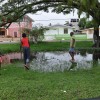
A Regional Foodbasket Plans for the Worst
Despite its highly variable climate, Guyana is the only Caribbean Community (CARICOM) country that enjoys food security. But rapid climate change could pose a challenge not only for Guyana, but for its Caribbean neigbours who depend on the South American country for much of their produce.
U.N. Chief Backs New Int’l Decade for Water for Sustainable Development
As the United Nations continues its negotiations to both define and refine a new set of Sustainable Development Goals (SDGs) before a summit meeting of world leaders in September, Secretary-General Ban Ki-moon has expressed support for a new “International Decade for Water for Sustainable Development.”
Why ACP Countries Matter for the EU Post-2015 Development Agenda
We are witnessing a shift in the original rationale behind the unique relationship between the European Union and the African, Caribbean and Pacific countries of the ACP group, which goes beyond the logic of “unilateral aid transfer”, “donor-recipient approach” and “North-South dialogue”.
G7’s Coal Addiction Behind Hunger
As heads of state and government of the G7 states prepare for their Jun. 7-8 summit in Germany, Oxfam has released a new report titled Let Them Eat Coal which they may find hard to digest.
As Jamaica’s Prime Forests Decline, Row Erupts Over Protection
For Jamaica, planting more trees as a way to build resilience is one of the highest priorities of the government's climate change action plan. So when Cockpit Country residents woke up to bulldozers in the protected area, they rallied to get answers from the authorities.
Pacific Civil Society Swings Out Against Free Trade Agreement
Fourteen Pacific Island Forum countries are currently locked in negotiations with their two largest economic neighbours, Australia and New Zealand, to forge a new regional free trade agreement called ‘PACER Plus’, which supporters believe will boost economic growth in the region.
Climate Fund Rolls Out Amid Hopes It Stays “Green”
After a difficult infancy, the Green Climate Fund is finally getting some legs. The big question now is what direction it will toddle off in.
Zimbabwean Women Weave Their Own Beautiful Future
Seventy-seven-year-old Grace Ngwenya has an eye for detail. You will never catch her squinting as she effortlessly weaves ilala palm fronds into beautiful baskets.
Zimbabwean Women Weave Their Own, Beautiful Future
 Seventy-seven-year-old Grace Ngwenya has an eye for detail. You will never catch her squinting as she effortlessly weaves ilala palm fronds into beautiful baskets.

Native Communities in Mexico Demand to be Consulted on Wind Farms
“It hurts us that our land is affected, and the environmental impacts are not even measured. Wind farm projects affect streams and hurt the flora,” said Zapotec Indian Isabel Jiménez, who is taking part in the struggle against the installation of a wind park in southern Mexico.
Prolonged Drought Leaves Caribbean Farmers Broke and Worried
St. Lucian farmer Anthony Herman was hoping that next year he’d manage to recoup some of the losses he sustained after 70 per cent of his cashew crop withered and died in the heat of the scorching southern Caribbean sun.
Growing Mobilisation Against Introduction of Fracking in Spain
Thousands of people in Spain have organised to protest the introduction of “fracking” – a controversial technique that involves pumping water, chemicals and sand at high pressure into shale rock to release gas and oil.
Small Arms Proliferation a Trigger for Rising Wildlife Crimes
The ongoing military conflicts in the Middle East and Africa continue to be fuelled by the proliferation of small arms and light weapons (SALW), primarily assault rifles, sub machine guns, hand grenades, portable anti-tank and anti-aircraft guns, rockets and self-loading pistols.
Laissez Faire Water Laws Threaten Family Farming in Chile
Family farmers in Chile are pushing for the reinstatement of water as a public good, to at least partially solve the shortages caused by the privatisation of water rights by the military dictatorship in 1981.
Bougainville: Former War-Torn Territory Still Wary of Mining
From Arawa, once the capital city of Bougainville, an autonomous region in eastern Papua New Guinea in the southwest Pacific Ocean, a long, winding road leads high up into the Crown Prince Ranges in the centre of the island through impenetrable rainforest.
Opinion: Voice of Civil Society Muffled in Post-2015 Negotiations for Better Future
In September, the United Nations will agree on new Sustainable Development Goals (SDGs) which will set development priorities for the next 15 years. The draft goals that have been developed are ambitious – they seek to end poverty and ensure no one is left behind.« Previous Page — Next Page »


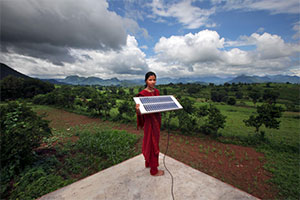 Bringing clean energy to rural India. Credit: Abbie Trayler-Smith / Panos Pictures / Department for International Development
Large reserves of oil, gas and minerals in developing countries generate opulent revenues. They could be used to stimulate economic growth and reduce poverty, but often result in environmental destruction and conflict, benefiting large companies and corrupt governments. Furthermore, competition over natural resources often manifests through geopolitical conflict. For example, before the US-Iraq war, Iraq’s domestic oil industry was nationalized. With US aggression came weakened Iraqi institutions and foreign intervention, thus eventually leading to the privatization of Iraqi oil, leaving the industry now largely dominated by Western companies. As another example, China’s rising investments within the lithium sector in South America are increasing the US-China rivalry across the Western Hemisphere. Notably, Bolivia has the largest reserves of lithium in the world, and the nation’s state-owned lithium extraction firm recently signed a contract with China’s CBC Consortium, while rejecting the entry of Western firms into the nation. In Bolivia’s case, rising Chinese investment in the nation’s lithium sector also raises concerns about environmental sustainability and the sociopolitical rights of Indigenous communities. More broadly, Sub-Saharan Africa holds nearly 30% of global reserves of critical minerals required for low-carbon technologies. Despite this, the region attracts less than 10% of global exploration investment, depicting a critical barrier to both the clean energy transitions and Sub-Saharan Africa’s economic development. Furthermore, resource wealth continues to fuel conflict like Sudan’s civil war, which has led to 9.1 million internally displaced people and is intensely connected to competition over gold, water, and agricultural land. IPS covers news about major oil, gas, and mining projects, their effects on the environment and local communities, and the ideas and actions of the interest groups involved.

The Week with IPS

NEXT STOP - SDGs
Tracking global progress towards a sustainable world
Tracking global progress towards a sustainable world
