Languages
Friday, September 25, 2026



News and Views from the Global South
Natural Resources

A Chimera in Growing Cooperation Between China and Brazil
A total of 35 agreements and contracts were signed during Chinese Prime Minister Li Keqiang’s visit to Brazil, as part of the growing ties between the two countries. But there is one project that drew all the attention: the Transcontinental Railway.
Climate Change: Some Companies Reject ‘Business as Usual’
When it comes to climate change, business as usual is simply “not an option”.
Lessons from an Indian Tribe on How to Manage the Food-Forest Nexus
Scattered across 240 sq km on the remote Niyamgiri hill range in the eastern Indian state of Odisha, an ancient tribal group known as the Dongria Kondh have earned themselves a reputation as trailblazers.
Lessons from an Indian Tribe on How to Manage the Food-Forest Nexus
 Scattered across 240 sq km on the remote Niyamgiri hill range in the eastern Indian state of Odisha, an ancient tribal group known as the Dongria Kondh have earned themselves a reputation as trailblazers.

U.N., World Bank Set 2030 Deadline for Sustainable Energy for All
Secretary-General Ban Ki-moon, an unrelenting advocate of sustainable energy for all (SE4All), once dramatised the need for modern conveniences by holding up his cell phone before an audience in the Norwegian capital of Oslo and asking: “What would we do without them?”
Development Threatens Antigua’s Protected Guiana Island
In June 2014, Gaston Browne led his Antigua and Barbuda Labour Party to a resounding victory at the polls with a pledge to transform the country into an economic powerhouse in the Caribbean.
African Women Mayors Join Forces to Fight for Clean Energy
When some 40,000 delegates, including dozens of heads of state, descend on Paris for the United Nations Climate Change Conference later this year, a group of African women mayors plan to be there and make their voices heard on a range of issues, including electrification.
Opinion: Edinburgh University Bows to Fossil Fuel Industry
The University of Edinburgh has taken the decision to not divest from fossil fuels, bowing to the short-term economic interests of departments funded by the fossil fuel industry, with little to no acknowledgement of the long-term repercussions of these investments.
“Swachh Bharat” (Clean India) Requires a Mindset Change
“Swachh Bharat”, or Clean India, is a slogan that most Indians today associate with the country’s Prime Minister Narendra Modi and his first nation-wide campaign launched soon after taking office in 2014.
Opinion: Clean Energy Access, a Major Sustainable Development Goal
The Sustainable Energy for All (SE4ALL) Forum will take place May 18-21 in New York. Success in achieving sustainable development and tackling climate change challenges requires investment in clean energy solutions.
Poor Land Use Worsens Climate Change in St. Vincent
For 32 years, Joel Poyer, a forest technician, has been tending to the forest of St. Vincent and the Grenadines.
The U.N. at 70: Energy Powers Lives, Literally
When, in 2003, Professor Richard Smalley, winner of the Nobel Prize for Chemistry, listed the top 10 problems facing humanity for the next 50 years in order of priority, energy was at the top of his list, followed by water, then food.
NGOs Urge Post-2015 Declaration Include Water, Sanitation as Basic Human Rights
Virtually every major international conference concludes with a “programme of action” (PoA) – described in U.N. jargon as “an outcome document” – preceded by a political declaration where 193 member states religiously pledge to honour their commitments.
Farmers Fight Real Estate Developers for Kenya’s Most Prized Asset: Land
Vegetables grown in the lush soil of this quiet agricultural community in central Kenya’s fertile wetlands not only feed the farmers who tend the crops, but also make their way into the marketplaces of Nairobi, the country’s capital, some 150 km south.
Opinion: Don’t Leave Indigenous Peoples Behind in SDGs
U.N. member states are meeting throughout the year to finalize the Sustainable Development Goals (SDGs), which will set the global development agenda for the next 15 years. The goals are supposed to be universal and aspire to “leave no one behind.”
Farmers Fight Real Estate Developers for Kenya’s Most Prized Asset: Land
Vegetables grown in the lush soil of this quiet agricultural community in central Kenya’s fertile wetlands not only feed the farmers who tend the crops, but also make their way into the marketplaces of Nairobi, the country’s capital, some 150 km south.

Opinion: A Development Fairytale or a Global Land Rush?
In our work at Greenpeace and the Oakland Institute around access and control over natural resources, we face constant accusations of being anti-development or “Northern NGOs who care more for the trees”, despite working with communities around the world, from Cameroon, to China, to the Czech Republic.
Opinion: The Bursting of Europe’s Biofuels Bubble
Last week, the European Union reached a momentous decision to finally agree a reform to its disastrous biofuels legislation, signalling Europe’s U-turn on the burning of crops for biofuels.
Prepaid Meters Scupper Gains Made in Accessing Water in Africa
While many countries appear to have met the U.N. Millennium Development Goal (MDG) of halving the proportion of people without sustainable access to safe drinking water, rights activists say that African countries which have taken to installing prepaid water meters have rendered a blow to many poor people, making it hard for them to access water.
Opinion: South-South Cooperation Vital for Sustainable Development
Sustainable development is central to a range of key discussions at the United Nations and elsewhere at the moment.
Living the Indigenous Way, from the Jungles to the Mountains
In the course of human history many tens of thousands of communities have survived and thrived for hundreds, even thousands, of years. Scores of these largely self-sustaining traditional communities continue to this day in remote jungles, forests, mountains, deserts, and in the icy regions of the North. A few remain completely isolated from modern society.« Previous Page — Next Page »


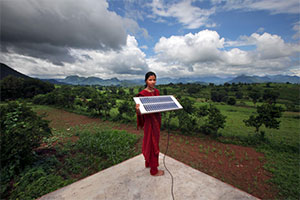 Bringing clean energy to rural India. Credit: Abbie Trayler-Smith / Panos Pictures / Department for International Development
Large reserves of oil, gas and minerals in developing countries generate opulent revenues. They could be used to stimulate economic growth and reduce poverty, but often result in environmental destruction and conflict, benefiting large companies and corrupt governments. Furthermore, competition over natural resources often manifests through geopolitical conflict. For example, before the US-Iraq war, Iraq’s domestic oil industry was nationalized. With US aggression came weakened Iraqi institutions and foreign intervention, thus eventually leading to the privatization of Iraqi oil, leaving the industry now largely dominated by Western companies. As another example, China’s rising investments within the lithium sector in South America are increasing the US-China rivalry across the Western Hemisphere. Notably, Bolivia has the largest reserves of lithium in the world, and the nation’s state-owned lithium extraction firm recently signed a contract with China’s CBC Consortium, while rejecting the entry of Western firms into the nation. In Bolivia’s case, rising Chinese investment in the nation’s lithium sector also raises concerns about environmental sustainability and the sociopolitical rights of Indigenous communities. More broadly, Sub-Saharan Africa holds nearly 30% of global reserves of critical minerals required for low-carbon technologies. Despite this, the region attracts less than 10% of global exploration investment, depicting a critical barrier to both the clean energy transitions and Sub-Saharan Africa’s economic development. Furthermore, resource wealth continues to fuel conflict like Sudan’s civil war, which has led to 9.1 million internally displaced people and is intensely connected to competition over gold, water, and agricultural land. IPS covers news about major oil, gas, and mining projects, their effects on the environment and local communities, and the ideas and actions of the interest groups involved.

The Week with IPS

NEXT STOP - SDGs
Tracking global progress towards a sustainable world
Tracking global progress towards a sustainable world
