Languages
Friday, September 25, 2026



News and Views from the Global South
Natural Resources

Falling Oil Prices Trigger Initial Economic Gains for Pacific Islanders
The recent dramatic fall in world oil prices, with Brent crude plummeting from a high of 115 dollars per barrel in June last year to around 47 dollars in January 2015, is beginning to benefit Pacific Islanders who are seeing lower prices for fuel and energy.
Costa Rica’s Energy Nearly 100 Percent Clean
Costa Rica has almost reached its goal of an energy mix based solely on renewable sources, harnessing solar, wind and geothermal power, as well as the energy of the country’s rivers.
Opinion: Healthy Diets for Healthy Lives
In the last half-century, people’s lifestyles have changed dramatically. Life expectancy has risen almost everywhere, but this has been accompanied by an increase of so-called non-communicable diseases (NCDs) – such as cardiovascular diseases, cancer, respiratory diseases, and diabetes – causing more and more deaths in all corners of the world.
The Blue Amazon, Brazil’s New Natural Resources Frontier
The Atlantic ocean is Brazil’s last frontier to the east. But the full extent of its biodiversity is still unknown, and scientific research and conservation measures are lagging compared to the pace of exploitation of resources such as oil.
Watch What Happens When Tribal Women Manage India’s Forests
Kama Pradhan, a 35-year-old tribal woman, her eyes intent on the glowing screen of a hand-held GPS device, moves quickly between the trees. Ahead of her, a group of men hastens to clear away the brambles from stone pillars that stand at scattered intervals throughout this dense forest in the Nayagarh district of India’s eastern Odisha state.
Opinion: Don’t Sell Sweden’s Vattenfall, Keep Coal in the Ground
The Swedish government is in the process of pondering an important decision -- whether to sell the vast lignite reserves of the state-owned Vattenfall energy giant or ensure that they stay in the ground. The decision will define Sweden’s commitment to tackling climate change.
Caribbean Stakes Out “Red Lines” for Paris Climate Talks
When the international climate change talks ended in Peru last December, the 15-member Caribbean Community (CARICOM), a political and economic union comprising small, developing, climate-vulnerable islands and low-lying nations, left with “the bare minimum necessary to continue the process to address climate change”.European Biofuel Bubble Bursts
Ten years of debate in the European Union over the detrimental effects of the demand for biofuels for transport on food prices, hunger, forest destruction, land consumption and climate change have come to an end.
Cash-Strapped Latin American Countries Turn to China for Credit
Angolans are generally grateful for China’s participation in the reconstruction of their central African country, in spite of the fact that some of the roads and buildings built by Chinese firms are of poor quality, and mainly Chinese labourers have been hired rather than local workers.
Grenada Braces for Impacts of Climate Change
Henry Prince has lived in this fishing village for more than six decades. Prince, 67, who depends on the sea for his livelihood, said he has been catching fewer and fewer fish, and the decrease is taking a financial toll on him and other fisher folk throughout the island nation of Grenada.
New Anti-Terrorism Law Batters Cameroonians Seeking Secession
Cameroon’s government under President Paul Biya is bearing down on a separatist movement fighting for the rights of a minority English-language region, using as its weapon a sweeping new anti-terrorism law introduced at the end of last year.Swelling Ethiopian Migration Casts Doubt on its Economic Miracle
The 28 Ethiopian migrants of Christian faith murdered by the Islamic State (IS) on Apr. 19 in Libya had planned to cross the Mediterranean Sea in search of work in Europe.
Kenyan Pastoralists Protest Wanton Destruction of Indigenous Forest
Armed with twigs and placards, enraged residents from a semi-pastoral community 360 km north of Kenya’s capital, Nairobi, protested this week against wanton destruction of indigenous forest – their alternative source of livelihood.
Planned Mega-Port in Brazil Threatens Rich Ecological Region
Activists and local residents have brought legal action aimed at blocking the construction of a nearly 50 sq km port terminal in the Northeast Brazilian state of Bahia because of the huge environmental and social impacts it will have.
Riches in World’s Oceans Estimated at Staggering 24 Trillion Dollars
The untapped riches in the world’s oceans are estimated at nearly 24 trillion dollars – the size of the world’s leading economies, according to a new report released Thursday by the World Wide Fund for Nature (WWF).
Opinion: The World Has Reached Peak Plutocracy
Parents in despair because they can’t pay the fees at the privatised neighbourhood school…
Shift to Renewables Seems Inevitable, But Is It Fast Enough?
Climate change may be one of the most divisive issues in the U.S. Congress today, but despite the staunch denialism of Republicans, experts say the global transition from fossil fuels to renewables is already well underway.
Tailings Ponds Pose a Threat to Chilean Communities
Chile lives under the constant threat of spillage from tailings ponds, which became even more marked in late March after heavy rains fell in the desert region of Atacama leaving over two dozen people dead and missing and thousands without a home.
From Slavery to Self Reliance: A Story of Dalit Women in South India
HuligeAmma, a Dalit woman in her mid-forties, bends over a sewing machine, carefully running the needle over the hem of a shirt. Sitting nearby is Roopa, her 22-year-old daughter, who reads an amusing message on her cell phone and laughs heartily.
To Defend the Environment, Support Social Movements Like Berta Cáceres and COPINH
The 2015 Goldman Environmental Prize for Central and South America has been awarded to Berta Cáceres, an indigenous Honduran woman who co-founded the Council of Popular and Indigenous Organizations of Honduras, known as COPINH.
Tribunal Ruling Could Dent “Monster Boat” Trawling in West African Waters
It was five in the afternoon and Buba Badjie, a boat captain, had just brought his catch to the shore. He had spent twelve hours at sea off Bakau, a major fish landing site in The Gambia.« Previous Page — Next Page »


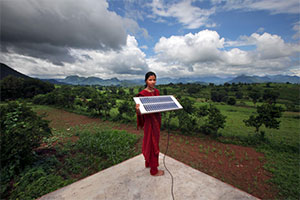 Bringing clean energy to rural India. Credit: Abbie Trayler-Smith / Panos Pictures / Department for International Development
Large reserves of oil, gas and minerals in developing countries generate opulent revenues. They could be used to stimulate economic growth and reduce poverty, but often result in environmental destruction and conflict, benefiting large companies and corrupt governments. Furthermore, competition over natural resources often manifests through geopolitical conflict. For example, before the US-Iraq war, Iraq’s domestic oil industry was nationalized. With US aggression came weakened Iraqi institutions and foreign intervention, thus eventually leading to the privatization of Iraqi oil, leaving the industry now largely dominated by Western companies. As another example, China’s rising investments within the lithium sector in South America are increasing the US-China rivalry across the Western Hemisphere. Notably, Bolivia has the largest reserves of lithium in the world, and the nation’s state-owned lithium extraction firm recently signed a contract with China’s CBC Consortium, while rejecting the entry of Western firms into the nation. In Bolivia’s case, rising Chinese investment in the nation’s lithium sector also raises concerns about environmental sustainability and the sociopolitical rights of Indigenous communities. More broadly, Sub-Saharan Africa holds nearly 30% of global reserves of critical minerals required for low-carbon technologies. Despite this, the region attracts less than 10% of global exploration investment, depicting a critical barrier to both the clean energy transitions and Sub-Saharan Africa’s economic development. Furthermore, resource wealth continues to fuel conflict like Sudan’s civil war, which has led to 9.1 million internally displaced people and is intensely connected to competition over gold, water, and agricultural land. IPS covers news about major oil, gas, and mining projects, their effects on the environment and local communities, and the ideas and actions of the interest groups involved.

The Week with IPS

NEXT STOP - SDGs
Tracking global progress towards a sustainable world
Tracking global progress towards a sustainable world
