Languages
Friday, September 25, 2026



News and Views from the Global South
Natural Resources
Clean Cookstoves Could Change the Lives of Millions in Nepal
 When 26-year-old Laxmi married into the Archaya household in Chhaimale village, Pharping, south of Nepal’s capital Kathmandu, she didn’t think she would be spending half the day in the kitchen inhaling smoke from the stove.
Clean Cookstoves Could Change the Lives of Millions in Nepal
When 26-year-old Laxmi married into the Archaya household in Chhaimale village, Pharping, south of Nepal’s capital Kathmandu, she didn’t think she would be spending half the day in the kitchen inhaling smoke from the stove.
Antigua Draws a Line in the Vanishing Sand
Jabberwock beach, located on the northeastern coast of Antigua, features a mile-long white sand beach and is a favourite with locals and visitors alike.
Nepal: A Trailblazer in Biodiversity Conservation
At dusk, when the early evening sun casts its rays over the lush landscape, the Chitwan National Park, a UNESCO World Heritage Site about 200 km south of Nepal’s capital, Kathmandu, is a place of the utmost tranquility.
Plunging Oil Prices Won’t Kill Vaca Muerta
Despite the precipitous fall in global oil prices, Argentina has continued to follow its strategy of producing unconventional shale oil, although in the short term there could be problems attracting the foreign investment needed to exploit the Vaca Muerta shale deposit.
In Belize, Climate Change Drives Coastal Management
A five-year project launched here in Belize City in March seeks to cement a shift in view of climate change and its impact on Belize’s national development.
Land Seizures Speeding Up, Leaving Africans Homeless and Landless
There is a new scramble for Africa, with ordinary people facing displacement by the affluent and the powerful as huge tracts of land on the continent are grabbed by a minority, rights activists here say.
Environmental Terrorism Cripples Palestinian Farmers
“Exactly which olive trees do you want to see? The Israeli settlers have cut down thousands. Can you be more specific?” asked the taxi driver, telling IPS that he wished to remain anonymous.
Millions of Dollars for Climate Financing but Barely One Cent for Women
The statistics tell the story: in some parts of the world, four times as many women as men die during floods; in some instances women are 14 times more likely to die during natural disasters than men.
Afghanistan’s Economic Recovery: A New Horizon for South-South Partnerships?
First the centre of the silk route, then the epicenter of bloody conflicts, Afghanistan’s history can be charted through many diverse chapters, the most recent of which opened with the election of President Ashraf Ghani in September 2014.Turkey Investing in Coal Despite Cheaper Renewable Energy
In response to rising demand for electricity, pressure to keep prices affordable and a need to maintain energy security, the Turkish government plans to increase electricity generation from coal.
Q&A: “Protect Your Biodiversity”
Richard Huber is chief of the Sustainable Communities, Hazard Risk, and Climate Change Section of the Department of Sustainable Development of the Organisation of American States (OAS). Its objective? Foster resilient, more sustainable cities – reducing, for example, consumption of water and energy – while simultaneously improving the quality of life and the participation of the community.
Pollution a Key but Underrated Factor in New Development Goals
Pollution is likely to be the most pressing global health issue in the coming years without effective prevention and clean-up efforts, experts say.
Opinion: Foreign Policy is in the Hands of Sleepwalkers
The United Kingdom has been accused of “sleepwalking” into the Ukraine crisis – and the accusation comes from no less than the House of Lords, not usually considered a place of critical analysis.
Pacific Islanders Say Climate Finance “Essential” for Paris Agreement
As Pacific Islanders contemplate the scale of devastation wrought by Cyclone Pam this month across four Pacific Island states, including Vanuatu, leaders in the region are calling with renewed urgency for global action on climate finance, which they say is vital for building climate resilience and arresting development losses.Gates Foundation Slammed for Plan to Privatise African Seed Markets
The Bill and Melinda Gates Foundation (BMGF) has been attacked by activists over alleged support of a plan to privatise African agricultural markets.
Opinion: The Scourge of Illegal Wildlife Trade
On Feb. 13, 2014, heads of state and ministers from 41 countries met in London to inject a new level of political momentum into efforts to combat the growing global threat posed by illegal wildlife trade to species such as elephants, rhinos and tigers.
Four Fast Facts to Debunk Myths About Rural Women
We are lucky to live in a country that has long since abandoned the image of the damsel in distress. Even Disney princesses now save themselves and send unsuitable “saviours” packing. But despite the great strides being made in gender equality, we are still failing rural women, particularly women farmers.
Opinion: Water and Sanitation in Nigeria – Playing the Numbers Game
In Nigeria, it’s all about the numbers. My nation recently became the largest economy in Africa by some distance, with a GDP of well over 500 billion dollars.
Lip-Service But Little Action on U.N. Business and Human Rights Principles in Latin America
“I would tell institutions and companies that are aware of the enormous damage they do to the soil, plants and the environment, to respect the decisions of the people. They are attacking life and health,” complained Taurino Rincón, an indigenous Mexican.‘Water Man of India’ Wins Stockholm Water Prize
A conservationist known as ‘The Water Man of India’ has been named Stockholm Water Prize Laureate for 2015.
« Previous Page — Next Page »


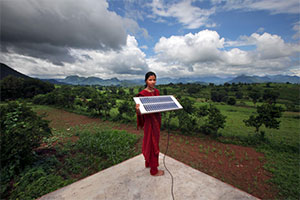 Bringing clean energy to rural India. Credit: Abbie Trayler-Smith / Panos Pictures / Department for International Development
Large reserves of oil, gas and minerals in developing countries generate opulent revenues. They could be used to stimulate economic growth and reduce poverty, but often result in environmental destruction and conflict, benefiting large companies and corrupt governments. Furthermore, competition over natural resources often manifests through geopolitical conflict. For example, before the US-Iraq war, Iraq’s domestic oil industry was nationalized. With US aggression came weakened Iraqi institutions and foreign intervention, thus eventually leading to the privatization of Iraqi oil, leaving the industry now largely dominated by Western companies. As another example, China’s rising investments within the lithium sector in South America are increasing the US-China rivalry across the Western Hemisphere. Notably, Bolivia has the largest reserves of lithium in the world, and the nation’s state-owned lithium extraction firm recently signed a contract with China’s CBC Consortium, while rejecting the entry of Western firms into the nation. In Bolivia’s case, rising Chinese investment in the nation’s lithium sector also raises concerns about environmental sustainability and the sociopolitical rights of Indigenous communities. More broadly, Sub-Saharan Africa holds nearly 30% of global reserves of critical minerals required for low-carbon technologies. Despite this, the region attracts less than 10% of global exploration investment, depicting a critical barrier to both the clean energy transitions and Sub-Saharan Africa’s economic development. Furthermore, resource wealth continues to fuel conflict like Sudan’s civil war, which has led to 9.1 million internally displaced people and is intensely connected to competition over gold, water, and agricultural land. IPS covers news about major oil, gas, and mining projects, their effects on the environment and local communities, and the ideas and actions of the interest groups involved.

The Week with IPS

NEXT STOP - SDGs
Tracking global progress towards a sustainable world
Tracking global progress towards a sustainable world
