Languages
Sunday, September 27, 2026



News and Views from the Global South
Natural Resources

Opinion: Sustainable Development Goals Could Be a Game-Changer for Water
Suppose money was being deposited and withdrawn from your bank account, but you didn’t know how much. And suppose you knew you had bills coming due, but you didn’t know when or what amount would be required to cover them.
Women in the Philippines at the Forefront of the Health Food Movement
When Tinay Alterado’s team from ARUGAAN, an organisation of women healthcare advocates, visited Eastern Visayas, a region of the Philippines devastated by Typhoon Haiyan in November 2013, they noticed that the relief and rescue sites were flooded with donated milk formula, which nursing mothers were feeding to their babies in vast quantities.
Why Investors Should Think Twice before Investing in Coal in India – Part 2
In November last year, India’s power minister Piyush Goyal announced that he plans to double coal production in India by the end of this decade and, in an effort to enhance production, the Indian government has started a process of auctioning coal blocks.
World’s Richest One Percent Undermine Fight Against Economic Inequalities
The growing economic inequalities between rich and poor – and the lopsided concentration of wealth and power in the hands of the world’s one percent - are undermining international efforts to fight global poverty, environmental degradation and social injustice, according to a civil society alliance.
In Thrall to the Mall Crawl and Urban Sprawl
There's little argument about the basic facts: It's ugly (think strip malls and big box stores). It's not very convenient (hours spent behind the wheel to get to work). And it wreaks havoc on the natural environment (lost farmland and compromised watersheds).
Why Investors Should Think Twice before Investing in Coal in India – Part 1
India’s Government under Narendra Modi is in overdrive mode to please businesses and investments in the country. The much aggrandised ‘Make in India’ campaign launched in September 2014 is a clarion call for spurring investments into manufacturing and services in India and all eyes have turned to the power sector which is expected to undergo dramatic shifts.
Women Turn Drought into a Lesson on Sustainability
When a group of women in the remote village of Sadhuraks in Pakistan’s Thar Desert, some 800 km from the port city of Karachi, were asked if they would want to be born a woman in their next life, the answer from each was a resounding ‘no’.
Caribbean Community Climate-Smarting Fisheries, But Slowly
Caribbean nations have begun work on a plan to ‘climate smart’ the region's fisheries as part of overall efforts to secure food supplies.
Indonesia’s Palm Oil Industry in Need of a Makeover
Over the past three decades, 50 percent of the 544,150 square kilometres that comprise Kalimantan, the Indonesian portion of the island of Borneo, has been taken over by the palm oil industry.
Middle East Conflicts Give Hefty Boost to Arms Merchants
The ongoing conflicts in Syria, Iraq, Libya and Yemen have helped spiral arms sales upwards to the Middle East, according to a study released Monday by the Stockholm International Peace Research Institute (SIPRI).
Empower Rural Women for Their Dignity and Future
Rural women make major contributions to rural economies by producing and processing food, feeding and caring for families, generating income and contributing to the overall well-being of their households – but, in many countries, they face discrimination in access to agricultural assets, education, healthcare and employment, among others, preventing them from fully enjoying their basic rights.Anger Seethes in Gabon after Wood Company Sacks Protesting Workers
There is rising anger among trade unionists, environmentalists and civil society groups in Gabon after a wood company, Rain Forest Management (RFM), sacked 38 fixed-term workers last month in Mbomao, Ogooué-Ivindo province.
Feeding a Warmer, Riskier World
Artificial meat. Indoor aquaculture. Vertical farms. Irrigation drones. Once the realm of science fiction, these things are now fact. Food production is going high tech – at least, in some places.
Safeguarding Africa’s Wetlands a Daunting Task
African wetlands are among the most biologically diverse ecosystems on the continent, covering more than 131 million hectares, according to the Senegalese-based Wetlands International Africa (WIA).
Coal: Burning Up Australia’s Future
With less than a year to go before the United Nation’s annual climate change meeting scheduled to take place in Paris in November 2015, citizens and civil society groups are pushing their elected leaders to take stock of national commitments to lower carbon emissions in a bid to cap runaway global warming.
From the Mountains to the Sea, Timorese Women Fight for More
In Timor-Leste, the gap between rich and poor is most keenly felt by rural women and children. But while women are working hard to help rebuild Timor-Leste, their contributions are not always recognised, in a country where men’s narratives still heavily dominate.
In India, an Indoor Health Crisis
For years, Kehmli Devi, a middle-aged woman from the village of Chachadeth in India’s northern Himalayan state of Uttarakhand, has prepared her family’s meals on a wood-burning stove.
Opinion: Eco-efficient Crop and Livestock Production for Nicaraguan Farmers
For Roberto Pineda, a smallholder farmer in the Somotillo municipality of Nicaragua, his traditional practice after each harvest was to cut down and burn all crop residues on his land, a practice known as “slash-and-burn” agriculture.
Can Indigenous and Wildlife Conservationists Work Together?
Indigenous and wildlife conservationists have common goals and common adversaries, but seem to be struggling to find common ground in the fight for sustainable forests.
Opinion: Bridging the Gap – How the SDG Fund is Paving the Way for a Post-2015 Agenda
The countdown has begun to September’s Summit on the Sustainable Development Goals (SDGs), with world leaders discussing the 17 goals and 169 targets proposed by the United Nations Open Working Group.Brazil Called upon to Block Genetically Engineered Eucalyptus Trees
Forest protection, increased biodiversity and wildlife conservation are just a few of the promises made by proponents of genetically engineered (GE) plants. But campaigners are not buying these promises.« Previous Page — Next Page »


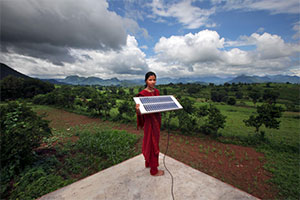 Bringing clean energy to rural India. Credit: Abbie Trayler-Smith / Panos Pictures / Department for International Development
Large reserves of oil, gas and minerals in developing countries generate opulent revenues. They could be used to stimulate economic growth and reduce poverty, but often result in environmental destruction and conflict, benefiting large companies and corrupt governments. Furthermore, competition over natural resources often manifests through geopolitical conflict. For example, before the US-Iraq war, Iraq’s domestic oil industry was nationalized. With US aggression came weakened Iraqi institutions and foreign intervention, thus eventually leading to the privatization of Iraqi oil, leaving the industry now largely dominated by Western companies. As another example, China’s rising investments within the lithium sector in South America are increasing the US-China rivalry across the Western Hemisphere. Notably, Bolivia has the largest reserves of lithium in the world, and the nation’s state-owned lithium extraction firm recently signed a contract with China’s CBC Consortium, while rejecting the entry of Western firms into the nation. In Bolivia’s case, rising Chinese investment in the nation’s lithium sector also raises concerns about environmental sustainability and the sociopolitical rights of Indigenous communities. More broadly, Sub-Saharan Africa holds nearly 30% of global reserves of critical minerals required for low-carbon technologies. Despite this, the region attracts less than 10% of global exploration investment, depicting a critical barrier to both the clean energy transitions and Sub-Saharan Africa’s economic development. Furthermore, resource wealth continues to fuel conflict like Sudan’s civil war, which has led to 9.1 million internally displaced people and is intensely connected to competition over gold, water, and agricultural land. IPS covers news about major oil, gas, and mining projects, their effects on the environment and local communities, and the ideas and actions of the interest groups involved.

The Week with IPS

NEXT STOP - SDGs
Tracking global progress towards a sustainable world
Tracking global progress towards a sustainable world
