Languages
Monday, September 28, 2026



News and Views from the Global South
Natural Resources
Prominent Lawyer Defending the Poor Gunned Down in Mozambique
As billions pour into Mozambique from foreign investors scooping up fields of coal and natural gas, the signs of newfound wealth are impossible to miss.
Opinion: Let’s Grant Women Land Rights and Power Our Future
Women are not only the world’s primary food producers. They are hardworking and innovative and, they invest far more of their earnings in their families than men. But most lack the single most important asset for accessing investment resources – land rights.Namibian President Wins $5 Million African Leadership Prize
Outgoing Namibian President Hifikepunye Pohamba was Monday named winner of the Ibrahim Prize for Achievement in African Leadership, believed to be the most lucrative individual award in the world.

Syrian Conflict Has Underlying Links to Climate Change, Says Study
Was the four-year-old military conflict in Syria, which has claimed the lives of over 200,000 people, mostly civilians, triggered at least in part by climate change?
Opinion: War on Wildlife Crime – Time to Enlist the Ordinary Citizen
It is no exaggeration to say that we are facing a “wildlife crisis”, and it is a crisis exacerbated by human activities, not least criminal ones.
Opinion: Manipulate and Mislead – How GMOs are Infiltrating Africa
The most persistent myth about genetically modified organisms (GMOs) is that they are necessary to feed a growing global population.
Bamboo – An Answer to Deforestation or Not in Africa?
Deforestation is haunting the African continent as industrial growth paves over public commons and puts more hectares into private hands.
A New Forensic Weapon to Track Illegal Ivory Trade
The wildlife trade monitoring network, TRAFFIC, is deploying a new forensic weapon - DNA testing - to track illegal ivory products responsible for the slaughter of hundreds of endangered elephants in Asia and Africa.
Opinion: Water and the World We Want
We have entered a watershed year, a moment critical for humanity.
Falling Oil Prices Won’t Derail St. Lucia’s Push for Clean Energy
At Plas Kassav, a roadside outlet in Canaries, a rural community in western St. Lucia, a busload of visitors from other Caribbean countries, along with tourists from North America and Europe, sample the 12 flavours of freshly baked cassava bread on sale.
Analysis: Collaboration Key for a Clean India
Prime Minister Narendra Modi’s call to action for a 100 percent Open Defecation Free (ODF) India by 2019 was announced as part of the Swachh Bharat Mission (SBM) or Clean India Campaign last year.
Indigenous Food Systems Should Be on the Development Menu
Overcoming hunger and malnutrition in the 21st century no longer means simply increasing the quantity of available food but also the quality.
Biogas Eases Women’s Household Burden in Rural Cuba
On the blue flame of her biogas stove, it takes half as long for rural doctor Arianna Toledo to heat bath water and cook dinner as it did four years ago, when she still used electric power or firewood.
Everything You Wanted to Know About Climate Change
So much information about climate change now abounds that it is hard to differentiate fact from fiction. Scientific reports appear alongside conspiracy theories, data is interspersed with drastic predictions about the future, and everywhere one turns, the bad news just seems to be getting worse.
Fighting Climate Change with Community Action
Not far above Trinidad’s capital, Port-of-Spain, in a corner of the St. Ann’s valley in the Northern Range, the community of Fondes Amandes has come together since 1982 to respond to climate change.
Indigenous Peoples – Architects of the Post-2015 Development Agenda
“We do not inherit the Earth from our ancestors, we borrow it from our children” – an ancient Indian saying that encapsulates the essence of sustainability as seen by the world’s indigenous people.
Keeping Food Security on the Table at U.N. Climate Talks
Food security has become a key issue of the U.N. climate negotiations this week in Geneva as a number of countries and observers raised concerns that recent advances in Lima are in jeopardy.
Getting Bang for the Buck on New Development Goals
Right now, the United Nations is negotiating one of the world’s potentially most powerful policy documents. It can influence trillions of dollars, pull hundreds of millions out of poverty and hunger, reduce violence and improve education — essentially make the world a better place. But much depends on this being done well.
Warming, Wildfires and Worries
World leaders from government, finance, business, science and civil society are attempting to negotiate a legally binding and universal agreement on climate change at the upcoming 21st United Nations Climate Change Conference being convened in Paris in December.
U.N. Climate Talks Advance Link Between Gender and Climate Change
A week of climate negotiations in Geneva, Switzerland Feb. 8-13 are setting the stage for what promises to be a busy year. In order to reach an agreement in Paris by December, negotiators will have to climb a mountain of contentious issues which continue to overshadow the talks.
Women Pick Up the Slack as Fishing Declines on India’s Southern Coasts
Geeta Selvaraj and a few other women take turns to prepare meals with just one large gas cooker in a tiny shop.« Previous Page — Next Page »


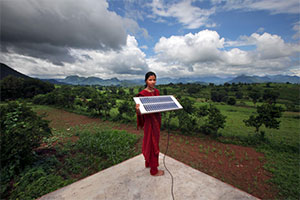 Bringing clean energy to rural India. Credit: Abbie Trayler-Smith / Panos Pictures / Department for International Development
Large reserves of oil, gas and minerals in developing countries generate opulent revenues. They could be used to stimulate economic growth and reduce poverty, but often result in environmental destruction and conflict, benefiting large companies and corrupt governments. Furthermore, competition over natural resources often manifests through geopolitical conflict. For example, before the US-Iraq war, Iraq’s domestic oil industry was nationalized. With US aggression came weakened Iraqi institutions and foreign intervention, thus eventually leading to the privatization of Iraqi oil, leaving the industry now largely dominated by Western companies. As another example, China’s rising investments within the lithium sector in South America are increasing the US-China rivalry across the Western Hemisphere. Notably, Bolivia has the largest reserves of lithium in the world, and the nation’s state-owned lithium extraction firm recently signed a contract with China’s CBC Consortium, while rejecting the entry of Western firms into the nation. In Bolivia’s case, rising Chinese investment in the nation’s lithium sector also raises concerns about environmental sustainability and the sociopolitical rights of Indigenous communities. More broadly, Sub-Saharan Africa holds nearly 30% of global reserves of critical minerals required for low-carbon technologies. Despite this, the region attracts less than 10% of global exploration investment, depicting a critical barrier to both the clean energy transitions and Sub-Saharan Africa’s economic development. Furthermore, resource wealth continues to fuel conflict like Sudan’s civil war, which has led to 9.1 million internally displaced people and is intensely connected to competition over gold, water, and agricultural land. IPS covers news about major oil, gas, and mining projects, their effects on the environment and local communities, and the ideas and actions of the interest groups involved.

The Week with IPS

NEXT STOP - SDGs
Tracking global progress towards a sustainable world
Tracking global progress towards a sustainable world
