Languages
Sunday, September 6, 2026



News and Views from the Global South
Natural Resources

Reaping the Gender Dividend
For the first time, an all-female flight crew recently operated a Royal Brunei Airlines jet from Brunei to Jeddah in Saudi Arabia. Such a feat certainly appears noteworthy in a country where gender segregation is pervasive. When women are still not permitted to drive a car; where there are separate entrances for men and women in banks, is there a possibility of an all-female crew operating a Saudi Airlines plane from Jeddah to Brunei? Not immediately, as there are disturbing signs that the limited gains on the gender front might face reversals.
Argentina’s ‘Shale Capital’ Suffers from Slowdown
The dizzying growth of Añelo, a town in southwest Argentina, driven by the production of shale oil and gas in the Vaca Muerta geological reserve, has slowed down due to the plunge in global oil prices, which has put a curb on local development and is threatening investment and employment.Damaging Effects
The year 2015 will be remembered for two landmark global agreements. In September, UN member states endorsed the 2030 Development Agenda and the Sustainable Development Goals. Later, 196 parties to the UN Framework Convention on Climate Change adopted the Paris Agreement at the conclusion of UN Climate Change Conference (COP21) in France.
Clean Water, Sanitation & Hygiene For All by 2030
Last year we watched with cautious optimism as UN chief Ban Ki-moon welcomed the new Sustainable Development Goals, and called upon the world to meet them.
Anti-Mining Protests in Turkey Book Temporary Victory
Over the past weeks, thousands of people across Turkey have protested against the planned construction of a gold mine in Cerattepe, close to the town of Artvin in the northeast of the country. Protesters fear that the mine will cause irreparable damage to the unique natural environment of the region.
Asian Scientists Grapple with How to Foster Crop Pollination
Pollinators, whose role is essential in a third of what the world eats, are at center stage after a landmark new United Nations report warned that many of the 20,000 species are threatened by human behaviour.
Groundwater Governance in Andhra Pradesh
India is the largest user of ground water in the world. But reliance of this overexploited resource has reached its limits in many parts of the country. Nowhere is this more evident than in the drought-prone districts of Rayalseema, uplands of Prakasam, Krishna, East-West Godavari, parts of Nellore, Vizianagaram and Srikakulam in the state of Andhra Pradesh (AP). Forty per cent of the state’s irrigation needs are met through groundwater. In the drought-prone Rayalseema region – which comprises Chittoor, Anantapur, Kurnool, Prakasam and Kadapa districts -- dependence on groundwater for irrigation is particularly high. The water crisis is also most severe in this region.
Fall in Commodity Prices Rings Alarm Bells in Papua New Guinea
Resource-rich Papua New Guinea (PNG) is seen as an economic powerhouse in the Pacific Islands with a state-led focus on resource extraction initially expected to drive one of the world’s highest growth rates of 15 per cent last year. But in the wake of falling commodity prices, GDP growth has plummeted from 8.5 per cent in 2014 to a forecasted 3 per cent this year. As the government faces a growing deficit between revenue and expenditure, exacerbated by high public debt, experts in the country believe greater efforts to diversify the economy are essential.
The UAE’s Journey Towards Clean Energy
The discovery of hydrocarbon reserves brought tremendous prosperity for the UAE and made it a central player in the global energy market. With one of the highest gross domestic product per capita levels in the world, the UAE has generally used its wealth wisely to stimulate sustainable economic growth. However, volatility in oil markets, growing unrest across the region and the growing threat of climate change has concentrated minds on the need for immediate and decisive action.
Global Renewable Energy Investments a Win-Win Scenario
The Paris climate change agreement adopted at the end of 2015 has put renewable energy at the heart of global energy system with investments expected to grow further even amidst the decline in fossil fuels.Zero Hunger? UN Leads With Landfill Salad and Recycled Food
When the United Nations hosted a high-level lunch for visiting world leaders at the UN dining room during the General Assembly sessions last September, they were in for an unexpected surprise.
Nevis Has A Date With Geothermal Energy
Legislators on the tiny volcanic island of Nevis in the northern region of the Lesser Antilles say they are on a path to going completely green and have now set a date when they will replace diesel-fired electrical generation with 100 per cent renewable energy.
One Fish Two Fish, No Fish: Rebuilding of Fish Stocks Urgently Needed
A major new study has revealed that the global seafood catch is much larger and declining much faster than previously known.
Science: Not Just a Western Sector, It Can Help Africa Too
Small-scale farmer Augustine Sibanda has grown resilient traditional sorghum varieties passed down through generations but has increased his yields after he adopted improved seed varieties developed through research.
Q&A: Ensuring Food Security for All
Coming from a developing country where, in our generation, we have experienced the devastating effects of food insecurity and the complexity of its root causes, I take to heart the objective of ensuring that during my mandate, CFS will make a ‘real’ difference to people’s lives. Achieving results is something that we owe each and every undernourished person who today, in 2016 goes to bed hungry. There is still an unacceptable 793 million people in this condition worldwide! Ensuring food security for all is also something that we owe our children.
Jamaica’s Climate Change Fight Fuels Investments in Renewables
By year’s end, Jamaica will add 115 mega watts (MW) of renewable capacity to the power grid, in its quest to reduce energy costs and diversify the energy mix in electricity generation to 30 per cent by 2030.
Thousands Face Hunger and Pray for Enough Rain in Malawi
It is 9 am in the morning but the scorching sun makes it feel like mid-afternoon. This type of weather is what experts are calling El Nino; a heat wave that is affecting countries in southern and eastern Africa.
CoP 21: The Start of a Long Journey
The agreement reached in December, 2015 at the 21st Conference of the Parties under the United Nations Framework Convention on Climate Change (UNFCCC) is a major step forward in dealing with the challenge of climate change. The very fact that almost every country in the world signed off on this agreement is a major achievement, credit for which must go in substantial measure to the Government of France and its leadership. However, in scientific terms, while this agreement certainly brings all the Parties together in moving ahead, in itself the commitments that have been made under the Intended Nationally Determined Contributions (INDCs) are quite inadequate for limiting temperature increase to 2 degrees Celsius by the end of this century relative to pre-industrial levels.The Role of SDGs in Achieving Zero Hunger
It is a well-known fact that 795 million or one in nine are undernourished in our world today. This figure only goes up to more than one in eight for the developing world. Hunger kills more people every year than malaria, AIDS and tuberculosis combined. At the same time, the food industry is a major source of jobs and livelihoods.
TAIWAN: Polls Harken End of Nuclear Power
Taiwan may soon be the first nation in Asia to resolve to become a nuclear free nation after four decades of reliance on nuclear power.
Jamaica’s Drought Tool Could Turn the Table on Climate Change
On a very dry November 2013, Jamaica’s Meteorological Service made its first official drought forecast when the newly developed Climate Predictability Tool (CPT) was used to predict a high probability of below average rainfall in the coming three months.« Previous Page — Next Page »


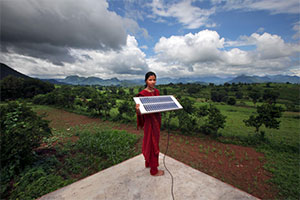 Bringing clean energy to rural India. Credit: Abbie Trayler-Smith / Panos Pictures / Department for International Development
Large reserves of oil, gas and minerals in developing countries generate opulent revenues. They could be used to stimulate economic growth and reduce poverty, but often result in environmental destruction and conflict, benefiting large companies and corrupt governments. Furthermore, competition over natural resources often manifests through geopolitical conflict. For example, before the US-Iraq war, Iraq’s domestic oil industry was nationalized. With US aggression came weakened Iraqi institutions and foreign intervention, thus eventually leading to the privatization of Iraqi oil, leaving the industry now largely dominated by Western companies. As another example, China’s rising investments within the lithium sector in South America are increasing the US-China rivalry across the Western Hemisphere. Notably, Bolivia has the largest reserves of lithium in the world, and the nation’s state-owned lithium extraction firm recently signed a contract with China’s CBC Consortium, while rejecting the entry of Western firms into the nation. In Bolivia’s case, rising Chinese investment in the nation’s lithium sector also raises concerns about environmental sustainability and the sociopolitical rights of Indigenous communities. More broadly, Sub-Saharan Africa holds nearly 30% of global reserves of critical minerals required for low-carbon technologies. Despite this, the region attracts less than 10% of global exploration investment, depicting a critical barrier to both the clean energy transitions and Sub-Saharan Africa’s economic development. Furthermore, resource wealth continues to fuel conflict like Sudan’s civil war, which has led to 9.1 million internally displaced people and is intensely connected to competition over gold, water, and agricultural land. IPS covers news about major oil, gas, and mining projects, their effects on the environment and local communities, and the ideas and actions of the interest groups involved.

The Week with IPS

NEXT STOP - SDGs
Tracking global progress towards a sustainable world
Tracking global progress towards a sustainable world
