Languages
Sunday, September 6, 2026



News and Views from the Global South
Natural Resources

Developing Countries Take Lead at Climate Change Agreement Signing
An unprecedented 175 countries signed the Paris Climate Change Agreement here Friday, with 15 developing countries taking the lead by also ratifying the treaty.
No Turning Back in the Global Fight Against Climate Change
As people around the globe observe Earth Day today, world leaders are making history at the United Nations in New York. Over 100 countries will sign the Paris Agreement on climate change, representing their commitment to join it formally. This marks a turning point in the story of our planet and may set a record for the largest number of signers to an international agreement in a single day. Moreover, last month, President Obama announced with President Xi Jinping that our two countries will sign the Paris Agreement today and formally join this year. We are confident other countries will do so too, with the intention of bringing this historic and ambitious agreement into force as quickly as possible.
Soil and Pulses: Symbiosis for Life
The Food and Agriculture Organization of the United Nations (FAO) in partnership with Biodiversity International and the Permanent Mission of Italy to the UN (Rome based UN agencies) jointly organized a seminar on “Soils and pulses: symbiosis for life”, providing a platform to stakeholders, including governments, research organizations, civil society and the private sector, to deliberate increased pulses production and consumption and its relation to higher productivity and fertility of soils. 2016 is the International Year of Pulses as declared by the United General Assembly.
Opinion: Unnoticed, We Are Close to Destruction of Our Planet
On the 17th of April, Italians were called to vote in a national referendum, on the extension of licenses to extract petrol and gas from the seas. The government, the media and those in the economic circles, all took a position against the referendum, claiming that 2000 jobs were at a stake. The proponents of the referendum (among them five regions), lost. Italy is following a consistent trend, after the Summit on Climate Change (Paris December 2015), in which all countries (Italy included) took a solemn engagement to reduce emissions.
OPINION: Breaking the Grip of Rimbunan Hijau over Papua New Guinea
James Sze Yuan Lau and Ivan Su Chiu Lu must be extremely busy men. Together, they are listed as directors of some 30 companies involved in various activities and services related to logging or agribusiness in Papua New Guinea (PNG). The former is the managing director of Rimbunan Hijau (RH) PNG and son-in-law of RH’s founder Tiong Hiew King; the latter is executive director of RH PNG Ltd.. All but two of these 30 companies have the same registered address at 479 Kennedy Road, in the national capital, Port Moresby–the headquarter of the RH group in the country.
Arsenic Threat Looms Large in India: Well Switching Provides the Way Forward
An Indian Govt. Parliamentary Committee on Estimates on “Occurrence of High Arsenic (As) content in Groundwater” in December, 2014 stated that more than 70 million people in 96 districts in India is under threat due to As occurrence in groundwater.
Developing countries left out of global tax decisions
Over one hundred developing countries continue to be left out of global tax cooperation negotiations despite leaks such as the Panama papers showing the high cost of tax avoidance.
A World Drowning in Oil
Thanks to tensions between Saudi Arabia and Iran, major oil producers couldn’t come to an agreement in Doha to freeze their output to January levels to raise oil prices. The current low oil prices have a lot to do with the grim outlook for global economic growth while supply is growing. China, the second largest economy in the world, is slowing down. Not surprisingly, global oil demand is much lower at 94.8 million barrels a day vis-à-vis supply of 96.3 million barrels a day in the first quarter of 2016 according to the International Energy Agency.
Timor-Leste Brings Maritime Dispute with Australia to United Nations
Timor-Leste which won independence from Indonesia in 1999 is now engaged in a new struggle with Australia over rights to oil and gas reserves in the Timor Sea.
Focusing on Future of Food: What’s Next for Global Agricultural Research?
Food security scientists from around the globe gathered in Johannesburg last week with one objective: to work towards the transformation of agriculture as engine for growth in developing regions of the world. The gathering was also an opportunity to examine what farmers need to prosper in the face of social and environmental challenges.A Promising Start for a High Seas Treaty
Delegates from 83 countries came together at the United Nations from March 28 to April 8 for the first in a series of landmark meetings on ocean protection. This Preparatory Committee will help forge an agreement to determine how nations move forward to protect the high seas—the 64 percent of the ocean that belongs to everyone but is governed by no one.
Turning to Agriculture
Facing an unprecedented economic crisis, South Sudan -- the newest nation of the world -- has urged its 12 million inhabitants to turn to agriculture instead of depending on declining oil revenues.
Global Guidelines on Land Tenure Making Headway in Latin America
Voluntary guidelines on land tenure adopted by the international community to combat the growing concentration of land ownership and improve secure access to land have begun to make headway in Latin America, a region that is a leader in the fight against hunger and that is taking firm steps towards achieving food security.
Balancing Economic Potential of Marine and Social Life
When Africa’s oldest protected marine area, Tsitsikamma -- the largest in the world, incorporating 80 km of rocky coastline, bustling with marine life, much of it endangered -- was opened as a pilot for public fishing on December 15, 2015, there was a big outcry.
Benefits of Backpack Biogas
Billions of dollars of aid has been pumped into Africa. Yet effective change too often remains an elusive outcome, leading to a vicious cycle: more needs, more aid but still little change. How to resolve this seemingly intractable dilemma?
UN Begins Negotiations on Treaty to Protect Marine Resources
The United Nations has begun negotiations for a new legally binding treaty for the conservation and sustainable use of marine biological resources in the world’s oceans – nearly 64 percent of which lie beyond national jurisdiction.
A New Roadmap to Meet Hunger Goals
As we move the Sustainable Development Goals from ideas into actions, tracking progress is going to be paramount. Goal two, to achieve food security, can be measured in many ways. This week, scientists are revealing new research that will be invaluable for reaching target 2.5: maintaining the genetic diversity of crop plants and their wild relatives.The Fuel of Economic Growth
Water has become Pakistan`s number one development and governance issue. While water availability in our river systems has remained fairly stable, per capita water availability has diminished from about 1,500 to nearly 1,000 cubic metres, owing to a fast-growing population.
Three International Days in a Week, But Is Anybody Listening?
For three consecutive days this week, we gave thought to our future. On International Forests Day, Monday, 21 March, we were reminded that forests are vital for our future water needs. On Tuesday, 22 March, World Water Day, we learned that half the world’s workers are involved in the water sector and some 2 billion people, especially women and girls, still need access to improved sanitation. World Meteorological Day, on Wednesday, 23 March, concluded with the warning of a hotter, drier and wetter future. A reality that is already evident and frightening, as productive land turns to sand or dust.
Build Healthy, Sustainable Food Systems to Fight Malnutrition
Creating healthy and sustainable food systems is key to overcoming hunger and all forms of malnutrition (undernourishment, micronutrient deficiencies, obesity) around the world. Food production has tripled since 1945 while average food availability per person has risen by 40 per cent. Current food systems are not delivering well on ensuring healthy diets for all. We have to fix the problem. The most efficient and sustainable approach will be to reshape and strengthen food systems that support healthy diets for all.
Forests Help Quench Urban Thirst
The next time you turn on the tap to fill the kettle, you might want to spare a thought for the forest that made it possible. It may be a hundred kilometres away or more from where you are sitting, but the chances are that you owe your cup of tea, in part at least, to the trees that helped to capture the water, and to filter it on its long journey to you the consumer.« Previous Page — Next Page »


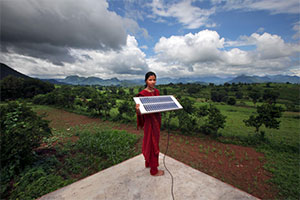 Bringing clean energy to rural India. Credit: Abbie Trayler-Smith / Panos Pictures / Department for International Development
Large reserves of oil, gas and minerals in developing countries generate opulent revenues. They could be used to stimulate economic growth and reduce poverty, but often result in environmental destruction and conflict, benefiting large companies and corrupt governments. Furthermore, competition over natural resources often manifests through geopolitical conflict. For example, before the US-Iraq war, Iraq’s domestic oil industry was nationalized. With US aggression came weakened Iraqi institutions and foreign intervention, thus eventually leading to the privatization of Iraqi oil, leaving the industry now largely dominated by Western companies. As another example, China’s rising investments within the lithium sector in South America are increasing the US-China rivalry across the Western Hemisphere. Notably, Bolivia has the largest reserves of lithium in the world, and the nation’s state-owned lithium extraction firm recently signed a contract with China’s CBC Consortium, while rejecting the entry of Western firms into the nation. In Bolivia’s case, rising Chinese investment in the nation’s lithium sector also raises concerns about environmental sustainability and the sociopolitical rights of Indigenous communities. More broadly, Sub-Saharan Africa holds nearly 30% of global reserves of critical minerals required for low-carbon technologies. Despite this, the region attracts less than 10% of global exploration investment, depicting a critical barrier to both the clean energy transitions and Sub-Saharan Africa’s economic development. Furthermore, resource wealth continues to fuel conflict like Sudan’s civil war, which has led to 9.1 million internally displaced people and is intensely connected to competition over gold, water, and agricultural land. IPS covers news about major oil, gas, and mining projects, their effects on the environment and local communities, and the ideas and actions of the interest groups involved.

The Week with IPS

NEXT STOP - SDGs
Tracking global progress towards a sustainable world
Tracking global progress towards a sustainable world
