Languages
Sunday, September 6, 2026



News and Views from the Global South
Natural Resources

Bees and Silkworms Spin Gold for Ethiopia’s Rural Youth
Beekeeping and silkworm farming have long been critical cogs of Ethiopian life, providing food, jobs and much needed income.
Justice for Berta Caceres Incomplete Without Land Rights: UN Rapporteur
The murder of Honduran Indigenous woman Berta Caceres is only too familiar to Victoria Tauli-Corpuz, the UN’s Special Rapporteur on the Rights of Indigenous Peoples.
Deadly Algal Bloom Triggers Social Uprising in Southern Chile
A ban on harvesting shellfish in Chiloé due to a severe red tide outbreak sparked a social uprising that has partially isolated thousands of local residents of the southern Chilean archipelago and revived criticism of an export model that condemns small-scale fishing communities to poverty and marginalisation.
Biomass Could Help Power Africa’s Energy Transition
As fuel, firewood remains the dominant source of energy in Uganda. It has a long history of being unsustainably harvested, leading to severe depletion of the country’s forest cover. But with new technology, biomass is now cleaning up its act.
Climate Change Leaves Kashmir’s Economy High and Dry
Trudging barefoot on his two-acre piece of land, 57-year-old Mukhtar Ahmad has little hope of growing any crops this year due to the sudden dry spell that has struck Kashmir’s winter.
WFO Calls for Farmer-Centred Sustainable Development
Over 600 delegates representing at least 570 million farms scattered around the world gathered in Zambia from May 4-7 under the umbrella of the World Farmers' Organisation (WFO) to discuss climate change, land tenure, innovations and capacity building as four pillars on which to build agricultural development.
Nobel Peace Laureates to Help Achieve Food Security
The Food and Agriculture Organisation (FAO) believes that ongoing military conflicts, which have also devastated agricultural crops and livestock, are one of the primary causes of food shortages in war zones in Africa and the Middle East.
Farmers Can Weather Climate Change – With Financing
Merian Kalala, a farmer in Solwezi, capital of the North-Western Province of Zambia, knows firsthand that climate change is posing massive problems for agricultural productivity.
No Farmers, No Food — True But Not Enough
Agriculture is the primary sector of all economies. It is the sector responsible for granting food and nutrition security to all human beings. Consequently it is responsible for social stability and health. And it provides work opportunities to families, men, women and youth, and largely contributes to the country Gross Domestic Product (GDP).
An Inclusive and Sustainable Approach to Rural Electrification in India: Case of Decentralized Renewable Systems
The Declaration of 2014- 2024 as the ‘Decade of Sustainable Energy for All’ by the United Nations (UN) is a clear manifestation of the importance attached to energy in the process of development. Setting ‘Universal Access to Energy’ as one of the goals of UN’s ‘SE4All’ initiative is reiteration of the fact that access to energy constitutes an essential ingredient in the process of economic development of any country. This underscores the complex and inextricable link that exists between energy and sustainable development.
Farmers Hold Keys to Ending Poverty, Hunger, FAO Says
With recent data showing that 793 million people still go to bed hungry, ending hunger and poverty in 15 years is the next development challenge that world leaders have set for themselves.
Seeking a New Farming Revolution
As the World Farmers' Organization meets for its annual conference in Zambia to promote policies that strengthen this critical sector, IPS looks at how farmers across the globe are tackling the interconnected challenges of climate change, market fluctuations, water and land management, and energy access.
New Generation Aims to Plug Africa’s Research Deficit
The tonnes of uncollected garbage piling up on the streets of her home in Cairo was a brain wave for Sherien Elagroudy.
Indian Women Worst Hit by Water Crisis
A staggering 330 million Indians, making up a quarter of the country's population (or roughly the entire population of the United States), are currently reeling under the effects of a severe drought, resulting in an acute drinking water shortage and agricultural distress.
Black Colombian Activists Continue Our Struggle For Rights
While Colombia’s peace talks continue in Havana, Cuba, back home in the region of North Cauca, Black Colombians have found their cries for access to their ancestral lands met with tear-gas and rubber bullets.
West Papuans Turn to Africa for Support in Freedom Bid
For more than half a century, the indigenous people of West Papua, located on the western side of the island of New Guinea, who are related to the Melanesians of the southwest Pacific Islands, have waged a resistance to governance by Indonesia and a relentless campaign for self-determination.
World Farmers’ Organisation Meeting Eyes New Markets, Fresh Investment
‘No Farmer, No Food’ is an old slogan that the Zambia National Farmers’ Union still uses. Some people consider it a cliché, but it could be regaining its place in history as agriculture is increasingly seen as the answer to a wide range of the world’s critical needs such as nutrition, sustainable jobs and income for the rural poor.
UN Predicts 40 Percent Water Shortfall by 2030
Ten presidents and prime ministers from around the world will work together to resolve the growing global water crisis amid warnings that the world may face a 40 percent shortfall in water availability by 2030.
Opinion: Increasing Productivity Key to Revive Growth and Support Sustainable Development in Asia and the Pacific
The Asia-Pacific region’s successful achievement of the 2030 Agenda for Sustainable Development needs to be driven by broad-based productivity gains and rebalancing of economies towards domestic and regional demand. This is the main message of the Economic and Social Survey of Asia and the Pacific 2016, published today by the Economic and Social Commission for Asia and the Pacific. Such a strategy will not only underpin the revival of robust and resilient economic growth, but also improve the quality of growth by making it more inclusive and sustainable.
G-77 Should Adopt South-South Climate Change Program of Action: Ambassador Djoghlaf
The 134 members of the Group of 77 and China (G-77) made their mark on the Paris Climate Change Agreement and should now adopt a program of action to implement it, Ambassador Ahmed Djoghlaf told IPS in a recent interview.
Harvesting Rainwater to Weather Drought in Northeast Argentina
In a semiarid region in the northeast Argentine province of Chaco, small farmers have adopted a simple technique to ensure a steady water supply during times of drought: they harvest the rain and store it in tanks, as part of a climate change adaptation project.« Previous Page — Next Page »


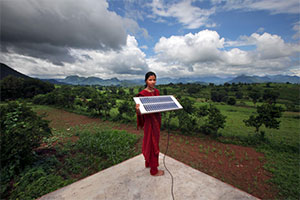 Bringing clean energy to rural India. Credit: Abbie Trayler-Smith / Panos Pictures / Department for International Development
Large reserves of oil, gas and minerals in developing countries generate opulent revenues. They could be used to stimulate economic growth and reduce poverty, but often result in environmental destruction and conflict, benefiting large companies and corrupt governments. Furthermore, competition over natural resources often manifests through geopolitical conflict. For example, before the US-Iraq war, Iraq’s domestic oil industry was nationalized. With US aggression came weakened Iraqi institutions and foreign intervention, thus eventually leading to the privatization of Iraqi oil, leaving the industry now largely dominated by Western companies. As another example, China’s rising investments within the lithium sector in South America are increasing the US-China rivalry across the Western Hemisphere. Notably, Bolivia has the largest reserves of lithium in the world, and the nation’s state-owned lithium extraction firm recently signed a contract with China’s CBC Consortium, while rejecting the entry of Western firms into the nation. In Bolivia’s case, rising Chinese investment in the nation’s lithium sector also raises concerns about environmental sustainability and the sociopolitical rights of Indigenous communities. More broadly, Sub-Saharan Africa holds nearly 30% of global reserves of critical minerals required for low-carbon technologies. Despite this, the region attracts less than 10% of global exploration investment, depicting a critical barrier to both the clean energy transitions and Sub-Saharan Africa’s economic development. Furthermore, resource wealth continues to fuel conflict like Sudan’s civil war, which has led to 9.1 million internally displaced people and is intensely connected to competition over gold, water, and agricultural land. IPS covers news about major oil, gas, and mining projects, their effects on the environment and local communities, and the ideas and actions of the interest groups involved.

The Week with IPS

NEXT STOP - SDGs
Tracking global progress towards a sustainable world
Tracking global progress towards a sustainable world
