Languages
Thursday, October 29, 2026



News and Views from the Global South
Natural Resources

Fracking, Seismic Activity Grow Hand in Hand in Mexico
Scientists warn that large-scale fracking for shale gas planned by Mexico’s oil company Pemex will cause a surge in seismic activity in northern Mexico, an area already prone to quakes.
For Guyana, Energy Plus Efficiency Equals Common Sense Development
Guyana is shaping up to set a gold standard for the Caribbean in implementing a national energy efficiency strategy to curb greenhouse gas emissions from fossil fuels.
IPCC Climate Report Warns of “Growing Adaptation Deficit”
The latest update of the world’s scientific consensus on climate change finds not only that impacts are already being felt on every continent, but also that adaptation investments are dangerously lagging.
Commonwealth Works to Raise Climate Resilience on Global Agenda
As they fine-tune preparations for the Small Island Developing States (SIDS) Conference in Samoa and the United Nations post-2015 development framework meeting in September, Commonwealth states are focusing on getting the international community to pay more attention to the challenges they face.
ExxonMobil to Disclose Carbon Emissions Risk
As the international community and the U.S. government place a heightened emphasis on reducing carbon emissions as a way to combat global climate change, shareholders have convinced the oil-and gas giant ExxonMobil to publicly disclose the risk that strengthened regulation could pose to its profits.
U.S. Joins Global Transparency Tide in Extractives Sector
An unusual combination of industry, government, investors and civil society here is celebrating the United States’ initial acceptance into a prominent global initiative aimed at strengthening transparency and accountability in the extractives industry.
Port Development Brings Progress to Brazil – At a Price
“We are victims of progress,”complained Osmar Santos Coelho, known as Santico. His fishing community has disappeared, displaced to make way for a port complex on São Marcos bay, to the west of São Luis, the capital of the state of Maranhão in Brazil’s northeast.
Egypt Gets Muscular Over Nile Dam
When Egypt’s then-president Mohamed Morsi said in June 2013 that “all options” including military intervention, were on the table if Ethiopia continued to develop dams on the Nile River, many dismissed it as posturing. But experts claim Cairo is deadly serious about defending its historic water allotment, and if Ethiopia proceeds with construction of what is set to become Africa’s largest hydroelectric dam, a military strike is not out of the question.World Bank Clears Congo’s Controversial Dam Project
The World Bank Thursday approved a 73.1-million-dollar grant in support of a controversial giant dam project in the Democratic Republic of the Congo (DRC).
Carbon-Cutting Initiative May Harm Indigenous Communities
Civil society and advocacy groups are warning that a prominent carbon-reduction initiative, aimed at curbing global emissions, is undermining land tenure rights for indigenous communities, putting their livelihoods at risk.In Accepting Ethiopia, Transparency Group “Sacrifices Credibility”
A major international initiative aimed at promoting transparency in the extractives industry is coming under harsh criticism for accepting an application from Ethiopia, despite significant ongoing legal restrictions on the country’s civil society.
Pepsi Pledge Signals Momentum on Land Rights
PepsiCo, the world’s second largest food and beverage manufacturer, has agreed to overhaul its longstanding policies around land rights, instituting a series of new safeguards and transparency pledges throughout its global supply chains.
Georgia Opts for Gold Mining at Protected Historical Site
It turns out the choice between gold and historical preservation is an easy one to make for officials in Georgia: the government is going for gold.
U.S. Oil Firm Creates Tension over Western Sahara
Even as U.S. and Moroccan executives meet to discuss strengthening private sector ties between the two countries, advocacy groups are raising concerns about plans by a U.S. energy firm to explore for oil in the contested territory known as Western Sahara.
Sun Shines on Forest Women
Chintapakka Jambulamma, 34, looks admiringly at a solar dryer. It’s the prized possession of the Advitalli Tribal Women’s Co-operative Society- a collective of women entrepreneurs that she leads.
Kerala Throttling its Golden Goose
Farming, tourism, poor fishing practices along with misdirected policies are muddying the famous backwaters of Kerala, one of India’s best known holiday destinations. Nowhere is this misuse more visible than in and around the 95-km-long Vembanad Lake.
Chevron Wins Latest Round in Ecuador Pollution Case
In the latest twist in a 21-year-old environmental pollution case, a U.S. federal judge Tuesday ruled that the victims of massive oil spillage and their U.S. attorney could not collect on a nine-billion-dollar judgement by Ecuador’s supreme court against the Chevron Corporation.
Kyrgyzstan Coal Wars Stymie Critical Industry
Kara-Keche, a sprawling deposit containing about 430 million tonnes of coal in mountainous Naryn Province, is a key asset for Kyrgyzstan’s struggling economy.Water, Water, Everywhere: To Green our Deserts
Providing water for our still growing human population is reaching crisis levels. Water is vital for agriculture, energy production and industrial processes worldwide. Floods and droughts in Asia, Latin America, Europe and the United States accompanied unprecedented typhoons and winter storms. While none could be linked directly to climate change, the debate surfaced. Mainstream media started covering these issues more broadly.
An Equal Share of Wealth Equals Lasting Peace in CAR
While wrangling over Central African Republic’s (CAR) wealth in natural resources played a role in the country's crisis, its future peace and stability still partly depends on a solution that factors in how to equitably distribute its national wealth.
Arab NGOs Warn IMF Against Sharp Cuts to Subsidies
Civil society activists from five Arab countries are urging the International Monetary Fund (IMF) to ease pressure on their governments to reduce food and fuel subsidies until stronger social-protection schemes and other basic reforms are implemented.« Previous Page — Next Page »





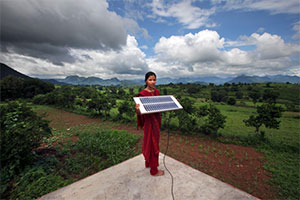 Bringing clean energy to rural India. Credit: Abbie Trayler-Smith / Panos Pictures / Department for International Development
Large reserves of oil, gas and minerals in developing countries generate opulent revenues. They could be used to stimulate economic growth and reduce poverty, but often result in environmental destruction and conflict, benefiting large companies and corrupt governments. Furthermore, competition over natural resources often manifests through geopolitical conflict. For example, before the US-Iraq war, Iraq’s domestic oil industry was nationalized. With US aggression came weakened Iraqi institutions and foreign intervention, thus eventually leading to the privatization of Iraqi oil, leaving the industry now largely dominated by Western companies. As another example, China’s rising investments within the lithium sector in South America are increasing the US-China rivalry across the Western Hemisphere. Notably, Bolivia has the largest reserves of lithium in the world, and the nation’s state-owned lithium extraction firm recently signed a contract with China’s CBC Consortium, while rejecting the entry of Western firms into the nation. In Bolivia’s case, rising Chinese investment in the nation’s lithium sector also raises concerns about environmental sustainability and the sociopolitical rights of Indigenous communities. More broadly, Sub-Saharan Africa holds nearly 30% of global reserves of critical minerals required for low-carbon technologies. Despite this, the region attracts less than 10% of global exploration investment, depicting a critical barrier to both the clean energy transitions and Sub-Saharan Africa’s economic development. Furthermore, resource wealth continues to fuel conflict like Sudan’s civil war, which has led to 9.1 million internally displaced people and is intensely connected to competition over gold, water, and agricultural land. IPS covers news about major oil, gas, and mining projects, their effects on the environment and local communities, and the ideas and actions of the interest groups involved.

The Week with IPS

NEXT STOP - SDGs
Tracking global progress towards a sustainable world
Tracking global progress towards a sustainable world
