Languages
Friday, October 30, 2026



News and Views from the Global South
Natural Resources

Arab NGOs Warn IMF Against Sharp Cuts to Subsidies
Civil society activists from five Arab countries are urging the International Monetary Fund (IMF) to ease pressure on their governments to reduce food and fuel subsidies until stronger social-protection schemes and other basic reforms are implemented.
Shifting Rainy Season Wreaks Havoc on Barbuda’s Crops
Water rationing has become a way of life for the 1,800 residents of the tiny island of Barbuda, which has been experiencing prolonged dry periods, especially in the Highlands area near the main agricultural lands.
Rich Railroad Brings Few Opportunities in Brazil
The Carajás railroad, regarded as the most efficient in Brazil, runs a loss-making passenger service for the benefit of the population. But this does little to make amends for its original sin: it was created to export minerals and crosses an area of chronic poverty.
Economic Reforms Needed for Peace in South Sudan
Gatmai Deng lost three family members in the violence that erupted in South Sudan on Dec. 15 and lasted until the end of January. And he blames their deaths on the government’s failure to use the country’s vast oil revenues to create a better life for its almost 11 million people.
An Environment-Wrecking Pipeline Hangs in Limbo
The Pine Ridge Reservation of the Lakota Nation, in the midwest of the United States, is one of the most abandoned places in the country and in the world.
‘Humanitarian Crisis’ for Ogaden Living Near Ethiopia’s Oil Fields
New allegations of scorched earth evictions of the Ogaden people have raised concerns that a lack of benefit sharing could escalate instability in the region and reinforce separatist tensions as foreign energy companies prepare to extract oil and gas from troubled southeastern Ethiopia.
Poverty Rises Amidst Gold
Natural reserves such as gold, copper, nickel, gas and timber are being extracted in the western Pacific island states of Papua New Guinea and Solomon Islands to feed the soaring economies of East and South East Asia. But despite these Pacific nations recording economic growth rates of 6-11 percent over the past seven years, opportunities for human development have not been grasped.
Website Gives Real-Time Snapshot of Deforestation
A new website launched Thursday will allow governments, businesses, civil society and private citizens to monitor near real-time loss and gain in forest cover in every country around the world.
Chagos Islanders ‘Will Not Give Up’ Fight to Return Home
“The Marine Protected Area (MPA) created around the Chagos archipelago is a new obstacle that the British government has placed in our path to prevent us from going back to our homeland,” claims Olivier Bancoult, leader of the Chagos Refugees Group (CRG).

U.N. Focuses on Faltering Goals: Water, Sanitation, Energy
When the U.N.'s Millennium Development Goals (MDGs) reach their deadline in 2015, there will still be a critical setback: millions of people in the developing world without full access to safe drinking water, proper sanitation and electricity in their homes.
“Blessed” Rains Become a Curse in Antigua
 Antigua is one of the most drought-prone countries in the Caribbean. So whenever it rains, the inhabitants generally regard the weather as “showers of blessing”.

DRC Mega-Dam to Be Funded by Private Sector, Groups Charge
Watchdog groups here are warning that a deal has been struck that would see Chinese investors fund a massive, contentious dam on the Congo River, the first phase of a project that could eventually be the largest hydroelectric project in the world.

Fossil Fuel Subsidies Dampen Shift Towards Renewables
Despite evolving public awareness and alarm over climate change, subsidies for the production and consumption of fossil fuels remain a stubborn impediment to shifting the world’s energy matrix towards renewable sources.Philippines Makes Tentative Truce With Islamists
After two years of intensive negotiations, the Philippine government and the country’s largest rebel group, the Moro Islamic Liberation Front (MILF), have signed a final peace agreement, which paves the way for a lasting resolution of one of the world’s longest-running intra-state conflicts.
Egypt’s Generals Face a Watery Battle
Heavy reliance on water intensive crops, a major upstream dam project for the Nile basin, and rising groundwater levels pushing at pharaoh-era monuments will be pressing issues for the next Egyptian president - whether military or civilian.
U.S. Selling Coal Mining Rights at Undervalued Prices
The U.S. government is violating federal leasing policies when it sells land to certain coal-mining companies, according to a new audit from an official watchdog agency.
After Slowdown, Global Fight for Land Rights at Tipping Point
Global trends towards a strengthening of legal rights over land for local and indigenous communities appear to have slowed significantly in recent years, leading some analysts to warn that the fight for local control over forests has reached an inflection point with a new danger of backtracking on previous progress.
Caribbean Walks the Talk on Clean Energy Policy
Despite having an abundance of wind and sunshine, Caribbean countries have found that going green is requiring significant shifts in policy, and most importantly, significant financing.
Q&A: Africa’s Tremendous Progress Amid War and Famine
The issue of peace and security, particularly in South Sudan and the Central African Republic, are expected to dominate the discussions at the African Union’s (AU) semi-annual summit being held in Addis Ababa, Ethiopia, this week.
U.S. Tightens Development Safeguards
Development activists and rights watchdogs are applauding a surprise strengthening of environmental and human rights policies governing U.S. development funding and overseas financial assistance.U.S. Agency Accused of Safeguards Failure in Liberia Investment
Hundreds of Liberians have filed a complaint accusing a U.S. government agency of failure to carry out due diligence or ensure that safeguards were followed for investments made to a failed biomass project in Liberia.« Previous Page — Next Page »





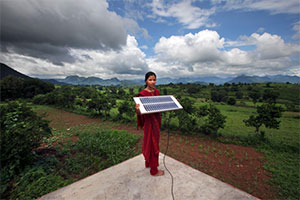 Bringing clean energy to rural India. Credit: Abbie Trayler-Smith / Panos Pictures / Department for International Development
Large reserves of oil, gas and minerals in developing countries generate opulent revenues. They could be used to stimulate economic growth and reduce poverty, but often result in environmental destruction and conflict, benefiting large companies and corrupt governments. Furthermore, competition over natural resources often manifests through geopolitical conflict. For example, before the US-Iraq war, Iraq’s domestic oil industry was nationalized. With US aggression came weakened Iraqi institutions and foreign intervention, thus eventually leading to the privatization of Iraqi oil, leaving the industry now largely dominated by Western companies. As another example, China’s rising investments within the lithium sector in South America are increasing the US-China rivalry across the Western Hemisphere. Notably, Bolivia has the largest reserves of lithium in the world, and the nation’s state-owned lithium extraction firm recently signed a contract with China’s CBC Consortium, while rejecting the entry of Western firms into the nation. In Bolivia’s case, rising Chinese investment in the nation’s lithium sector also raises concerns about environmental sustainability and the sociopolitical rights of Indigenous communities. More broadly, Sub-Saharan Africa holds nearly 30% of global reserves of critical minerals required for low-carbon technologies. Despite this, the region attracts less than 10% of global exploration investment, depicting a critical barrier to both the clean energy transitions and Sub-Saharan Africa’s economic development. Furthermore, resource wealth continues to fuel conflict like Sudan’s civil war, which has led to 9.1 million internally displaced people and is intensely connected to competition over gold, water, and agricultural land. IPS covers news about major oil, gas, and mining projects, their effects on the environment and local communities, and the ideas and actions of the interest groups involved.

The Week with IPS

NEXT STOP - SDGs
Tracking global progress towards a sustainable world
Tracking global progress towards a sustainable world
