
Friday, November 20, 2026



News and Views from the Global South
Environment
U.N. Biodiversity Plan Demands Voice for Women
Women provide up to 90 percent of the rural poor's food and produce up to 80 percent of food in most developing countries, and yet they are almost completely ignored when policy decisions are made about agriculture and biodiversity.Agro-Tech Alone No Panacea for Food Insecurity
Providing technology to communities to ensure food security doesn't work if local traditions and social dynamics are not taken into account, concluded the participants in a forum here at the Fourth Assembly of the Global Environment Facility.
MEXICO: Women Electrical Workers at Centre of Struggle for Jobs
"Our male coworkers have had to acknowledge it: we have worked side by side in this struggle," says Emilia Peña, describing the role of women in driving forward the battle waged by thousands of workers to reopen a state power company in Mexico.Peruvian Congress Calls in Debt from U.S. Oil Executive
The Peruvian Congress has opened proceedings to demand that U.S. businessman William Kallop pay the Treasury 482.2 million dollars -- taxes on the 900-million-dollar sale of a petroleum company and other debts to the government.BRAZIL: Bridge to Drive Urban Growth in Heart of Amazon
The 74 pillars that will hold up the bridge over the Negro river to join this major city in Brazil's Amazon jungle to nearby urban districts have mostly been laid, without environmental protests or major debates on the impact of a fast-growing metropolitan area in the heart of the Amazon rainforest.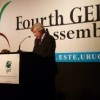
LATIN AMERICA: Governments Call for Greater Voice in Environmental Funding
"There should be a mechanism for recipient countries to help bring about a more balanced distribution of GEF funds," Cuban delegate Jorge Luis Fernández told IPS after a forum Tuesday on how to boost the efficiency and effectiveness of the Global Environment Facility.
Historic Conservation Pact a Decade in the Making
It was here in Yellowknife, on an inlet of the Great Slave Lake, that Stephen Kakfwi, then a minister of wildlife and economic development who would go on to become premier of the Northwest Territories, brought together in 1996 a group that would decide which areas of the forest needed to be protected and which areas could be developed.NICARAGUA: Nature as a Sword of Damocles
More than 1.8 million Nicaraguans are at high risk due to the various natural disasters that strike this Central American country, according to Civil Defence authorities.CLIMATE CHANGE: Latin America, EU Set Sights on Cancun Summit
Governments from the European Union and from Latin America and the Caribbean are confident that at year's end the international climate conference will produce a concrete legal mandate to truly protect the environment.
Q&A: “Militarisation of Zimbabwe’s Diamond Fields Continues”
Almost a year after a review mission of the Kimberley Process Certification Scheme (KPCS) found Zimbabwe guilty of "serious non-compliance" with the scheme’s minimum criteria on conflict diamonds, the militarisation of the southern African country’s diamond mining operations continues.GULF: Search On for Green Options to Forestall Water Shortage
Realising that achieving water security in the future is not an option but a necessity, oil-rich Gulf countries are striving to find new environment-friendly and more economical ways of producing freshwater.
More Funds, Less Red Tape, NGOs Tell GEF Assembly
Civil society organisations called for more funds, less bureaucracy and greater decision-making power, at the opening of the Fourth Global Environment Facility (GEF) Assembly Monday in this Uruguayan resort town.BOLIVIA: Morales Caught Between Gas Revenues and Indigenous Demands
The Bolivian government negotiated with native groups to head off major marches and roadblocks aimed at demanding protection of indigenous land rights and conservation of the environment in their territories.
How to Spend Environmental Funds
The world's multilateral credit institutions have often faced the criticism that they cause more problems than they prevent. As the challenges increase, such as those posed by climate change, the debate is shifting to environmental financing.U.N. Body Urges Caution on Synthetic Bacteria, Geoengineering
Scientists announced the creation of first self-replicating synthetic life form last Friday, and a few hours later, a United Nations science advisory body meeting here urged countries to take a strong precautionary approach to avoid release of such entities into the environment.BRAZIL: Report Challenges Rio Slum Evictions
The debate surrounding the evacuation decree for eight "favelas" or slums in this Brazilian city, ordered by the Rio municipal government citing the danger of landslides, has taken a new course with the release of a study that undermines the official argument.
AFRICA: “EU Subsidises Companies Guilty of Illegal Fishing”
The European Union has for years been paying subsidies to the tune of one billion euro annually to industrial fishing companies based in its member states, including companies that have been caught fishing illegally in African waters.
BIODIVERSITY: Watching Over the Future
Her husband died last year, but "he will be forever a guardian of biodiversity."
Imagine a World Without Bluefin Tuna
The resistance against banning trade in bluefin tuna leaves the door open to industrial fishing, with unforeseen consequences for the ecological balance of the seas, say experts.
Latin America and Europe Set Sights on Next Climate Summit
Sustainable development actions are bringing Latin American and European countries together in agreements that activists are criticizing due to their "market-based profile."Ecobreves – BRAZIL: Purified Water, No Energy Wasted
A technique developed by researchers at the University of São Paulo's school of agriculture could help Brazilians obtain purified water at low cost and using less energy.« Previous Page — Next Page »


Through our global network of local writers, we are continuing our award-winning coverage of global and local environmental challenges, with a focus on the people for whom the ecosphere matters in a direct way: rural dwellers who have little means to protect themselves against adverse conditions; communities that need to switch to sustainable development in order to survive; poor women and children, who are the most vulnerable in natural disasters. Sponsored by the United Nations Environment Program (UNEP), the United Nations Development Program (UNDP) and The World Bank (WB), IPS also maintains the award-winning Tierramérica, a specialised information service on environment and development.

The Week with IPS

Tracking global progress towards a sustainable world


