Languages
Wednesday, November 18, 2026



News and Views from the Global South
Active Citizens
Chile’s Native Communities Find Ally in Supreme Court
Indigenous groups in Chile celebrated a recent court ruling that represented the latest victory in the struggle for respect for their right to be previously consulted about major projects which directly affect their communities.Quake Empowers Japanese Women
Devastating as the Tohoku earthquake was it gave the local women of the remote region an opportunity to come into their own and take on leadership roles in an essentially patriarchal country.

Q&A: “Social Unrest Can Be a Creative Force”
Social unrest and demands for change are not a negative thing during times of crisis like today, says Rubens Ricupero, a Brazilian diplomat and thinker.Could Europe’s Anti-Counterfeiting Pact be a “Pandora’s Box” of Rights Violations?
Foggy details surrounding Europe’s anti-counterfeiting trade agreement (ACTA) have divided pubic opinion, with activists on one end of the spectrum claiming it to be the end of Internet freedom and the generic drug market, while proponents continue to defend the act as a “modest” agreement to protect Europe’s intellectual property.Malaysians Fight Radioactive Waste From Oz
Malaysians protesting against an Australian-owned rare earth refinery, that will generate radioactive waste, are determined to agitate until the project is abandoned.Abolitionists Target Funds Behind Nuclear Arms Industry
The world's nuclear weapons industry is being funded - and kept alive - by more than 300 banks, pension funds, insurance companies and asset managers in 30 countries, according to a new study.Little Money to Promote Gender Equality in Eastern Europe
Despite pushes from international bodies such as the United Nations (UN) or the European Union (EU) to promote gender equality in Central and Eastern Europe, access to funding for such initiatives remains largely conditional upon national governments’ willingness to embrace this agenda.More Japanese Turn Against Whaling
The arrest and release of a Dutch activist in Japan has put in bad light this country’s refusal to heed international calls to limit traditional dolphin and whale hunting practices in favour of conservation.Facing Painful Cuts and Tuition Hikes, U.S. Students “Occupy Education”
Shawn Deez, a freshman in peace and conflict studies, says she thinks she knows why some classes are scheduled at the University of California, Berkeley, and some are not. It's corporate influence that makes the difference, she said.U.N. Meet Holds Governments to Account on Women’s Equality
In 2008, delegates meeting for the annual U.N. Commission on the Status of Women (CSW) agreed that much greater investments in women and gender equality were a critical – and overlooked – aspect of sustainable development.Women Still Trapped Below Glass Ceiling of Party Politics
The right of women to participate in political life is guaranteed by several international conventions, but transforming an abstract right into a reality requires hard work on the ground, says a new study released here.CULTURE-ARAB SPRING: A Revolution Through the Lens
The Arab world is talking about a revolution; not just out on the streets but in films, in newspapers, in songs – using any means necessary to document events, expose the horrors of war and explore the struggles and possibilities that lie ahead as the Arab Spring feels the wintry chill of post-revolutionary democratic challenges.U.S.: A Musical Movement for Liberation
Inside a dimly lit restaurant in New York City's historic Harlem neighbourhood, on an unusually warm night in the middle of February, an audience of 120 people sits spellbound while a forgotten gem is dusted off, polished and presented to the crowd.
Q&A: Where Abusing Women Is “An Accepted Norm”
Violence, torture and other forms of cruel treatment are on the rise for women in the highlands of Papua New Guinea.Social Unrest on the Rise in Southern Chile
The police have cracked down hard on demonstrators in the southern Chilean region of Aysén, who have been protesting the area's isolation and high local prices of fuel and food for the past two weeks.
Illegal Wiretapping Continues in Colombia, U.N. Says
Illegal spying on human rights activists and journalists is still happening in Colombia, according to a new report by the Office of the United Nations High Commissioner for Human Rights.U.S. Voters Increasingly Alienated by Two Major Parties
A new book shows there are now more U.S. voters who identify as independent than as Democrats or Republicans, despite the fact that the two major parties maintain their virtual stranglehold on U.S. politics and, so far, on the 2012 presidential election process.Tunisia Summit Highlights Glaring Absence of Unity on the ‘Syria Question’
In the Friends of Syria meeting held in Tunis last week, Gulf Arab monarchies offered nearly unqualified support for the Syrian opposition, while the democratic states were more cautious.SPAIN: Demonstrators Protest Bank Bailouts and Spending Cuts
Demonstrators in nearly two dozen cities in Spain raised their voices Friday to protest against the use of public funds to bail out banks while the budgets for basic services like education and health are being slashed.NGOs Urge “Solution from Within” For Somalia
While the international community discusses Somalia's future in London and Brussels, European and Somali non-governmental organisations are calling for a radical shift from a military to a humanitarian approach as the only solution to the country's war-torn condition.Privatisation Derailed Argentina’s Rail System
Increasingly frequent and tragic railway accidents in Argentina, like this week’s crash, show that the rail system, run by private companies that receive hundreds of millions of dollars in subsidies from the state, constantly ignores warnings from inspectors and fines, observers say.« Previous Page — Next Page »


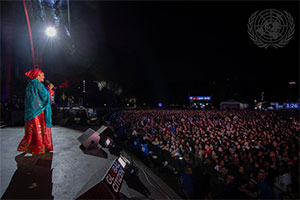 Global Citizen Festival in New York. Credit: UN Photo/Eskinder Debebe
Active citizens are committed to social change because they know that it is achievable. However, major political challenges face active citizens across the world. For example, in authoritarian regimes in Latin America where the hegemonic party has been in power for decades on end, protestors and human rights activists face enormous repression and struggle to materialize their advocacy into concrete results. The same can be said for Africans, where a shift towards elected government in recent decades has yet to translate into an effective voice in decision-making. Now, the Strengthening Citizen Demand for Good Governance, which uses evidence-based approaches – funded by DFID's Governance and Transparency Fund – seeks to raise their voices.
In 2025, the CIVICUS Monitor’s People Power Under Attack report revealed that civic freedoms are severely limited in 122 of 198 countries and territories, and only 7.2% of the global population now lives in countries where civic space is open. Through partnership with the Overseas Development Institute (ODI) and CIVICUS, IPS reporters across the continent will seek to define the extent and limits of state capability, government accountability and the responsiveness of leaders to the needs of citizens.

The Week with IPS

NEXT STOP - SDGs
Tracking global progress towards a sustainable world
Tracking global progress towards a sustainable world
