Languages
Monday, October 26, 2026



News and Views from the Global South
Active Citizens

What can Development Banks do to Protect Human Rights?
In a petition signed by 150 NGOs, the Coalition for Human Rights in Development have called for development banks to make sure that human rights are respected by their beneficiaries.
Teachers and Students: Tip of Iceberg of Mexico’s Human Rights Crisis
Mexico is experiencing a monumental human rights crisis. There is abundant evidence of widespread human rights violations in the country, including torture, extrajudicial executions, enforced disappearances and violence against journalists and human rights defenders.
Civil Society Organizations Worried About Declining Involvement
Less than a year after the adoption of the global Sustainable Development Goals (SDGs), non-government organizations (NGOs) are concerned about declining possibilities for participation, both at the UN and in national politics.
Girls in Rural Bangladesh Take Back Their Futures
Four years ago, Farzana Aktar Ruma, now 18, was almost married off without her consent.
Talking Openly – The Way to Prevent Teenage Pregnancy
In plain and simple language, an Argentine video aimed at teenagers explains how to get sexual pleasure while being careful. Its freedom from taboos is very necessary in Latin American countries where one in five girls becomes a mother by the time she is 19 years old.
Crisis of the Left
Over the last few years, quite a few countries have witnessed the rise of social movements against inequality, xenophobia, and fiscal austerity. The most notable of these are the Occupy movement and Bernie Sanders’ campaign in the US, Syriza and Podemos in continental Europe, and the rise of Jeremy Corbyn and the Momentum campaign in Britain’s Labour party.
Post-War Truth and Justice Still Elusive in Bougainville
Almost every family in the islands of Bougainville, an autonomous region of about 300,000 people in the Pacific Island state of Papua New Guinea, has a story to tell of death and suffering during the decade long civil war (1989-1998), known as ‘the Crisis.’
Why I Started SMART ALEC – Lobbying for the Public Good
For many years, as a reporter, including for IPS, I wrote about the dominance of a giant, corporate-funded lobbying organization called ALEC (the American Legislative Exchange Council), on public policy in the United States.
Civil Society Under Serious Attack
Despite their contribution to social justice, civil society organisations came under “serious attack” in 109 countries in 2015, according to a new report published by CIVICUS Monday.
Women’s Cooperatives Ease Burden of HIV in Kenya
Seventy-three-year-old Dorcus Auma effortlessly weaves sisal fronds into a beautiful basket as she walks the tiny path that snakes up a hill. She wound up her farm work early because today, Thursday, she is required to attend her women's group gathering at the secretary’s homestead.
Can Better Technology Lure Asia’s Youth Back to Farming?
Farming and agriculture may not seem cool to young people, but if they can learn the thrill of nurturing plants to produce food, and are provided with their favorite apps and communications software on agriculture, food insecurity will not be an issue, food and agriculture experts said during the Asian Development Bank (ADB)’s Food Security Forum from June 22 to 24 at the ADB headquarters here.
Bringing Back Our Girls Is Not The End of The Story
"Wherever war reaches there is rape, and wherever rape is there is trauma, pain and terror” Zainab Bangura, Special Representative of the Secretary General on Sexual Violence in Conflict said here last week.
The Environment: Latin America’s Battleground for Human Rights
2015 was the deadliest year on record for the killings of environmental activists around the world, according to a new Global Witness report.
Civil Society in Latin America Campaigns Against Trans-Pacific Partnership
Civil society organisations from Chile, Mexico and Peru are pressing their legislatures and those of other countries not to ratify the Trans-Pacific Partnership (TPP).
Children of a Lesser God: Trafficking Soars in India
Sunita Pal, a frail 17-year-old, lies in a tiny bed in the women’s ward of New Delhi’s Ram Manohar Lohia Hospital. Her face and head swathed in bandages, with only a bruised eye and swollen lips visible, the girl recounts her ordeal to a TV channel propped up by a pillow. She talks of her employers beating her with a stick every day, depriving her of food and threatening to kill her if she dared report her misery to anybody.
Combating Rape Requires Cultural Change in Brazil
The outrage in Brazil over the gang-rape of a 16-year-old girl by more than 30 men prompted mass protests by thousands of women on the streets of cities around the country, while activists complain that the response to the case by politicians has been misfocused.
Bougainville Women Turn Around Lives of ‘Lost Generation’
Finding a sense of identity and purpose, as well as employment are some of the challenges facing youths in post-conflict Bougainville, an autonomous region in eastern Papua New Guinea in the southwest Pacific Islands.
Youth Leaders Push for More Progressive Action to End HIV AIDS
Young people are disproportionately affected by HIV, yet their concerns about sexual education, and discrimination of key populations were ignored at the UN General Assembly High Level Meeting on ending AIDS.
Fear of a Triumph by Keiko Fujimori, the Key to Peru’s Elections
Thousands of Peruvians took to the streets of Lima and other cities to protest the likely triumph in the Sunday Jun. 5 runoff election of Keiko Fujimori, the daughter of former president Alberto Fujimori, who is serving a 25-year sentence for corruption and crimes against humanity.
Transgender in Pakistan: A “Forgotten People”
At an open market in the district of Mehmoodabad in Karachi, Miss Bindiya Rana, 35, starts another day at work selling clothes. Living in one of the poorer parts of the city, like many others here she faces a daily struggle to make ends meet. Yet, of strong build with dyed hair and wearing heavy make-up, she and others like her face a bigger challenge than most.
LGBT Communities Silenced in HIV Reduction Efforts
Treatment for HIV and AIDS has increased, but key populations including lesbian, gay, bisexual and transgender (LGBT) communities continue to be left behind and even excluded altogether.« Previous Page — Next Page »





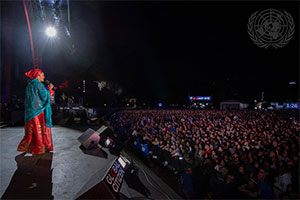 Global Citizen Festival in New York. Credit: UN Photo/Eskinder Debebe
Active citizens are committed to social change because they know that it is achievable. However, major political challenges face active citizens across the world. For example, in authoritarian regimes in Latin America where the hegemonic party has been in power for decades on end, protestors and human rights activists face enormous repression and struggle to materialize their advocacy into concrete results. The same can be said for Africans, where a shift towards elected government in recent decades has yet to translate into an effective voice in decision-making. Now, the Strengthening Citizen Demand for Good Governance, which uses evidence-based approaches – funded by DFID's Governance and Transparency Fund – seeks to raise their voices.
In 2025, the CIVICUS Monitor’s People Power Under Attack report revealed that civic freedoms are severely limited in 122 of 198 countries and territories, and only 7.2% of the global population now lives in countries where civic space is open. Through partnership with the Overseas Development Institute (ODI) and CIVICUS, IPS reporters across the continent will seek to define the extent and limits of state capability, government accountability and the responsiveness of leaders to the needs of citizens.

The Week with IPS

NEXT STOP - SDGs
Tracking global progress towards a sustainable world
Tracking global progress towards a sustainable world
