Languages
Tuesday, September 15, 2026



News and Views from the Global South
Education
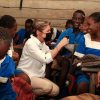
It Takes a Village to Raise and Support a Child in a Humanitarian Crisis
As we come together to celebrate people helping people on this year’s World Humanitarian Day, we honor the courageous and remarkable humanitarians delivering on the frontlines to help us achieve our goals for peace, universal human rights, and education for all.
Tapping into the Power of Young People for Climate Action
Today, our world is 1.1°C warmer than it was in the pre-industrial era, and failure to act urgently could possibly result in increases of 1.5°C-2°C between 2026 and 2042. Climate change poses a serious risk to the fundamental rights of people of every age.
Education Cannot Wait Proud to Participate in Global Citizen Festival 2022: Calling on World Leaders and Donors to Empower Girls and End Extreme Poverty Now
Education Cannot Wait (ECW) - the United Nations global fund for education in emergencies and protracted crises - is proud to support and participate in the 2022 Global Citizen Festival. Participants will call on world leaders at the UN General Assembly - and ahead of the G20 and COP27 in November - to step up and invest $600 million into the future of women and girls, close the annual $10 billion climate financing shortfall, deliver $500 million to help African farmers respond to the global food crisis, and provide relief from crushing debts to End Extreme Poverty Now.
ECW Interviews Three Inspiring #Youth4EiE Advocates on International Youth Day
On this International Youth Day, ECW interviewed three inspiring #Youth4EiE Advocates – Nataly Rivas, Angela Abizera, and Jean-Paul Saif. Nataly, Angela, and Jean-Paul are three Global Youth for Education in Emergencies panel members.
‘Aid Organizations Must Include the Youth Voice’ August 12, 2022—International Youth Day
Today marks International Youth Day, a global celebration of the transformative power of young people. Introduced by the United Nations General Assembly in 1999, the event was inaugurated not only to observe the power of the youth voice, but to serve as a promise from those in power to activate the power of youth across the development sector.
UN’s Education Summit: An Opportunity to Create a Bottom-Up Global Governance
The upcoming summit on Education, part of the UN Secretary General’s ambitious agenda, can truly bring accountability and participation to the inevitably new ways education will be imparted in the future.
Managing sea cucumber fisheries in the Pacific region: a one-day training to educate key stakeholders in New Caledonia
Holothurians, also known as sea cucumbers, are an important source of income for coastal communities in the Pacific. Their exploitation has grown over the past decades, targeting international markets. In some parts of the world, they are considered a delicacy where they can fetch very high prices consequently, they are being overfished in some areas of the Pacific region.
Frugal Innovation is Key to Advancing the UN’s Global Goal for Education
The world needs tens of millions of new teachers by 2030, according to UNESCO – an order of magnitude that requires “frugal innovation.” I’ve studied frugal innovation for more than a decade, and it holds a vital key to this global challenge. A model created by BRAC in Bangladesh deserves special attention in this worldwide pursuit.
Introducing Hope Over Fate: the Story of Sir Fazle Hasan Abed and BRAC
About seven years ago, I started working on a project with Sir Fazle Hasan Abed, the founder of BRAC. It was originally supposed to be a memoir: the story of Abed, the mild-mannered accountant who would rid the world of poverty, as told by the man himself. I was privileged to be Abed’s speechwriter for the last several years of his life, and I would sit for hours listening to stories from his remarkable life: of his boyhood in British India, his love life in London in the 1960s, his three marriages, and how, in 1972, with a few thousand pounds from the sale of his flat in Camden, he launched a small nonprofit organization to aid refugees, originally called the Bangladesh Rehabilitation Assistance Committee. Many people would go on to call BRAC, which Abed led until his death in 2019, the world’s most effective anti-poverty organization.
Not a World for Young People
Many of us assume that an identification with a certain gender, race, nation or even age makes us particularly knowledgeable. When it comes to age, it is in most cultures of the world assumed that age and experience favour wisdom. I am not entirely sure about that, though I am convinced that as we grow older we tend to overestimate our own knowledge and importance. An arrogance that might burden and even marginalize the youth.
Webinar: Lessons in Development from the Global South: 50 Years of BRAC

This virtual event was hosted by BRAC, the Permanent Mission of Bangladesh to the UN, and the Permanent Mission of Rwanda to the UN on the sidelines of the 2022 UN High Level Political Forum.
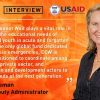
Education Cannot Wait Interviews USAID Deputy Administrator Isobel Coleman
Isobel Coleman was sworn in as Deputy Administrator for Policy and Programming at the United States Agency for International Development (USAID) in November 2021.

The Digital Divide, a Pending Issue in Chile’s Educational System
A Chilean government plan seeks to ensure connectivity in remote areas, in a first step to address a deep digital divide among the country's inhabitants that includes a lack of access to technology and digital education deficits, exposed by the COVID-19 pandemic.
Sharing Minds Can Change the World
Parasite, a Korean black comedy film directed by Bong Joon-ho, shows the story of a poor family who infiltrated the household of an affluent family by getting employment by pretending to be highly qualified persons.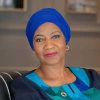
‘When it Comes to Gender Equality, Our Best is Not Good Enough’: says Dr Phumzile Mlambo-Ngcuka
The Covid-19 pandemic has impacted lives all over the world. According to this report, gender is emerging as a significant factor in the social, economic and health effects of Covid-19. Women have been hit much harder socially and economically than men. The greatest and most persistent gender gap was seen in employment and uncompensated labour, with 26% of women reporting loss of work compared with 20% of men globally in September 2021.
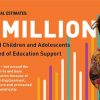
Education Cannot Wait: 222 Million Crisis-Impacted Children in Urgent Need of Educational Support According to New Study
The United Nations global fund for education in emergencies and protracted crises, Education Cannot Wait (ECW), released a shocking new report today that indicates the number of crisis-impacted school-aged children requiring educational support has grown from an estimated 75 million in 2016 to 222 million today.
Countering Hate Speech Through Media: A Young Caribbean Woman’s Perspective
Hate speech is a phenomenon that can be defined as threatening speech or writing expressing prejudice towards a specific group, primarily based on race, religion, or sexual orientation.
Taliban: The Return of Misogynistic Gynophobes in Afghanistan
Gynophobia is defined as an intense and irrational fear of women or hatred of women, it may be characterized as a form of specific phobias, which involves a fear that is centered on a specific trigger or situation, which in the case of gynophobia is women.

Bilingual Intercultural Education, an Endangered Indigenous Right in Peru
"I always express myself in Quechua and I don't feel I’m less of a person," said Elías Ccollatupa, 47, who has been a bilingual intercultural teacher for more than two decades in the Chinchaypujio district, one of the nine that make up the province of Anta, in the department of Cuzco, in the southern Andean region of Peru.
Education Cannot Wait Interviews UNICEF Executive Director Catherine M. Russell
Catherine M. Russell became UNICEF’s eighth Executive Director on 1 February 2022. Ms. Russell brings to the role decades of experience in developing innovative policy that empowers underserved communities around the world, including high-impact programmes that protect women and girls, including in humanitarian crises. She has extensive experience building, elevating and managing diverse workforces and mobilizing resources and political support for a broad range of initiatives.

Developing countries and the Perfect Storm
Part II: What Developing Countries Need to Do
Developing countries are facing a combination of crises that are unprecedented in recent times. Over the last three years they have had to face the COVID-19 crisis, the food crisis, the energy crisis, the climate change crisis, the debt crisis and, on top of all this, a global recession. The crises have overlapped, and each has added to the problems created by the previous ones.
« Previous Page — Next Page »


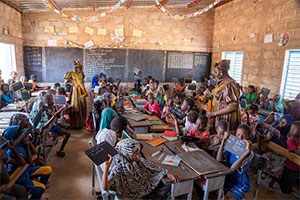 Two teachers work in a classroom in Forces Vives School in Dori, Burkina Faso. Credit: UNICEF/UNI978361
Safe and uninterrupted education is a fundamental right for all children. Education is paramount to global development, as it has been proven that investing in education – especially for girls and children – contributes significantly to economic growth and prosperity. Although more than 1 billion children go to school, many are subjected to conditions that are not conducive to a proper learning environment, including makeshift facilities, a lack of supplies, violence in classrooms, inadequate sanitation, untrained instructors, and widespread school closures. Since 2015, there have been immense gains in education with an increase of 109 million children in school. However, as of 2023, 272 million children are still out of school.
High poverty levels in developing countries also impede children’s access to a proper education. For example, from the early to mid 2000s, Sub-Saharan African nations witnessed a dramatic decline in trained teachers due to inadequate funding in the education sector. Furthermore, major cuts to United States international aid threaten an estimated 23 million additional children's access to education, as USAID‑funded school programmes across Africa and Asia face closure.
Various other factors contribute to the decline of education, notably hunger, which has increased as conflict and climate change interfere with global food production and dissemination. Meanwhile, certain social and cultural practices also impede children’s access to education, with gender inequality, discrimination, child labour, and child marriages preventing millions of children from attending school. Economic conditions such as the inaccessibility of higher education also affect disenfranchised communities across the world. In extreme situations, such as warfare where educational facilities are destroyed in their totality, notably in Gaza and Sudan, entire generations of children might grow up without access to education. Rebuilding educational infrastructure is a long and arduous process, especially when violence persists across generations, and this significantly stunts the development of societal prosperity and stability.
IPS is dedicated to telling the shocking truths about worldwide education through impassioned opinion pieces and comprehensive articles, highlighting global issues that impede worldwide education and the courses of action being taken by organizations such as UNICEF and Education Cannot Wait.

The Week with IPS

NEXT STOP - SDGs
Tracking global progress towards a sustainable world
Tracking global progress towards a sustainable world
