Languages
Monday, September 21, 2026



News and Views from the Global South
Education

Lessons from Liberia for Scaling Poverty Reduction Globally
For the past three years, BRAC International has been piloting in Liberia an adaptation of its acclaimed Graduation approach, whose impact on reducing extreme poverty was first proven in Bangladesh. The success of the Liberia pilot, which I managed, provides not only further proof of impact but vital lessons that can enhance and accelerate scaling of the approach globally.
International Women’s Day, 2022
Girls’ Education Must Come First
For decades now, world leaders have talked about ending hunger and poverty and building a new world order based on human rights and gender-equality.

International Women’s Day, 2022
Celebrating the Transformative Impact of Women as Non-Formal Educators
Women around the world play crucial roles in education as formal educators, school staff members, and parents of students. But women are also transforming education as non-formal educators in ways that can be scaled to improve education broadly. As we celebrate International Women’s Day (March 8), it’s important that this transformative role is recognized.

International Women’s Day, 2022
War, Want, Weather and Wellbeing: Where Are We Now?
WAR The world is currently facing a devastating war with dire prospects for our global security. Men are waging this war while women seek peace and security for their families, communities and our global society. Women are give birth and nurture while some men actively seek death and destruction. This is one of the fundamental differences between the sexes which underpins patriarchy and generates inequality on many levels. Women and girls bear the brunt of this unbalanced approach to life.

International Women’s Day, 2022
Women in Science – Are They Still Hidden Figures?
Again we commemorate International Women’s Day – it is March, 8. We want to celebrate women’s achievements and raise awareness for their successes, taking action for equality. Today I would like to draw your attention to women in science and in particular to one outstanding scientist.

Education Cannot Wait Interviews German Minister for Economic Cooperation and Development Svenja Schulze
ECW: Germany recently announced €200 million (US$228.3 million), in new, additional funding for Education Cannot Wait (ECW). What inspired Germany to make such a game-changing investment in ECW by prioritizing multi-year funding for education in emergencies?

Gender Lens Crucial to Leaving No One Behind (Part 2)
A crucial two-day meeting of Parliamentarians from the Asian, Arab and African regions will put human-rights-based legislative frameworks under the spotlight as the regions work to implement the ICPD Programme of Action.
Financialization at Heart of Economic Malaise
COVID-19 has exposed major long-term economic vulnerabilities. This malaise – including declining productivity growth – can be traced to the greater influence of finance in the real economy.
Alarm: Every Two Weeks a Mother Tongue Disappears Due to Globalisation
“Every two weeks a language disappears taking with it an entire cultural and intellectual heritage. At least 43% of the estimated 6000 languages spoken in the world are endangered. Only a few hundred languages have genuinely been given a place in education systems and the public domain, and less than a hundred are used in the digital world.”
International Accreditation in Education Can Bring Huge Benefits to the Pacific- If It Is Done Right
All over the world, students who attend tertiary education do so with the belief that the investment of their time, money and effort will provide them with returns on that investment that will change their lives and the lives of their families for years to come. As qualified graduates, those students emerge from their tertiary programmes with recognised skills and knowledge making them employable in their chosen fields, moving them forward along a career pathway and in many cases, bringing recognition to the institutions that trained them as they experience success and achievements related to their expertise.
The Fierce Urgency of Now is Required to Include Crisis-Affected Children with Disabilities in Education – ECW’s Yasmine Sherif says
Unable to walk, see or hear, and without assistance, the multiple barriers between 240 million children with disabilities and the education system mean nearly half are likely never to have attended school.
Dream. Dare. Do.
Conflict, forced displacement, climate change and COVID-19 are disrupting the education of millions of crisis-affected children and adolescents around the world.
Responding to New Threats to Poverty Eradication in Asia
With consistent, robust economic growth, countries across Asia have made monumental strides in eradicating extreme poverty over the past 30 years. In Bangladesh, for example, the population living in extreme poverty dropped from 43% in 1991 to 10.5% in 2019. Similarly in Cambodia, poverty incidence fell from 53% in 2004 to below 10% by 2016.
Education Cannot Wait Interviews The Rt. Hon. Gordon Brown, UN Special Envoy for Global Education and Chair of ECW’s High-Level Steering Group
ECW: You played a critical role in establishing Education Cannot Wait just five years ago. As the Chair of ECW’s High-Level Steering Group, what are some of the key successes achieved by ECW over the last five years; and what needs to be done in the next five years as we approach the 2030 Agenda for Sustainable Development deadline?
Storybook Apps Turn African Learners Into Writers
Suwaiba Hassan published an engrossing story. She used digital apps that are giving literacy a boost.
Increased Investment Critical to End Female Genital Mutilation as COVID-19 Rages On
“Multiple overlapping crises are putting millions of girls at increased risk of female genital mutilation. “Countries already grappling with rising poverty, inequality and conflict are seeing the COVID-19 pandemic further threaten years of progress to end the practice, creating a crisis within a crisis for the world’s most vulnerable and marginalized girls.
Tap Community to Stop Human Trafficking, says Survivor
A single line at the end of the United States State Department 2021 Trafficking in Persons Report made headlines in Jamaica and had many perturbed. “Some police allegedly facilitated or participated in sex trafficking,” it read.
Investing in a Child’s Education is Investing in all of Humanity, Says ECW’s Yasmine Sherif Welcoming Germany’s €200 million Donation
Education lifts millions out of poverty, but because the COVID-19 pandemic wiped out gains made in recent decades, a holistic approach to providing education in crises is crucial, says German Minister for Economic Cooperation and Development, Svenja Schulze.
Up to 70% of Children in Developing Countries to Be Left Unable to Read?
“Unless we take action, the share of children leaving school in developing countries who are unable to read could increase from 53 to 70 percent.”
Count Me in: Working Together for Disability Inclusion in Guatemala
“Persons with disabilities are capable and equal. It is time the world understands that,” says Antonio Palma, a UN Volunteer at the Resident Coordinator’s Office in Guatemala. Antonio, who has a visual impairment, expresses what many other persons with disabilities feel. Ignored, mistreated, misunderstood, underestimated, condescended to.
How Place of Birth Shapes Chances of Going to University
Many newly independent African countries in the 1960s inherited regional and ethnic inequalities in formal educational attainment. These new states bound together sub-national regions of diverse ethnic and religious communities. The regions differed in their exposure to missionary activity – the main vector in the spread of formal western education in the colonial era.« Previous Page — Next Page »


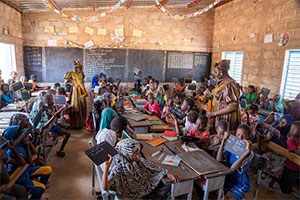 Two teachers work in a classroom in Forces Vives School in Dori, Burkina Faso. Credit: UNICEF/UNI978361
Safe and uninterrupted education is a fundamental right for all children. Education is paramount to global development, as it has been proven that investing in education – especially for girls and children – contributes significantly to economic growth and prosperity. Although more than 1 billion children go to school, many are subjected to conditions that are not conducive to a proper learning environment, including makeshift facilities, a lack of supplies, violence in classrooms, inadequate sanitation, untrained instructors, and widespread school closures. Since 2015, there have been immense gains in education with an increase of 109 million children in school. However, as of 2023, 272 million children are still out of school.
High poverty levels in developing countries also impede children’s access to a proper education. For example, from the early to mid 2000s, Sub-Saharan African nations witnessed a dramatic decline in trained teachers due to inadequate funding in the education sector. Furthermore, major cuts to United States international aid threaten an estimated 23 million additional children's access to education, as USAID‑funded school programmes across Africa and Asia face closure.
Various other factors contribute to the decline of education, notably hunger, which has increased as conflict and climate change interfere with global food production and dissemination. Meanwhile, certain social and cultural practices also impede children’s access to education, with gender inequality, discrimination, child labour, and child marriages preventing millions of children from attending school. Economic conditions such as the inaccessibility of higher education also affect disenfranchised communities across the world. In extreme situations, such as warfare where educational facilities are destroyed in their totality, notably in Gaza and Sudan, entire generations of children might grow up without access to education. Rebuilding educational infrastructure is a long and arduous process, especially when violence persists across generations, and this significantly stunts the development of societal prosperity and stability.
IPS is dedicated to telling the shocking truths about worldwide education through impassioned opinion pieces and comprehensive articles, highlighting global issues that impede worldwide education and the courses of action being taken by organizations such as UNICEF and Education Cannot Wait.

The Week with IPS

NEXT STOP - SDGs
Tracking global progress towards a sustainable world
Tracking global progress towards a sustainable world
