Languages
Tuesday, October 6, 2026



News and Views from the Global South
Education
Five Steps to Combat Gender-Based Violence Globally
The 410 Legal Aid Centers that I manage in Bangladesh for BRAC’s Human Rights and Legal Aid Services received approximately 35,900 requests for assistance in 2020. Almost all of them involve gender-based violence against women and girls.
Inequality, COVID-19 and the Plight of the Young
Inequality characterizes the world we live in, predisposing how we act and think. We perceive our existence as composed of dichotomies – men and women, young and old, black or white, as well as a difference between those who have and those who do not have access to wealth, health, education and influence. Dichotomies are also born out of comparisons, about how things are now and how they could have been, how they were before and how they are now.
Sustainable Development Goals Can Guide Asia-Pacific to Build Back Better
The COVID-19 crisis poses an unprecedented threat to development in the Asia-Pacific region that could reverse much of the hard-earned progress made in recent years. The good news is we know how to tackle this challenge. Recovery from the pandemic and our global efforts to deliver the United Nations Sustainable Development Goals (SDGs) by 2030 must go hand-in-hand. The Goals provide a compass to navigate this crisis, faster and greener, everywhere and for everyone.COVID-19 Education Response: Education Cannot Wait and Partners Reach over 9 Million Vulnerable Children and Youth
As the world marks the one-year anniversary of the COVID-19 pandemic on 11 March 2021, initial progress reports on Education Cannot Wait’s (ECW) COVID-19 emergency responses to date show that the Fund and its partners have already reached over 9 million vulnerable girls and boys in the midst of the worst education crisis of our lifetime.
Extent of Violence Against Women During Pandemic Exposed
COVID-19 restrictions exposed women and girls to heightened abuse – revealing the conditions in which gender-based violence became the shadow pandemic on the continent, a recent webinar attended by parliamentarians from Africa and Asia heard.
Death of an Ambassador and the Congolese Slaughter
On the morning of 22nd February a jeep from the World Food Programme (WFP), followed by another one with the Italian ambassador, Luca Anastasio, was driving along Route Nationale 2 passing by The Virunga National Park, an UNESCO Congolese World Heritage Site famous for its dwindling population of unique mountain gorillas.
ECW Interviews Youth Refugee Advocate Nujeen Mustafa
Nujeen Mustafa is a Syrian refugee, youth advocate and champion for children with disabilities for the UN Refugee Agency. At just sixteen years old, Nujeen Mustafa made the 3,500-mile journey from Syria to Germany in a steel wheelchair. Nujeen was born with cerebral palsy and spent the majority of her life confined to her apartment in Aleppo, Syria, where she taught herself English watching shows on TV.
Can Free Phones Close the Digital Gender Divide?
The gender gap in mobile phone ownership is well-documented. For years now, the financial inclusion community has been trying to get phones into the hands of more women at the last mile — spurred on by mounting evidence that mobile money can increase women’s financial resilience, expand their economic opportunities and improve their intra-household bargaining power.
International Women’s Day, 2021
Why Green Growth and Climate Action Fall Short Without Addressing Gender Inequality
As the global effort to address climate change has strengthened over the last few years, so has the realization that rising temperatures and climactic disruptions disproportionately impact women, particularly in developing countries, as they tend to be more dependent upon natural resources and are thus overrepresented in resource-intensive economic sectors. Furthermore, inherent in gender inequality are disadvantages for and discrimination against women in all facets of society, including in the economy and politics. Thus, it is unfortunate, yet perhaps unsurprising, that these structural disparities are mirrored in the negative effects of climate change. Therefore, if gender differences are not incorporated into climate change plans, women will be unable to access the co-benefits that arise from concerted climate action.

International Women’s Day, 2021
Every Girl Has a Right to An Education
Access to an inclusive quality education is a universal human right. When the inherent right to a good education is ignored or denied, the consequences are severe. For a girl in country of conflict or forced displacement, the impact is brutally multiplied.

International Women’s Day, 2021
Women Must Continue To Claim Power & Challenge The Unseen Barriers
Power is an intriguing concept and it means different things to different people. In simple words, power is the ability to influence the behavior of others to get what you want. Power distribution is usually visible in most societies when there is a clear and obvious division between the roles of the men and expectations from women. One can’t talk about power without talking about patriarchy - in which men always hold the power and women are largely excluded from it. Women are almost always taught power and ambition are two dirty words, and should not be linked to their personalities.
International Women’s Day, 2021
Women’s Leadership in the Global Recovery from COVID-19 Pandemic
Today is International Women’s Day (IWD), and the theme for this year’s celebration is "Women in leadership: Achieving an equal future in a COVID-19 world." We recognize the tremendous contribution and leadership demonstrated by women and girls around the world in shaping our recovery from the COVID-19 pandemic and a more sustainable future.

Education Cannot Wait Interviews Karina Gould Canada’s Minister of International Development
The Honourable Karina Gould was first elected as the Member of Parliament for Burlington in 2015. A graduate of McGill University and the University of Oxford, Minister Gould is passionate about public service and international development. Before her election as the Member of Parliament for Burlington, she worked as a trade and investment specialist for the Mexican Trade Commission in Toronto, a consultant for the Migration and Development Program at the Organization of American States in Washington, D.C., and spent a year volunteering at an orphanage in Mexico.
International Women’s Day, 2021
A Just COVID-19 Recovery – Not Without Women’s Leadership
Almost exactly a year ago today, I packed my computer and a couple of necessities in the office in New York, hugged the colleagues, and headed home to what most people thought would be a couple of week’s Covid-19 lockdown. Little did we know.

International Women’s Day, 2021
International Women’s Day: To Change the World, Women Must Choose to Challenge
Among the greatest gifts with which I have been blessed were parents who instilled in me a deep-rooted sense of identity, and the unequivocal belief that there was no difference between what a boy and a girl could achieve.
This assurance sustained me while growing up, as the tenth child out of twelve wonderful siblings, and through the numerous times when it was suggested by others that I would never succeed, simply because I was black, poor and female.

International Women’s Day, 2021
Women in Leadership: Achieving an Equal Future in a COVID-19 World
International Women’s day 2021 heralds a particularly challenging time for women and girls. The Covid pandemic has battered our world to such an extent that we know that our lives have been irrevocably changed and has rolled back some of the gains we made in the human rights and gender equality field.

International Women’s Day, 2021
#MarchWithUs: 5 Activists on Dismantling “Gender Lies”
Today, despite centuries of activism and mobilisations, women and non-binary people continue to remain disadvantaged in almost every sphere – from “public life” to the “shadow pandemic” of gender-based violence.

International Women’s Day, 2021
Celebrating International Women’s Day on March 8, 2021 AD – What are We Waiting For?
Every year on March 8, the International Women’s Day is commemorated. What do women think about this famous anniversary, first honored 1911 in European countries? As I cannot speak for other women, I share with you my personal reflections on this special day, bringing in a developmental perspective.

International Women’s Day, 2021
Women’s Leadership Must Drive the Global Recovery from COVID-19
International Women’s Day is always an occasion to celebrate strong women and an important day in the global calendar to highlight the gender injustices still lingering in every part of the world.

International Women’s Day, 2021
The World Not Only Needs Women Leaders – It Needs Feminist Leaders
International Women's Day pays tribute to the achievements of women worldwide and reminds us what still needs to be done for full gender equality. In 2021, we are taking stock of the many ways in which COVID-19 has disproportionately affected women and girls around the world.

International Women’s Day, 2021
Removing Barriers to Women’s Leading Role in African Agriculture
Africa’s population will double by 2050 if growth rates continue their trajectory, but the creation of jobs is not keeping pace, with up to five times more young people seeking employment each year as there are new posts to fill. And, on top of this, the COVID pandemic is plunging Africa into its first recession in 25 years.
« Previous Page — Next Page »





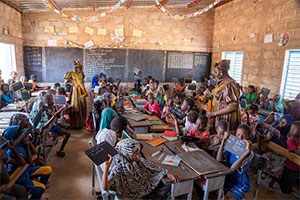 Two teachers work in a classroom in Forces Vives School in Dori, Burkina Faso. Credit: UNICEF/UNI978361
Safe and uninterrupted education is a fundamental right for all children. Education is paramount to global development, as it has been proven that investing in education – especially for girls and children – contributes significantly to economic growth and prosperity. Although more than 1 billion children go to school, many are subjected to conditions that are not conducive to a proper learning environment, including makeshift facilities, a lack of supplies, violence in classrooms, inadequate sanitation, untrained instructors, and widespread school closures. Since 2015, there have been immense gains in education with an increase of 109 million children in school. However, as of 2023, 272 million children are still out of school.
High poverty levels in developing countries also impede children’s access to a proper education. For example, from the early to mid 2000s, Sub-Saharan African nations witnessed a dramatic decline in trained teachers due to inadequate funding in the education sector. Furthermore, major cuts to United States international aid threaten an estimated 23 million additional children's access to education, as USAID‑funded school programmes across Africa and Asia face closure.
Various other factors contribute to the decline of education, notably hunger, which has increased as conflict and climate change interfere with global food production and dissemination. Meanwhile, certain social and cultural practices also impede children’s access to education, with gender inequality, discrimination, child labour, and child marriages preventing millions of children from attending school. Economic conditions such as the inaccessibility of higher education also affect disenfranchised communities across the world. In extreme situations, such as warfare where educational facilities are destroyed in their totality, notably in Gaza and Sudan, entire generations of children might grow up without access to education. Rebuilding educational infrastructure is a long and arduous process, especially when violence persists across generations, and this significantly stunts the development of societal prosperity and stability.
IPS is dedicated to telling the shocking truths about worldwide education through impassioned opinion pieces and comprehensive articles, highlighting global issues that impede worldwide education and the courses of action being taken by organizations such as UNICEF and Education Cannot Wait.

The Week with IPS

NEXT STOP - SDGs
Tracking global progress towards a sustainable world
Tracking global progress towards a sustainable world
