Languages
Thursday, October 8, 2026



News and Views from the Global South
Education

International Women’s Day, 2021
Removing Barriers to Women’s Leading Role in African Agriculture
Africa’s population will double by 2050 if growth rates continue their trajectory, but the creation of jobs is not keeping pace, with up to five times more young people seeking employment each year as there are new posts to fill. And, on top of this, the COVID pandemic is plunging Africa into its first recession in 25 years.
Education Cannot Wait, the Inter-agency Network for Education in Emergencies and the Un Girls’ Education Initiative Call for Gender Equality to Be at the Centre of COVID-19 Education Crisis Recovery Efforts
Education Cannot Wait (ECW), the Inter-agency Network for Education in Emergencies (INEE) and the United Nations Girls’ Education Initiative (UNGEI), today launched a new toolkit to support stronger integration of gender equality in education responses for children and youth in countries affected by emergencies and protracted crises.
International Women’s Day, 2021
To Aspire and Achieve- Women’s Leadership in the 21st Century
As a member of the second wave of the feminist movement who were also the first generation of women to receive positions of leadership, I recall the prejudices and biases that framed our experience. Women rarely were put in charge of “hard” core issues, only what were termed “soft” ones in keeping with their role as nurturer and carer. When they were present in the Board room, they were often silent. When they spoke, they were inevitably spoken over. It was the exceptional woman who could navigate the corridors of corporate culture, male expectations, and a workplace that was unsympathetic to her dual burden.

End Inequality and Achieve Sustainable Development for All
Back in the 1990s, the discovery of antiretrovirals offered a ray of hope to save people’s lives from the HIV epidemic. Over this decade, people living with HIV benefited from the scientific advances and began to have longer, healthier and more productive lives. However, almost all the beneficiaries were from rich countries in the global north. As a result, about nine million people died by the year 2000 due to the inequality in accessing these life-saving medicines.
A Technology-based Parasol of Protection for Victims of Domestic Abuse
During the COVID19 lockdown, there has been an approximate 25% increase in domestic abuse, dubbed by the United Nations as the ‘pandemic within a pandemic’. While the home is perceived as a secure place, for domestic abuse victims battling the pandemic is equally and increasingly unsafe. A parasol of protection is needed to rehabilitate victims of abuse starting from detection, reaching out, providing help and support.
How Marginalised Women in India Bore an Extra Burden of COVID-19 ‘Shadow Pandemic’
Women living in rural India and those belonging to marginalised communities faced an enormous burden during the COVID-19 pandemic shutdowns, including domestic violence, loss of financial assistance and income, says Rehana Adeeb, a grassroots Muslim woman leader and activist.EIE-GenKit Launch: A Core Resource Package for Gender in Education in Emergencies
In the lead up to International Women’s Day, the Inter-agency Network for Education in Emergencies (INEE), Education Cannot Wait (ECW) and the UN Girls’ Education Initiative (UNGEI), are launching a new core resource package for gender in education in emergencies: the ‘EiE-GenKit’!
Drug Use is a Health Issue – We Need to Decriminalize
Earlier this month, and in December 2020 the Government of Samoa conducted operations that resulted in the confiscation of a total of 1,400 grams of methamphetamine at the border, smuggled from the US. The law enforcement officials (from the Ministry of Customs and Revenue and the Ministry of Police and Prisons) that intercepted these drugs deserve congratulations for their professionalism and skill. Meth is destructive and harmful - and it is good to see this potential threat removed from the community.
Myanmar: Heroes and Villains
Myanmar’s State Counsellor was recently deposed and arrested along with other leaders of her ruling party – National League for Democracy (NLD). The Leader of Tatmadaw, the Military, Min Aung Hlaing, announced that elections in November last year had been fraudulent and in an “effort to save democracy” the military would now rule the nation for at least one year, until new elections could be organised. Counsellor Aung San Suu Kyi is accused of “importing ten or more walkie-talkies” and of violating the nation’s “Natural Disaster Law”. Some might agree that Suu Kyi deserves to be locked up. As an admired role model and Nobel Peace Prize winner, she was globally depicted as an almost saintlike being, canonized in movies like Luc Bessons’s The Lady. U.S. Secretary of State, Hillary Clinton, watched the movie before she in 2011 visited Suu Kyi, who by then had spent altogether fifteen years in house imprisonment, deprived of the company of an ailing and eventually dying husband and two sons. In spite of her forced isolation she became an eloquent representative for her compatriots’ resistance and perseverance under almost fifty years of military dictatorship.The Last of the Kharia Speakers
Since her husband Abrahm Soreng died two years ago, 70-year-old Veronica Kerketa doesn't get the chance to talk in her mother tongue at home. None of her children or grandchildren speak the Kharia language.
Sustainable Energy Key to COVID-19 Recovery in Asia and the Pacific
The past year is one that few of us will forget. While the impacts of the COVID-19 pandemic have played out unevenly across Asia and the Pacific, the region has been spared many of the worst effects seen in other parts of the world. The pandemic has reminded us that a reliable and uninterrupted energy supply is critical to managing this crisis.
The Boon and Bane of LDC Graduation: The Bangladesh Experience
Bangladeshis at the present time share a modicum of justifiable pride in the fact that the world merits this country worth watching in terms of its economic potentials. To my mind , we have reached this stage for the following reasons: First, effective utilization of early foreign assistance; second a steady ,albeit sustained, move away from a near -socialistic to an open and liberal economy; third , a shift from agriculture to manufacturing as land-space shrank to accommodate urbanization; fourth , an unleashing of remarkable entrepreneurial spirit among private sector captains of industry, as evidenced in the Ready Made Garments industry: fifth, the prevalence of a vibrant civil society intellectually aiding the social transformation with its focus on health, education, and gender issues: and finally ,a long period of political stability notwithstanding the traditional predilections of Bengali socio-political activism.
Education Cannot Wait: COVID-19 Emergency Response Fact Sheet
Education Cannot Wait’s (ECW) COVID-19 emergency response has reached over 9 million children and youth (47% girls) to date. ECW’s COVID-19 emergency grants span across 33 crisis-affected countries/emergency contexts.
Overcoming the Learning Divide: Assessing What Students Missed During School Closings for COVID-19
School closings and the varied impacts of remote learning amid the COVID-19 pandemic are a global challenge. Educators worldwide have been struggling to meet contemporary educational standards in this environment. But this challenge is followed by yet another: how to assess the readiness of students to resume in-school education when schools open. At BRAC, the international nongovernmental organization that operates 25,000 schools in Bangladesh, serving 750,000 students, we have developed an approach that could be helpful.
The Perils of Child Marriage & the Promise of Freedom
How much is a girl worth? If you are Maja, the answer is a chicken, a six-pack of beer and 100 euros. That is how much her family, living in a Roma settlement in Serbia, received in exchange for her hand “in marriage.” She was 11 years old at the time. “They benefited maybe a month from it, and I was left with a problem for my whole life,” Maja, now 18, said.
Argentina’s Abortion Legislation Sparks Hope in Caribbean Region
It was a joyful, tearful celebration in the early morning hours of Dec. 30, 2020 for countless Argentinians when they heard the news: the senate had legalized terminations up to 14 weeks of pregnancy. Prior to this, activists have said that more than 3,000 women died of botched, illegal abortions since 1983. And across the Latin American and Caribbean (LAC) region, this renewed sense of optimism was compounded after President Joe Biden rescinded what is known as the “global gag rule,” which essentially denied funding to international non-profit organizations that provided abortion counseling or referrals.
COVID-19 Pandemic has Shown Humanity at its Best– & at its Worst
WHO and UNICEF have a long, deep and very special relationship. Neither of us could do what we do without the other. UNICEF’s success is WHO’s success, and we are proud to be your partner on so many issues: Ebola, polio, maternal health, nutrition, infection prevention and control, primary health care – the list is long.
We Must Make It Happen – Together!
“As we enter 2021, education must be at the core of pandemic response and recovery efforts,” says António Gutteres, Secretary-General of the United Nations, in his interview with Education Cannot Wait (ECW) for this monthly issue, reminding us that “upholding our pledge to leave no one behind starts with education.”
The Struggle to End Female Genital Mutilation: A Dark Secret No More
Survivors of female genital mutilation or cutting (FGM/C), are determined to share their stories to end this practice – even though they face ostracisation by their communities. Masooma Ranalvi, an FGM/C survivor and founder of ‘WeSpeakOut’, an organisation committed to eliminating FGM/C or khafd/khafz/khatna explains that FGM/C is practised by various communities in India but is prominently practised among the Dawoodi Bohras.
Education Cannot Wait Interviews United Nations Secretary-General António Guterres
Education Cannot Wait’s interview with the Secretary-General of the United Nations, António Guterres, focused on the crucial role of education in the lives of crisis-affected children and youth, follows below. ECW: Why is education a priority in emergencies and protracted crises? António Guterres: The COVID-19 pandemic has upended societies and created the largest-ever disruption of education systems, affecting more than 1.5 billion students. While remote solutions were rolled out, 1 in 3 children missed out on such opportunities, exposing and exacerbating inequalities and vulnerabilities, especially for those in crisis situations. In such circumstances, education protects girls and boys from sexual violence and exploitation, trafficking, early pregnancy and child marriage, forced recruitment into armed groups and child labour. It also ensures that they continue learning, offering them hope for the future. As we enter 2021, education must be at the core of pandemic response and recovery efforts. Without resolute political commitment by global leaders, as well as additional resources for Education Cannot Wait, and its UN and civil society partners, millions of girls and boys may never return to school. Investing in the education of these vulnerable children and youth is an investment in peace, prosperity and resilience for generations to come – and a priority for the United Nations.[related_articles]
The Struggle to End Female Genital Mutilation: A Dark Secret No More
Survivors of female genital mutilation or cutting (FGM/C), are determined to share their stories to end this practice – even though they face ostracisation by their communities. Masooma Ranalvi, an FGM/C survivor and founder of ‘WeSpeakOut’, an organisation committed to eliminating FGM/C or khafd/khafz/khatna explains that FGM/C is practised by various communities in India but is prominently practised among the Dawoodi Bohras.« Previous Page — Next Page »





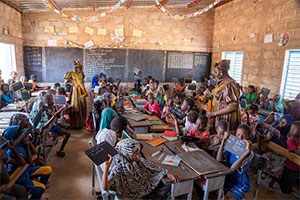 Two teachers work in a classroom in Forces Vives School in Dori, Burkina Faso. Credit: UNICEF/UNI978361
Safe and uninterrupted education is a fundamental right for all children. Education is paramount to global development, as it has been proven that investing in education – especially for girls and children – contributes significantly to economic growth and prosperity. Although more than 1 billion children go to school, many are subjected to conditions that are not conducive to a proper learning environment, including makeshift facilities, a lack of supplies, violence in classrooms, inadequate sanitation, untrained instructors, and widespread school closures. Since 2015, there have been immense gains in education with an increase of 109 million children in school. However, as of 2023, 272 million children are still out of school.
High poverty levels in developing countries also impede children’s access to a proper education. For example, from the early to mid 2000s, Sub-Saharan African nations witnessed a dramatic decline in trained teachers due to inadequate funding in the education sector. Furthermore, major cuts to United States international aid threaten an estimated 23 million additional children's access to education, as USAID‑funded school programmes across Africa and Asia face closure.
Various other factors contribute to the decline of education, notably hunger, which has increased as conflict and climate change interfere with global food production and dissemination. Meanwhile, certain social and cultural practices also impede children’s access to education, with gender inequality, discrimination, child labour, and child marriages preventing millions of children from attending school. Economic conditions such as the inaccessibility of higher education also affect disenfranchised communities across the world. In extreme situations, such as warfare where educational facilities are destroyed in their totality, notably in Gaza and Sudan, entire generations of children might grow up without access to education. Rebuilding educational infrastructure is a long and arduous process, especially when violence persists across generations, and this significantly stunts the development of societal prosperity and stability.
IPS is dedicated to telling the shocking truths about worldwide education through impassioned opinion pieces and comprehensive articles, highlighting global issues that impede worldwide education and the courses of action being taken by organizations such as UNICEF and Education Cannot Wait.

The Week with IPS

NEXT STOP - SDGs
Tracking global progress towards a sustainable world
Tracking global progress towards a sustainable world
