Languages
Thursday, November 26, 2026



News and Views from the Global South
Food and Agriculture

Belize Fights to Save a Crucial Barrier Reef
Home to the second longest barrier reef in the world and the largest in the Western Hemisphere, which provides jobs in fishing, tourism and other industries which feed the lifeblood of the economy, Belize has long been acutely aware of the need to protect its marine resources from both human and natural activities.
Warmer Days a Catastrophe in the Making for Kenya’s Pastoralists
Seif Hassan is a pastoralist from Garissa, Northern Kenya, some 380 kilometres outside of the capital, Nairobi. He sells his animals at the Garissa livestock market where, during a good season, pastoralists can sell up to 5,000 animals per week and “it is a cash-making business.”
OPINION: Innovation Needed to Help Family Farms Thrive
Family farms have been contributing to food security and nutrition for centuries, if not millennia. But with changing demand for food as well as increasingly scarce natural resources and growing demographic pressures, family farms will need to innovate rapidly to thrive.
Family Farmers – Forward to the Future
"Who is more concerned than the rural family with regards to preservation of natural resources for future generations?"
Bamboo Could Be a Savior for Climate Change, Biodiversity
Bamboo Avenue is a two-and-a-half mile stretch of road in Jamaica’s St. Elizabeth parish. It is lined with giant bamboo plants which tower above the road and cross in the middle to form a shady tunnel. The avenue was established in the 17th century by the owners of the Holland Estate to provide shade for travelers and to protect the road from erosion.
High-Tech, High Yields: Caribbean Farmers Reap Benefits of ICT
Farmers in the Caribbean are being encouraged to make more use of farm apps and other forms of ICT in an effort to increase the knowledge available for making sound, profitable farming decisions.
Curbing Biodiversity Loss Needs Giant Leap Forward
When political leaders from climate-threatened Small Island Developing States (SIDS) addressed the U.N. General Assembly last month, there was one recurring theme: the urgent need to protect the high seas and preserve the world's marine biodiversity.
Family Farming – A Way of Life
It does not make the headlines, but 2014 is the International Year of Family Farming (IYFF) and family farming will be centre-stage at this year’s World Food Day on Oct. 16 at the Food and Agriculture Organisation of the United Nations (FAO).
Measuring How Climate Change Affects Africa’s Food Security
For the past 40 years Josephine Kakiyi, 55, has been cultivating maize, beans and vegetables on her small plot of land in the remote area of Kwa Vonza, in Kitui County, eastern Kenya.
Biodiversity, Climate Change Solutions Inextricably Linked
The remarkable biodiversity of the countries of the Caribbean, already under stress from human impacts like land use, pollution, invasive species, and over-harvesting of commercially valuable species, now faces an additional threat from climate change.
Vanuatu Puts Indigenous Rights First in Land Reform
Stemming widespread corruption in the leasing of customary land to investors is the aim of bold land reform, introduced this year in the Southwest Pacific Island state of Vanuatu, which puts the rights of traditional landowners above the discretionary powers of politicians.
Reducing Hunger: More Than Just Access to Food
“We want healthy food, we want to produce according to our traditions,” farmers and activists demanded during an international forum of experts on agriculture and the environment in this southern Italian city.
Marine Litter: Plunging Deep, Spreading Wide
Imagine a black-footed albatross feeding its chick plastic pellets, a baby seal in the North Pole helplessly struggling with an open-ended plastic bag wrapped tight around its neck, or a fishing vessel stranded mid-sea, a length of discarded nylon net entangled in its propeller. Multiply these scenarios a thousand-fold, and you get a glimpse of the state of the world’s oceans.
Family Farmers Don’t Need Climate-Smart Agriculture
Small farmers can look to options like agroecological intensification and innovation, without necessarily turning to climate-smart agriculture, which is promoted by the United Nations but has awakened doubts among global experts meeting in this Italian city.
A Billion Tons of Food Wasted Yearly While Millions Still Go Hungry
In his parody of the Michael Jackson hit “Beat It”, the American satirist and singer Weird Al Yankovic has a parent urging his son to eat the food on his plate, warning that “other kids are starving in Japan”.
Acid Oceans Could Deal Heavy Blow to Fishing-Dependant Nations
Scientists here are warning Caribbean countries, where the fisheries sector is an important source of livelihoods and sustenance, that they should pay close attention to a new international report released Wednesday on ocean acidification.
Fracking Fractures Argentina’s Energy Development
Unconventional oil and gas reserves in Vaca Muerta in southwest Argentina hold out the promise of energy self-sufficiency and development for the country. But the fracking technique used to extract this treasure from underground rocks could be used at a huge cost.
Hotter Caribbean Poses Challenges for Livestock Farmers
Livestock farmers in the Caribbean are finding it increasingly difficult and expensive to rear healthy animals because of climate change, a situation that poses a significant threat to a region that is already too dependent on imports to feed its population.
Thirsty Land, Hungry People
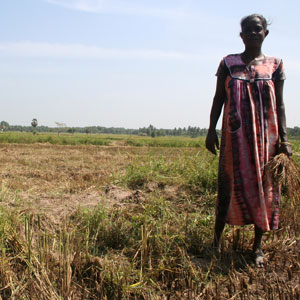
 Gazing out over the parched earth of Sri Lanka’s Northern Province, one might think these farmlands have not seen water in years. In fact, this is not too far from the truth.
Floods Wash Away India’s MDG Progress
The northeastern Indian state of Assam is no stranger to devastating floods. Located just south of the eastern Himalayas, the lush, 30,000-square-km region comprises the Brahmaputra and Barak river valleys, and is accustomed to annual bouts of rain that swell the mighty rivers and spill over into villages and towns, inundating agricultural lands and washing homes, possessions and livestock away.

Synthetic Biology Could Open a Whole New Can of Worms
Haiti, the poorest country in the Western Hemisphere, is the world’s leading producer of vetiver. In the southwest of the country, vetiver production is hard to ignore.« Previous Page — Next Page »


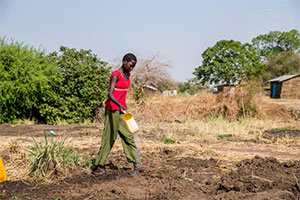 Farming on the Outskirts of Juba. Credit: UN Photo/JC McIlwaine
Promoting human and planetary health is a central focus of the United Nations, as laid out in the 2030 Sustainable Development Goals (SDGs). World hunger and unsustainable farming practices continue to be pressing concerns for the world. According to the 2025 State of Food Security and Nutrition in the World report by the Food and Agriculture Organization (FAO), 673 million people faced hunger in 2024. There are stark regional disparities, with the FAO projecting that 60% of the world population facing hunger will reside in Africa by 2030. Globally, the prevalence of food insecurity has remained consistently higher for women than men.
Sustainable and efficient national food systems are essential in preserving health, education, environmental well-being, peace, economy, and security. However, creating sustainable food systems can be a challenging endeavor, as food production takes a heavy toll on the environment. The agricultural sector accounts for a significant portion of greenhouse gases. Finding safe, sustainable, and ethical strategies to feed the world is crucial in ensuring planetary longevity. A recent initiative from 2023, the EU Regulation on Deforestation-free Products (EUDR), seeks to advocate for sustainable food systems. The main driver of deforestation is the expansion of agricultural land used to produce commodities like cattle, wood, cocoa, coffee, etc. The EUDR is part of the 2020 European Green New Deal and the EU Biodiversity Strategy for 2030 and aims to limit Europe’s consumption of products linked with deforestation by requiring that companies prove that their products are deforestation-free. Despite aiming to achieve major strides in sustainability, policies such as EUDR also raise socioeconomic concerns for targeted countries. Many emerging Latin American economies are impacted by the policy, and have raised the question of how developing countries can grapple with the tensions between economic development and advancing sustainability.
IPS has been at the forefront of providing compelling and insightful stories on communities facing hunger as well as the cost of food production. IPS uses statistics from FAO, the World Food Programme (WFP) and the International Fund for Agricultural Development (IFAD) to bring relevant and hard-hitting facts to readers. This gathering of information and data from such organizations helps bring the best stories from IPS journalists working in the different regions in consultation with experts on the ground.

The Week with IPS

NEXT STOP - SDGs
Tracking global progress towards a sustainable world