Languages
Thursday, October 8, 2026



News and Views from the Global South
Global Green Growth Institute (GGGI)

Ethiopia’s Struggle Against Climate Change Gets a Boost from Green Climate Fund
Faced with worsening droughts due to climate change, Ethiopia is joining an international initiative seeking to build global resilience against the problems caused by it, and enable developing countries to become part of a united solution to the ongoing problem.
Freezing Inside UAE’s High Rise Buildings While Temperatures Soar Outside
“Look at these tall, beautiful buildings. I have worked as a mason during the construction and was one of those who laid [the brickwork] brick by brick,” says Mohammed Akhtar* who has been working as mason for over a decade in Dubai, United Arab Emirates (UAE). Akhtar has seen the evolution of Dubai’s skyline over time. “It has been an overwhelming journey.” When asked what has changed in the last 10 years, Akhtar smiles and says the weather.
Unfinished Business – Nurture entrepreneurs, connect the dots between youth, innovation, and jobs toward green growth
It was the summer time in 2011, when I visited the rural town called Takéo for the first time, located in the southwest of Cambodia, about 90 km away from Phnom Penh, the capital city. Once an empire in the Southeast Asian region – which covered territories of what is now Cambodia, Thailand, Vietnam and Laos from roughly A.D. 802 to 1431 – Cambodia is one of the world’s least developed countries (LDCs). I spent much time there to initiate and manage the capacity building program testing out a solar home system (SHS) technology. That time I was curious about witnessing how the concept of green economy – learned from the office when contributing to the publication of UN’s first Green Economy Report – is applied in the field in developing countries.
Q&A: Achieving Sustainable Goals: “In the End it is All About People. If People Want, it Will Happen.”
Today just over two billion people live without readily available, safe water supplies at home. And more than half the world’s population, roughly 4.3 billion people, live in areas where demand for water resources outstrips sustainable supplies for at least part of the year.
Why India’s Solar Water-Drawing ATMs and Irrigation Pumping Systems Offer Replicable Strategies
At New Delhi’s Savda Ghevra slum settlement, waterborne diseases have become less frequent thanks to solar-powered water ATMs that were installed here as a social enterprise venture three years ago.
How Safe Drinking Water in Rural Vanuatu Will Save Women Time While Aiding in Economic Development
Access to safe water for drinking and an adequate supply of water for other purposes is challenging in the rural areas of Vanuatu. A new project, that uses solar water pumping technology, will save time and energy for rural women whose task it is to collect and make water more accessible to their communities.
GGGI awarded A+ rating by DFID for the first time
The Global Green Growth Institute (GGGI) has received an A+ rating in the UK Department for International Development (DFID)’s 2017 Annual Review, highlighting the excellent progress made last year.
Is Thailand Making Progress Towards Reaching its Climate Change Mitigation Goals?
As preparations are underway for an important formal discussion between countries committed to the Paris Agreement; Thailand, Southeast Asia’s second-largest economy, has been determining its progress towards reducing greenhouse gas (GHG) emissions by 20 to 25 percent by 2030. But experts have warned against merely emphasising policies to affect real changes.
Q&A: Indonesia Takes Steps to Reduce Emissions – But It’s Not Enough
The South Asian nation of Indonesia is the world’s fifth-largest emitter of greenhouses gases (GHG) and is ranked as the world’s second-largest plastic polluter of oceans, just behind China. So when the country committed in the Paris Agreement to limit the rise in average global temperatures to below 2°C by unconditionally reducing its emissions by 29 percent with using its own finances and by 41 percent with international funding, many felt the goals too ambitious.
Q&A: Air Pollution Remains Cause for Alarm in Asia
At the start of the year the pollution in Vietnam’s capital, Hanoi, reached six times the World Health Organization’s guideline levels for air quality. Yet the levels, which appear higher than those of South Korea’s capital Seoul—where most people monitor the air pollution levels daily—is not treated with equal concern because of a lack of general awareness. This is despite the fact that air pollution has become the largest cause of premature deaths in Asia.
Greening the Way for Thailand’s First Green and Smart City
Thailand’s industrial sector must focus on sustainable and green development to remain competitive in the region.
GGGI and AMATA ink an MoU to establish Green and Smart city
The Global Green Growth Institute (GGGI) and AMATA Corporation Public Company Limited, a Thai industrial estates provider, signed a Memorandum of Understanding (MoU) today to advance green growth and sustainable development especially in the area of Green and Smart City in industrial land development in Thailand.
War, High Tariffs and Nationalisation – their Cost to Africa’s Climate
Africa’s political instability, its armed conflicts and regulatory issues are placing at risk investment needed to tackle climate change and reduce greenhouse gas (GHG) emissions on the continent.
West Africa Moves Ahead with Renewable Energy Despite Unpredictable Challenges
The West African nation of Guinea may be a signatory of the Paris Agreement, a global undertaking by countries around the world to reduce climate change, but as it tries to provide electricity to some three quarters of its 12 million people who are without, the commitment is proving a struggle.
Building West Africa’s Capacity to Access Climate Funding
When Senegalese president Macky Sall opened the 30MW Santhiou Mékhé solar plant last June, the country gained the title of having West Africa's largest such plant. But the distinction was short lived.
West Africa Building Renewable Energy Sector Partnership and Capacity
“Financing NDC Implementation in the Energy Sector” will feature in an upcoming regional capacity development workshop at Hôtel Royal Beach in Ouagadougou, Burkina Faso on June 26-28. The upcoming workshop will be attended by representatives of Burkina Faso, Côte d'Ivoire, The Gambia, Guinea, and Senegal.
Q&A: Greening Colombia’s Energy Mix
Colombia is a global power in biodiversity and water resources, but at the same time it depends on exports of fossil fuels, coal and oil, to the world. But don't panic: in the green economy there are also incomes and jobs - says a world expert on the subject, Juhern Kim.
GGGI signs an Implementation Agreement with the Independent State of Papua New Guinea to provide support in accessing climate finance
The Global Green Growth Institute (GGGI) signed an agreement to implement a Green Climate Fund (“GCF”) project as a delivery partner for the Independent State of Papua New Guinea’s Climate Change and Development Authority (CCDA).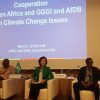
Public-Private Pacts Open Doors to Climate Finance in Rwanda and Ethiopia
The Global Green Growth Institute (GGGI) presented the African model of a National Financing Vehicle in which the governments of Rwanda and Ethiopia have successfully promoted green growth and climate resilience, at an event May 25 on the sidelines of the annual meetings of the Board of Governors of the African Development Bank (AfDB) in Busan, South Korea.
Ethiopia’s Green Growth Goals: A Launchpad for Wider Climate Action in Africa
The vision for a sustainable future in Africa is being realized at a time of great possibilities and this vision is underpinned by a shift in continental focus towards sustainable and inclusive economic growth and development. This focus highlights strategic efforts towards poverty alleviation, resilience building, promoting sustainable infrastructure and, efficient management of natural resources.
Unlocking Private Finance for Developing Countries’ Green Growth
Climate finance has never been more urgently needed, with massive investments in climate action required to meet the goals of the Paris Agreement and avoid the devastating effects of a warmer planet.« Previous Page — Next Page »





Based in Seoul, the Global Green Growth Institute (GGGI) is an intergovernmental organization that supports developing country governments transition to a model of economic growth that is environmentally sustainable and socially inclusive. GGGI delivers programs in 26 partner countries with technical support, capacity building, policy planning & implementation, and by helping to build a pipeline of bankable green investment projects. More on GGGI’s events, projects and publications can be found on www.gggi.org.

The Week with IPS

NEXT STOP - SDGs
Tracking global progress towards a sustainable world
Tracking global progress towards a sustainable world
