Languages
Wednesday, November 18, 2026



News and Views from the Global South
Humanitarian Emergencies

Urgently Needed: Studies Linking Land Degradation, Migration, Conflict and Political Instability
Some 135 million people could be displaced by 2045 as a result of land desertification, according to a recent UK ministry of defence report. This figure could rise to 200 million who are displaced by other climate change impacts like natural disasters by 2050, said British environment refugee specialist Norman Myers.Opinion: Battling Iran-Backed Extremists in Yemen
In a region racked by strife, Yemen stands out. It is the poorest country in the Middle East and since March, the plight of my people has been worsened by an inhumane war.
Pakistani Communities Reel in the Wake of Massive Earthquake
“My grandmother rushed inside the room to save me. Roof suddenly collapsed and she died,” said 12-year-old Mushtari Bibi.Opinion: Turn Words into Action Involving Women for Lasting Peace
We have recently celebrated the peace deal struck between the government in Colombia and the main guerrilla group. The deal reached on justice issues represents the clearest sign yet of a possible end to five decades of conflict.A New Framework in an Age of Migration
With the worldwide numbers of displaced people at all-time highs, migration has become the watchword for humanitarian crises.
As the Mediterranean Refugee Crisis Endures, International Morality Ebbs
As the world suffers its biggest upheaval of human mobility, with 60 million people forced to desert their homes or countries due to persecution, armed conflicts, starvation and hunger that are a veritable danger to their lives, the response from the international community has been rather laggard.
Western Double Standards on Deadly Cluster Bombs
The 2008 Convention on Cluster Munitions (CCM) banned the use of these deadly weapons for two primary reasons: they release small bomblets over a wide area, posing extended risks beyond war zones, and they leave behind unexploded ordnance which have killed civilians, including women and children, long after conflicts have ended.
Mental Health Another Casualty of Changing Climate
Jun* is in chains, tied to a post in the small house that resembles a fragile nipa hut. His brother did this to prevent him from hurting their neighbours or other strangers he meets when he’s in a ballistic mood. Jun has been like this for three years now, but since Typhoon Haiyan hit the Philippines two years ago, his symptoms have worsened.
Rich Gulf Nations Tight-Lipped on Growing Refugee Crisis
As Western and Central European nations seem overwhelmed by the growing refugee crisis – triggered mostly by the inflow of hundreds and thousands of displaced people largely from Syria, Libya, Afghanistan and Iraq – one lingering question remains unanswered: why aren’t some of the rich Arab Gulf nations reaching out to help these hapless refugees?
Opinion: Promoting Culture of Peace Through Dialogue – Part One
This week, for the fourth time in a row, the annual gathering of the apex intergovernmental body of the United Nation deliberating on peace and non-violence will take place at the U.N. headquarters in New York.
Migrants Waiting Their Moment in the Moroccan Mountains
In the middle of the mountains behind the border fence of Ceuta, the Spanish enclave in Morocco, and eight kilometres from the nearest Moroccan village of Fnideq, an uncertain number of migrants live in the woods. No one knows exactly how many they are but charity workers in Melilla, Spain’s other enclave in Morocco, say they could be in their thousands.
European Residents Offer Support, Homes to Refugees
As the migration crisis in Europe continues to grow and government response remains slow, European citizens have taken it upon themselves to act by opening up their homes to those in need.
Europe Invaded Mostly by “Regime Change” Refugees
The military conflicts and political instability driving hundreds of thousands of refugees into Europe were triggered largely by U.S. and Western military interventions for regime change – specifically in Iraq, Afghanistan, Libya and Syria (a regime change in-the-making).Killing of Aid Workers Threatens Humanitarian Response in Yemen
With 21 million Yemeni civilians caught in the grips of a conflict that has been escalating since March, the killing of two local aid workers Wednesday could worsen their misery, as a major humanitarian organisation considers the future of its operations in parts of the war-torn country.U.N. Officials Warn of Dengue Outbreak in War-Torn Yemen
An outbreak of dengue fever in Yemen’s most populated governorate has prompted urgent calls from the World Health Organisation (WHO) for a “humanitarian corridor” to facilitate the flow of medicines to over three million civilians trapped in the war-torn area.
Europe Squabbles While Refugees Die
As tens of thousands of refugees continue to flee conflict-ridden countries, including Afghanistan, Iraq, Libya and Syria, Western European governments and international humanitarian organisations are struggling to cope with a snowballing humanitarian crisis threatening to explode.
U.S.-Made Cluster Munitions Causing Civilian Deaths in Yemen
New research released today by a leading human rights watchdog has found evidence of seven attacks involving cluster munitions in Yemen’s northwestern Hajja governorate.
Deliberate Targeting of Water Sources Worsens Misery for Millions of Syrians
Imagine having to venture out into a conflict zone in search of water because rebel groups and government forces have targeted the pipelines. Imagine walking miles in the blazing summer heat, then waiting hours at a public tap to fill up your containers. Now imagine realizing the jugs are too heavy to carry back home.
Majority of Child Casualties in Yemen Caused by Saudi-Led Airstrikes
Of the 402 children killed in Yemen since the escalation of hostilities in March 2015, 73 percent were victims of Saudi coalition-led airstrikes, a United Nations official said Monday.
U.N. Aid Agencies Launch Emergency Hotline for Displaced Iraqis
In the hopes of better responding to the needs of over three million displaced Iraqis, United Nations aid agencies today launched a national hotline to provide information on emergency humanitarian services like food distribution, healthcare and shelter.
U.S. Provides Cover for Use of Banned Weapons in Yemen
The United States is providing a thinly-veiled cover virtually legitimising the use of cluster bombs – banned by an international convention – by Saudi Arabia and its allies in their heavy fighting against Houthi rebels in Yemen.« Previous Page — Next Page »


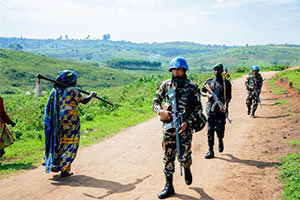 MONUSCO Peacekeepers and FARDC Soldiers Patrol Fataki Area. Credit: UN Photo/Jorkim Jotham Pituwa
Conflict, human rights violations, natural disasters, and famine have been at the forefront of concerns for humanitarian organizations. The escalation of humanitarian crises has led to over 239 million people in need of humanitarian assistance at the start of 2026, as estimated by OCHA’s Global Humanitarian Overview. The 2025 humanitarian appeal received only $12 billion, the lowest funding in over a decade, which has left 24 million fewer people reached in comparison to 2024. Conflict has remained the primary driver of crisis.
Humanitarian emergencies massively impact progress towards the Sustainable Development Goals (SDGs), adversely affecting economic development, inequality, education, planetary well-being, and poverty. Millions of people are faced with reduced access to essential services, including shelter, food, healthcare, and access to clean drinking water. UN Organizations such as UNHCR and the United Nations Children’s Fund (UNICEF) are committed to providing direct relief to affected communities when state governments cannot.
The United Nations 2024 Summit of the Future discussed measures that will be taken to reduce global inequality and promote peacekeeping efforts around the world. The recent UN Climate Change Conference (COP30) in Belém, Brazil, agreed to mobilize $1.3 trillion annually for climate action by 2035, operationalize the loss and damage fund, and triple adaptation finance. However, a fossil fuel transition commitment was not secured, despite climate change and the greenhouse effect being major contributors to humanitarian crises worldwide.
Countries across the world have also rallied to end humanitarian crises, as witnessed in conflicts such as Palestine and Ukraine. IPS is committed to providing relevant and in-depth reports of humanitarian emergencies around the world and their implications.

The Week with IPS

NEXT STOP - SDGs
Tracking global progress towards a sustainable world
Tracking global progress towards a sustainable world