Languages
Thursday, November 19, 2026



News and Views from the Global South
Humanitarian Emergencies

U.N. Team Confirms Syria Chemical Attack but Not Culpability
After an intense investigation of the military attack on civilians in Syria last month, a U.N. team of arms inspectors has reached a predictable conclusion: the deadly attack had all the trappings of the widespread use of chemical weapons.OP-ED: Making Sense of Syria
Tarzie Vittachi, a Sri Lankan journalist who in his final years was the bemused occupant of a high United Nations office, once summed up with his characteristic terse wit a central truth about international affairs: “Everything is about something else.”U.S. Public-Elite Disconnect Emerges Over Syria
While much of the foreign policy elite here sees the tide of public opposition to U.S. air strikes against Syria that swept over Washington during the past two weeks as evidence of a growing isolationism, veteran pollsters and other analysts say other factors were more relevant.
DRC Peacebuilding Ignores Local Solutions
Despite existing local expertise and strategies in the Democratic Republic of Congo (DRC) to build peace-supporting structures at the community level, official debates and media coverage continue to focus predominantly on military interventions.
OP-ED: South Sudan’s Army Must Be Held Accountable
On the last day of July, South Sudanese soldiers shot dead two unarmed women, Anyibi Baba and Ateil Rio. The killings were the latest in a pattern of grave violations against civilians by Sudan People’s Liberation Army (SPLA) soldiers fighting a Murle rebel group in Jonglei state.
Europe Failing Syrian Refugees
Refugee rights organisations are demanding an EU-wide temporary protection regime for Syrian refugees. The announcement by some countries that they can take a few thousand refugees is not enough, the groups say.
Mixed Reactions to Obama’s Embrace of Russian Deal
President Barack Obama’s decision to put off a vote by Congress on the use of military force against Syria in order to pursue a Russian proposal to place Damascus’ chemical-weapons arsenal under international control has evoked both cheers and jeers from across the political spectrum here Wednesday.
Preoccupied with Syria, U.S. Still Saddled with Egypt
The United States, which is preoccupied with the ongoing political and military developments in Syria, is still saddled with an unresolved problem elsewhere in the Middle East: the military takeover of Egypt's first democratically-elected government.Italy Sees New Migrants Influx
After what is remembered as the North Africa emergency of 2011, Italy is again seeing an increase in the arrivals of migrants, especially asylum seekers.
Even if Syria Complies on Chemical Arms, Six Others Still at Large
If Syria eventually agrees to relinquish its stockpile of chemical arms under the 1993 international Chemical Weapons Convention (CWC), what of the six other countries that have either shown reluctance or refused to join the treaty?Russia Throws Obama a Life Preserver on Syria
With President Barack Obama facing increasingly certain defeat in his quest for Congressional authorisation to carry out military strikes against Syria, the Russian government Monday appeared to offer the White House a way out of the crisis.U.N. Inspection a Figleaf to Justify Air Strike on Syria
The United Nations, which has remained deadlocked over Syria, is in danger of being craftily exploited to justify the impending air strike on Damascus.
Mugabe’s Policies Starve Zimbabweans
Tambudzai Javangwe from Mwenezi district in southern Zimbabwe, has run out of food and each day she begs for hand-outs from well-wishers so that she can feed herself an her six orphaned grandchildren.
Obama Increasingly Isolated on Syria Military Action
With a week of intense lobbying behind him, U.S. President Barack Obama looks increasingly beleaguered - both at home and abroad - in his effort to rally support for a military strike against Syria to punish its government for its alleged Aug. 21 chemical-weapons attack outside Damascus.
U.N. Urges Culture of Peace amid Rising Sectarian Strife
Against the backdrop of widespread sectarian violence in Iraq, Lebanon, Egypt and Syria - and rising xenophobia and Islamophobia in Western Europe and the United States - the United Nations hosted its second high-level forum on the "culture of peace".OP-ED: Syria Has Become Iran’s Vietnam – Let’s Help It Escape
As if the Iran nuclear issue was not already difficult enough, it became even more complicated when Bashar al-Assad unleashed his chemical weapons across Damascus suburbs last month. Suddenly, the Syria issue is overshadowing all other factors concerning Iran.Iran Looms over Syria Debate for Pro-Israel Groups
With Congress still deliberating over Barack Obama’s request for authorisation to take military action against Syria, the powerful Israel lobby here has taken the lead in pressing the president’s case.
Ex-World Leaders Urge U.S. to Forego Military Attack on Syria
The United States, which is preparing to launch a military strike on Syria, is being cautioned by several former world leaders and Nobel Peace laureates to seek a political solution to the ongoing crisis - and forego armed intervention in the beleaguered Middle Eastern nation.
Poor Picked for ‘Paradise’
“I consider myself lucky after finding my son,” says Muhammad Jabeen, a juice vendor in Bannu, one of the 25 districts of the Khyber Pakhtunkhwa province in northern Pakistan. The Taliban had taken his son, Mateen Shah, away from a madrassa to join their ranks.
Top Republicans, Israel Lobby Weigh for Obama’s Syria Strike
In an important boost for President Barack Obama, two key Republicans and the Israel’s lobby’s two most influential groups Tuesday announced their support for a proposed Congressional resolution authorising limited military strikes against Syria for its alleged use of chemical weapons.
U.N. Chief Dodges Question on “Illegal” Attack on Syria
When Secretary-General Ban Ki-moon was South Korea's foreign minister during 2004-2006, his answers to reporters were so predictably evasive the press corps in Seoul affectionately dubbed him "the slippery eel".« Previous Page — Next Page »


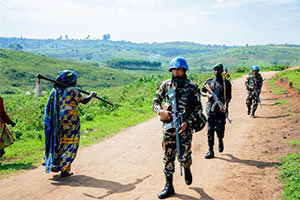 MONUSCO Peacekeepers and FARDC Soldiers Patrol Fataki Area. Credit: UN Photo/Jorkim Jotham Pituwa
Conflict, human rights violations, natural disasters, and famine have been at the forefront of concerns for humanitarian organizations. The escalation of humanitarian crises has led to over 239 million people in need of humanitarian assistance at the start of 2026, as estimated by OCHA’s Global Humanitarian Overview. The 2025 humanitarian appeal received only $12 billion, the lowest funding in over a decade, which has left 24 million fewer people reached in comparison to 2024. Conflict has remained the primary driver of crisis.
Humanitarian emergencies massively impact progress towards the Sustainable Development Goals (SDGs), adversely affecting economic development, inequality, education, planetary well-being, and poverty. Millions of people are faced with reduced access to essential services, including shelter, food, healthcare, and access to clean drinking water. UN Organizations such as UNHCR and the United Nations Children’s Fund (UNICEF) are committed to providing direct relief to affected communities when state governments cannot.
The United Nations 2024 Summit of the Future discussed measures that will be taken to reduce global inequality and promote peacekeeping efforts around the world. The recent UN Climate Change Conference (COP30) in Belém, Brazil, agreed to mobilize $1.3 trillion annually for climate action by 2035, operationalize the loss and damage fund, and triple adaptation finance. However, a fossil fuel transition commitment was not secured, despite climate change and the greenhouse effect being major contributors to humanitarian crises worldwide.
Countries across the world have also rallied to end humanitarian crises, as witnessed in conflicts such as Palestine and Ukraine. IPS is committed to providing relevant and in-depth reports of humanitarian emergencies around the world and their implications.

The Week with IPS

NEXT STOP - SDGs
Tracking global progress towards a sustainable world
Tracking global progress towards a sustainable world