Languages
Thursday, November 12, 2026



News and Views from the Global South
Humanitarian Emergencies

Haunting Photos of Bangladesh’s COVID Pandemic
 Documentary photographer and filmmaker Mohammad Rakibul Hasan has documented the health crisis in Bangladesh over the past several months. In these haunting images, Hasan brings to life the conditions in which many patients are being treated in poor conditions exacerbated by the COVID-19 pandemic.

Cuba, a Small Island State Seeking to Manage Its Vulnerability
Cuba, already beset by hurricanes, floods, droughts that deplete its main water sources, among other natural disasters, has seen its socioeconomic difficulties, similar to those faced by other Caribbean island nations, aggravated by the COVID-19 pandemic.
As Climate Disaster Migration Rises, Girls Get Married Off
When 11-year-old Mitali Padhi hugged her childhood friends to say goodbye, she felt a deep-seated foreboding.
Resilience in a Riskier World
Over the past two decades, the Asia-Pacific region has made remarkable progress in managing disaster risk. But countries can never let down their guard. The COVID-19 pandemic, with its epicentre now in Asia, and all its tragic consequences, has exposed the frailties of human societies in the face of powerful natural forces. As of mid-August 2021, Asian and Pacific countries had reported 65 million confirmed coronavirus cases and more than 1 million deaths. This is compounded by the extreme climate events which are affecting the entire world. Despite the varying contexts across geographic zones, the climate change connection is evident as floods swept across parts of China, India and Western Europe, while heatwaves and fires raged in parts of North America, Southern Europe and Asia.
Drought, Storms, Intense Rainfall and Fires Threatening Millions in Latin America and the Caribbean
In 2020, Brazil, Paraguay and Bolivia faced their worst drought in half a century. The Atlantic Basin saw 30 named storms – the most recorded in a single year. Two category 4 hurricanes achieved an unprecedented feat by making landfall in Nicaragua.
Southern African Migrants Excluded as COVID-19 Pandemic Grows
Migrants across the Southern Africa region are massively disadvantaged as they find themselves excluded from vaccine programmes – even when the global vaccine initiative COVAX often funds these programmes.
Where Did We Go So Wrong in Afghanistan?
President Biden’s decision to finally withdraw US forces from Afghanistan was the correct decision and certainly overdue. However, the lack of preparation to do so orderly and safely was yet another terrible mistake in a string of mistakes that have plagued the US from day one.
NDC Partnership: Supporting a Global Network of Youth Climate Advocates
Just over six months after launching its Youth Engagement Plan, the NDC Partnership, the coalition assisting governments with their climate action plans, has brought together youth climate advocates for its inaugural NDC Global Youth Engagement Forum.
How Many More Innocent Lives Must be Lost in Tigray, asks Adama Dieng
Despite a June 30 unilateral ceasefire declaration by Ethiopian President Abiy Ahmed, United Nations agencies say a recent escalation in fighting has been ‘disastrous’ for children, amid reports of over 100 children being killed in an attack on displaced families.
Privatised Health Services Worsen Pandemic
Decades of public health cuts have quietly taken a huge human toll, now even more pronounced with the pandemic. Austerity programmes, by the International Monetary Fund (IMF) and World Bank, have forced countries to cut public spending, including health provisioning.
UN’s Ultimatum to Staff & Diplomats: Get Vaccinated or Go Hungry
As New York city struggles to cope with the widespread outbreak of the deadly new coronavirus Delta variant -– which has claimed more than 100,000 cases per day in the US— the United Nations is laying down strict guidelines at its headquarters (UNHQ) for staffers, diplomats and visiting delegates.
Q&A: Why the World ‘Can’t Afford to Wait’ for Transparent, Equitable Food Systems
The world has been put on notice that there is no time to waste in achieving the goal of food systems transformation.
We Were Born to Do This!
The first time I visited South Sudan in 2004 - prior to its independence - I travelled across the entire the country which was then a region devastated by man’s inhumanity to man. Although South Sudan is slightly larger than France, I could find only one concrete school building in Rumbek.
The ‘Covid-19 Timebomb’ – Dispelling the Single- Story Humanitarian Narrative for Africa
An article published in April 2020 by the World Economic Forum warning that Africa was facing a Covid-19 time bomb was widely shared among the humanitarian sector, with increasing alarm.
Between Horror and Hope in the Villages of Ituri
“We have buried twenty-eight people. I have seen them with my own eyes. We also found three bodies in the fields and buried them too. I can show them to you. It’s not far from here. We buried them there.” The man points to the hills. He doesn’t want to show his face or say his name, but he agrees that his voice can be recorded, so that his words don’t get lost. The camera can’t shoot him; it can only look at the tall grass or at the forest towards the countryside where it is no longer possible to cultivate food. The man talks while music from Lengabo’s catholic church marks the time of truce and hope.
ECW Interviews the Honourable Awut Deng Acuil, Minister of General Education and Instruction for South Sudan
Awut Deng Acuil is the first female Minister of Education for South Sudan, and only the second person to serve as Minister of Education for her country – which became independent country in 2011. Prior to this role, Minister Acuil was the first woman to serve as the country’s Minister of Foreign Affairs and International Cooperation. Recently, Minister Acuil made history as the first women to lead a South Sudan university when she was appointed head of council at the University of Bahr El-Ghazal.
‘Don’t Forget Leprosy’ Campaign Amid COVID-19 Pandemic
A visit to a leprosy facility in Korea with his father, Ryoichi Sasakawa, spurred Yohei Sasakawa to dedicate his life to eliminating both the disease and discrimination of those affected.
Multilateral Peace Operations in 2020: Developments & Trends
The first year of the Covid-19 pandemic saw wide-ranging impacts on multilateral peace operations. The crisis simultaneously affected all operations, host nations, headquarters and contributing countries. It caused major disruption—from the political-strategic level where mandates are drawn up, down to the operational and tactical levels.
Central Banks Must Address Pandemic Challenges
Hopes for an inclusive global economic recovery are fast fading. As rich countries have done little to ensure poor countries’ access to vaccines and fiscal resources, North-South “fault lines” will certainly widen. Enhancing relief, recovery, transformation While the International Monetary Fund (IMF) has revised rich countries’ recovery prospects upward, the United Nations (UN) notes formidable challenges, especially for developing countries, due to the pandemic.
DR Congo, Ituri. Fleeing War, Weaving Life in IDP Camps of Bunia
He moves aside the curtain, thin as gauze, and then bends over. The darkness dazzles for a few seconds when one enters the house—actually, a den made of earth where air and light filter through the narrow entrance. Jean de Dieu Amani Paye holds her tiny baby, wrapped in an elegant fabric, in his arms. He was a teacher of French and Latin and had a small business. He also cultivated the land: cassava, corn, sorghum, and beans.
Alarming Crisis of Impunity for Crimes Against Journalists in DRC
The Democratic Republic of Congo is one of the most hostile and dangerous regions for journalists. A complex conflict, deeply rooted in the country’s past, allows very little freedom, both movement and the press.« Previous Page — Next Page »





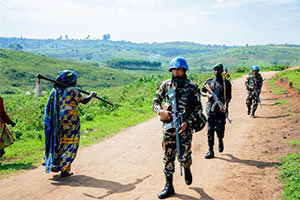 MONUSCO Peacekeepers and FARDC Soldiers Patrol Fataki Area. Credit: UN Photo/Jorkim Jotham Pituwa
Conflict, human rights violations, natural disasters, and famine have been at the forefront of concerns for humanitarian organizations. The escalation of humanitarian crises has led to over 239 million people in need of humanitarian assistance at the start of 2026, as estimated by OCHA’s Global Humanitarian Overview. The 2025 humanitarian appeal received only $12 billion, the lowest funding in over a decade, which has left 24 million fewer people reached in comparison to 2024. Conflict has remained the primary driver of crisis.
Humanitarian emergencies massively impact progress towards the Sustainable Development Goals (SDGs), adversely affecting economic development, inequality, education, planetary well-being, and poverty. Millions of people are faced with reduced access to essential services, including shelter, food, healthcare, and access to clean drinking water. UN Organizations such as UNHCR and the United Nations Children’s Fund (UNICEF) are committed to providing direct relief to affected communities when state governments cannot.
The United Nations 2024 Summit of the Future discussed measures that will be taken to reduce global inequality and promote peacekeeping efforts around the world. The recent UN Climate Change Conference (COP30) in Belém, Brazil, agreed to mobilize $1.3 trillion annually for climate action by 2035, operationalize the loss and damage fund, and triple adaptation finance. However, a fossil fuel transition commitment was not secured, despite climate change and the greenhouse effect being major contributors to humanitarian crises worldwide.
Countries across the world have also rallied to end humanitarian crises, as witnessed in conflicts such as Palestine and Ukraine. IPS is committed to providing relevant and in-depth reports of humanitarian emergencies around the world and their implications.

The Week with IPS

NEXT STOP - SDGs
Tracking global progress towards a sustainable world
Tracking global progress towards a sustainable world